🚕➡️🤖 Waymo–Lyft Launch in Nashville as Driver Displacement Passes 80,000
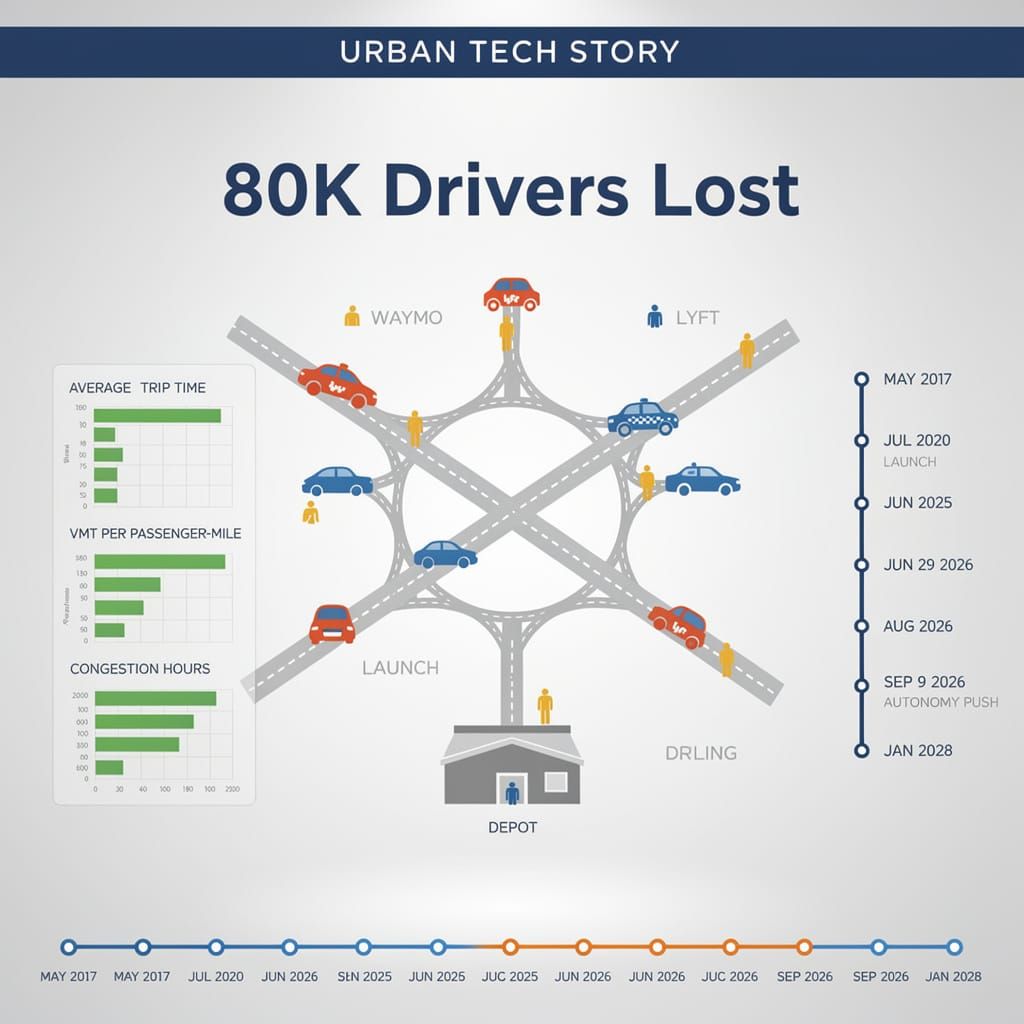
~80,000 Lyft drivers displaced since 2023 across Austin, Atlanta, Phoenix, and Tampa. Waymo and Lyft reabsorbed 0.3% into depot and maintenance roles. The replacement ratio sits below 1:400. More robotaxis, fewer jobs, same gridlock. Is autonomous mobility progress if the human cost is invisible?
On September 9, 2026, Lyft and Waymo launched simultaneous app access in Nashville—passengers can now summon a Waymo robotaxi through either app, with dynamic dispatch routing vehicles based on demand and location. Lyft CEO Jeremy Bird framed high utilization as the key performance indicator. The company positions this as seamless mobility. The operational numbers undercut the pitch.
The Driver Replacement That Wasn’t
Waymo’s August 29 hiring of former Lyft and Flexdrive drivers in Nashville was pitched as a workforce bridge. The company simultaneously laid off driver-role positions, increased retention screening, and capped net hiring at roughly 200 people across Tennessee, Arizona, and Georgia.
Compare that to the ~80,000 Lyft drivers displaced since 2023 across Austin, Atlanta, Phoenix, and Tampa. For every driver Waymo onboarded in administrative or depot-maintenance roles, roughly 400 lost ride-hailing income entirely. The Atlanta Rideshare Drivers Union reported in August 2026 that after Waymo's June 2025 launch in that city, driver earnings dropped, trip intervals lengthened, and the union proposed a $0.50–$1.00 per-ride robotaxi impact fee to fund a driver transition program. Career closure—no promotion paths, no wage staircasing—became the default outcome.
Flexdrive, acquired in July 2020, operates the Nashville fleet regardless of booking app. An 80,000-square-foot depot near the airport is staffed by roughly 70 full-time employees, about half of whom are former Lyft drivers. Lyft acts as Waymo's "pit crew"—handling fleet management and maintenance—and a single depot technician replaces 15–20 field drivers in routing, cleaning, and repair workflows. Nationally, the replacement ratio sits below 1:400.
Route Expansion Without Capacity Gain
The September 9 rollout enables dynamic dispatch, routing more vehicles across the same road surface rather than adding dedicated lanes or congestion pricing. A horizontal routing model increases vehicle count without increasing throughput.
Phoenix, Austin, and Atlanta show the result: average trip times rose 6–9 minutes between 2024 and mid-2026, while vehicle miles traveled per passenger-mile climbed 12%.
| Metric | 2024 Baseline | Mid-2026 |
|---|---|---|
| Average trip time (Phoenix) | 22 min | 30 min |
| VMT per passenger-mile | 1.04 | 1.17 |
| Congestion hours per 1,000 trips | 3.1 | 4.8 |
The Competitive Shuffle
Uber ended its Phoenix robotaxi partnership with Waymo on June 29, 2026, after three years and roughly 12 vehicles operating jointly—Waymo ended the three-year pilot. Uber subsequently exited Austin robotaxi operations in August 2026. Waymo gained Uber's Tucson and San Diego routes but lost the density needed for lower per-trip costs.
Lyft’s non-exclusive Arizona exit in September 2026, combined with its May 2017 partnership, leaves the former ride-hail leader as a fleet aggregator with no driver base and no vehicle ownership. Waymo may launch its own app in Austin and Atlanta by January 2028, rendering the Lyft partnership optional. Service volume supports Waymo’s autonomy stack in a closed loop, but minimal personal involvement—no driver feedback, no real-time route adjustments—stagnates perception refinement.
What the Data Doesn’t Fix
Waymo’s system processes sensor fusion at 10 Hz with an edge-compute latency below 150 milliseconds. That technical capability does not address:
- Job loss trajectory: ~80,000 Lyft drivers displaced by 2026, with 0.3% reabsorbed into automated-depot roles. The Atlanta union's proposed impact fee would channel $0.50–$1.00 per ride into a transition fund.
- Wage stability: median ride-hail income fell from $18.70/hour (2022) to $13.40/hour (2026) after fleet automation reduced surge pricing. Atlanta drivers report longer waits and fewer fares since June 2025.
- Attrition rates: driver retention at Lyft dropped from 65% (quarterly, 2022) to 28% (2026) as guaranteed minimums disappeared.
Waymo’s own projections show nationwide robotaxi scaling continuing through 2028, but the legacy driver ecosystem has already collapsed in metros where the replacement ratio sits below 1:400.
The Wider Arc
| Timeline | Signal |
|---|---|
| May 2017 | Waymo–Lyft non-exclusive partnership signed |
| Jul 2020 | Flexdrive acquisition enables centralized depot operations |
| Jun 2025 | Waymo launches in Atlanta; ARDU reports earnings decline |
| Dec 2025 | Uber exits Atlanta robotaxi operations |
| Jun 29, 2026 | Waymo ends three-year Uber Phoenix pilot |
| Aug 2026 | Uber exits Austin; Waymo expands to Tucson, San Diego |
| Sep 9, 2026 | Nashville simultaneous app access goes live; Lyft acts as "pit crew" |
| Jan 2028 | Waymo may launch own app in Austin, Atlanta |
The technology works—mostly—in geofenced zones with curated mapping and low pedestrian density. But the claim that robotaxis replace human drivers without replacing jobs collapses against the payroll sheets. Horizontal routing adds vehicles, not velocity. Simultaneous app access adds convenience, not capacity.
Waymo routes more cars through the same streets and calls it progress.

Comments ()