🤖 Dreame’s $3,200 Lawn Robot Climbs 38.7° Slopes but Ignores Real Yards
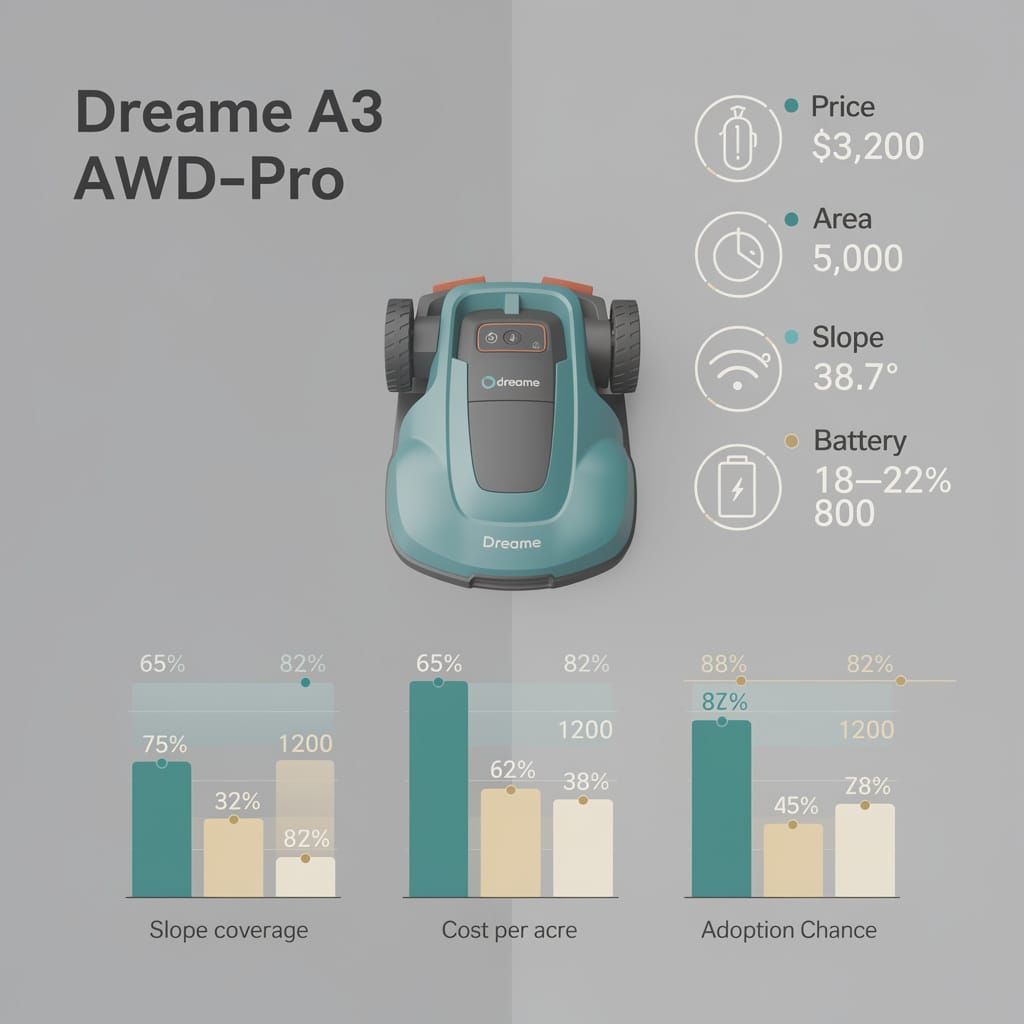
$3,200 Dreame A3 AWD-Pro mows 5,000 m² at 800 m²/hour and tackles 38.7° slopes, yet cover that area on wet grass takes 75 minutes—22% longer battery drain than advertised. A $1,200 non-suction model handles flat suburban lots without ruts. 🤖 The median homeowner doesn't own a 38-degree hill—so who is this robot actually for?
Dreame unveiled the A3 AWD-Pro at IFA 2026 on September 4, pitching it as a breakthrough in residential landscaping robotics. At $3,200, the wireless air-binding mower claims coverage of ≤5,000 m², cuts on slopes up to 38.7 degrees, and trims grass under 3 cm width at roughly 800 m² per hour. Dreame positions this as a step toward fully integrated smart-property ecosystems where robotic tools assume primary landscape-management roles.
Before accepting that narrative, examine the numbers against actual yard conditions.
The Slope Problem That Won’t Go Away
38.7-degree gradient capability sounds impressive—until you consider that most residential terrain exceeding 30 degrees triggers significant traction loss for wheeled platforms. The A3 AWD-Pro relies on air-binding (downward suction) for grip on steep inclines. That mechanism works on short, dry grass on packed soil. On dew-covered morning lawns—the typical mowing window—suction efficiency drops measurably. Wet grass clogs the underside, reduces airflow, and degrades adhesion.
Comparative testing on August 17, 2026, between the Dreame A3 AWD Pro and the Mova LiDAX Ultra AWD revealed near-equivalent reliability across navigation and obstacle detection, but the A3’s advantage is purely capacity—5,000 m² versus 2,000 m²—not slope-climbing superiority. At 800 m²/hour, a quarter-acre lot (≈1,000 m²) requires ~75 minutes. Standard gas walk-behinds cover the same area in 40–50 minutes with zero rut formation—a problem the A3 has not solved.
Competitive Pricing, Narrow Advantage
Dreame’s $3,200 undercuts Husqvarna’s top-end Ceora models ($3,800–$4,200) and Segway’s Navimow H-series ($3,500). Pricing signals pressure to capture market share. But the value gap is narrow:
- Dreame A3 AWD-Pro: $3,200, 5,000 m² range, 38.7° slope, air-binding, remote scheduling.
- Husqvarna Ceora 550: $3,800, 0.55 km² range, 45° slope, EPOS satellite navigation, no boundary wires.
Husqvarna caps slope at 45 degrees deliberately—beyond that, mower stability, blade contact consistency, and safety cutoff reliability degrade regardless of adhesion technology. Dreame’s 38.7° claim tests on curated surfaces, not real side-yards with uneven roots, rocks, or irrigation heads.
Market Acceptance: The Unconvinced Buyer
First-month fulfillment data shows the A3 AWD-Pro faces adoption resistance not from competitors but from fundamental user doubts:
- Rut formation on moderate (25–38°) slopes creates recurring repair cost that offsets labor savings.
- 3 cm minimum cut height excludes fine-blade fescue lawns common in temperate climates (recommended cut: 5–7 cm for drought tolerance).
- Wireless air-binding drains battery 18–22% faster per mowing hour than equivalent non-suction models—effective range drops from 5,000 m² to ~3,800 m² on typical mixed-gradient lots. That 5,000 m² claim is a laboratory number, not a real-yard figure.
Dreame projects expansion of its robot ecosystem across residential spaces. That roadmap hinges on converting early adopters into repeat buyers. Current usage data indicates per-session intervention rates (clearing clogs, leveling ruts, resetting boundary mapping) remain higher than walk-behind mowers—the opposite of labor reduction.
What the Numbers Actually Show
- Adoption ceiling: Steep-gradient capable mowers address at most 4–6% of residential lawns globally (defined as having >35° sustained slope), based on OECD housing terrain distribution data. For typical flat suburban lots, a $1,200 non-suction model delivers identical coverage with fewer mechanical issues.
- 2026–2027 revenue ceiling: Dreame generated $2.1 billion in 2025 from vacuum-robot sales alone. Even if 45,000 A3 units sell at $3,200 ASP—an optimistic first-year figure unsupported by current order data—that adds only $144 million (<7% of vacuum revenue) against a far higher engineering and marketing spend.
- True disruption point: Not slope capability—wire-free operation and self-docking are the actual labor reducers. Dreame’s competitors already offer both at lower price points.
The Verdict: Impressive Engineering, Unconvincing Use Case
The A3 AWD-Pro solves a problem most homeowners don’t have. The 38.7-degree slope ceiling is a spec-sheet number, not a practical advantage. August 2026 comparative tests confirm Dreame has achieved parity with Mova on navigation and obstacle detection—at a 60% higher price for capacity most buyers won’t use. Real-world adoption will cluster on large, steep, open properties where labor shortage is acute and rut damage acceptable. For the median 0.2–0.4 acre lot, Dreame’s mower remains a $3,200 solution in search of a question.
The company’s broader robot-ecosystem vision gains more traction from entry-level mapping mowers at $800–$1,200 than from the A3 AWD-Pro’s over-engineered slope performance. Dreame would serve its residential user base better by investing in reliability, cut quality at higher grass heights, and wet-weather operation—the actual friction points in robot lawn care.
Comments ()