Waymo's 95% Safety Claim Faces a Quiet Statistical Catch
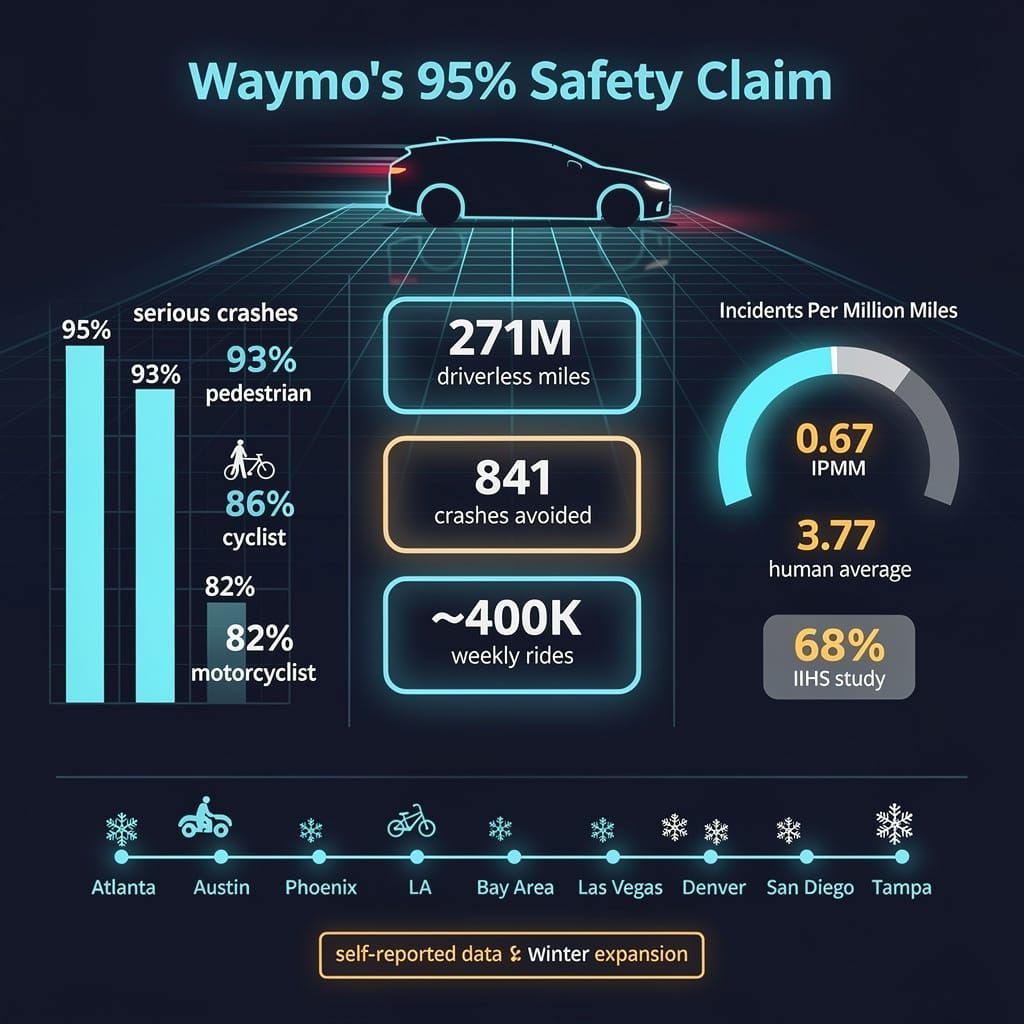
Waymo's robotaxis report 95% fewer serious crashes than human drivers—841 injury crashes avoided across 271M driverless miles. 🚗📉 That's a striking margin, and an independent IIHS review backs the methodology. But here's the catch: the data is self-reported against police records that miss private fender-benders—so the human baseline itself may be undercounted. The number also shifts by window, from 94% to 68% to 95%. Safer than the median driver in sunny urban corridors, yes. A blank check for snowy, chaotic roads? Not yet. How confident are you in safety numbers a company reports about itself? 👇
The press release landed with the force of a verdict. Waymo, the Alphabet-owned robotaxi operator, announced on September 24 that its autonomous vehicles are involved in 95% fewer serious crashes than human drivers. Across 271 million miles of fully driverless operation in Atlanta, Austin, Phoenix, Los Angeles, and the Bay Area, the company counts 841 injury-causing crashes it avoided—93% fewer pedestrian crashes, 86% fewer cyclist crashes, 82% fewer motorcyclist crashes—alongside an independent IIHS study it says validates the findings.
Impressive ledger. And precisely why we should read it slowly.
Whose numbers are these, exactly?
Here is the structural tension: the crash data is self-reported by Waymo, compiled against police-report databases. The company compares its own rider-only (RO) crash rates against human benchmarks drawn from those same records. Johns Hopkins researchers are cited as independent validation, and IIHS separately reviewed the methodology.
That independence is real but bounded. What the analysts actually assessed was whether Waymo's accounting framework held together—whether its crash classifications matched human-crash classifications. They were not on the streets watching both drivers. The benchmark itself is the question.
Consider how human crashes get counted. Police reports capture drivers who collide, get cited, or file claims. They miss the enormous volume of fender-benders resolved privately, with no report generated. Waymo's own materials acknowledge this: human drivers "often remain undetected" in comparative datasets. When your comparison group undercounts its baseline incidents, your relative improvement inflates accordingly.
The denominator that matters
The projectable framing survives contact with one inconvenient date: an IIHS study Waymo cites reported a 68% reduction in serious crashes across a separate 2021–2024 dataset—softer than the flagship 95%. The company's headline number shifts depending on the benchmark, the window, and the geography you pull into the denominator.
Nor is the margin stable. In Phoenix, Santa Monica, Las Vegas, San Francisco, Austin, and Atlanta, Waymo's incident rate stands at 0.67 IPMM (injuries per million miles), versus a national average of roughly 3.77. That is an apples-to-oranges ratio in one key respect: Phoenix at midnight is not Nebraska at rush hour. Urban robotaxi corridors skew toward dense, slower, more camera-visible road networks—conditions that flatter any driver, human or machine.
None of this invalidates the directional claim. A camera-light architecture demonstrating a crash reduction this wide across five distinct metro environments is not noise. The fleet now spans ~4,000 vehicles—upgraded to custom Ojai robots with sixth-generation drivers—logging more than 500,000 paid rides weekly, with ~2 million driverless miles per week captured since the study period closed in June. The fleet scales; the safety record has, so far, scaled with it.
The expansion math gets harder
Here is where the 95% starts to look borrowed against the future. Waymo's stated target is 1 million weekly rides globally by Q4 2026, and the rollout is accelerating: full driverless operation went live in Las Vegas on July 8, 2026, with Denver, San Diego, and Tampa queued. Those are new geographies, new road cultures, new enforcement patterns—each one a fresh denominator that could dilute the carefully curated baseline.
And then there is the snow. Waymo's next advertised test is expansion into snow-region markets—conditions the current operating envelope has barely touched. The 271-million-mile baseline was earned almost entirely in mild-climate, high-sunshine grids. Its denser, more weather-robust Ojai platform claims better winter resilience, but the claim remains untested in the environments where human benchmarks get their toughest comparisons.
What it does and doesn't prove
The strictest reading: Waymo appears to be measurably safer than the median human driver in the specific geographies it has chosen to serve. It does not prove robots out-drive humans everywhere, in snow, in construction chaos, or against the messy accident one human driver causes that never makes a report.
The 95% figure is also oddly elastic—94% in one December 2025 dataset, 68% in the IIHS 2021–2024 window, 95%, 93%, 86%, 82% for successive crash classes. Strong marketing headline, genuinely promising data point—not a proof of universal superiority, and not a blank check for everyone else's robotaxi ambitions.
The cars may indeed brake earlier than we do. But the database they're braking against undercounts us—and that's the quiet caveat the press release left out of its own headline.

Comments ()