IIHS: Most Class 3 Trucks, Vans Lag on Crash Avoidance
IIHS's first crash-avoidance ratings for commercial vehicles gave weak marks to most of the 11 Class 3 pickups and vans tested. IIHS reported motorcycle detection as the biggest failure and weak pedestrian detection.
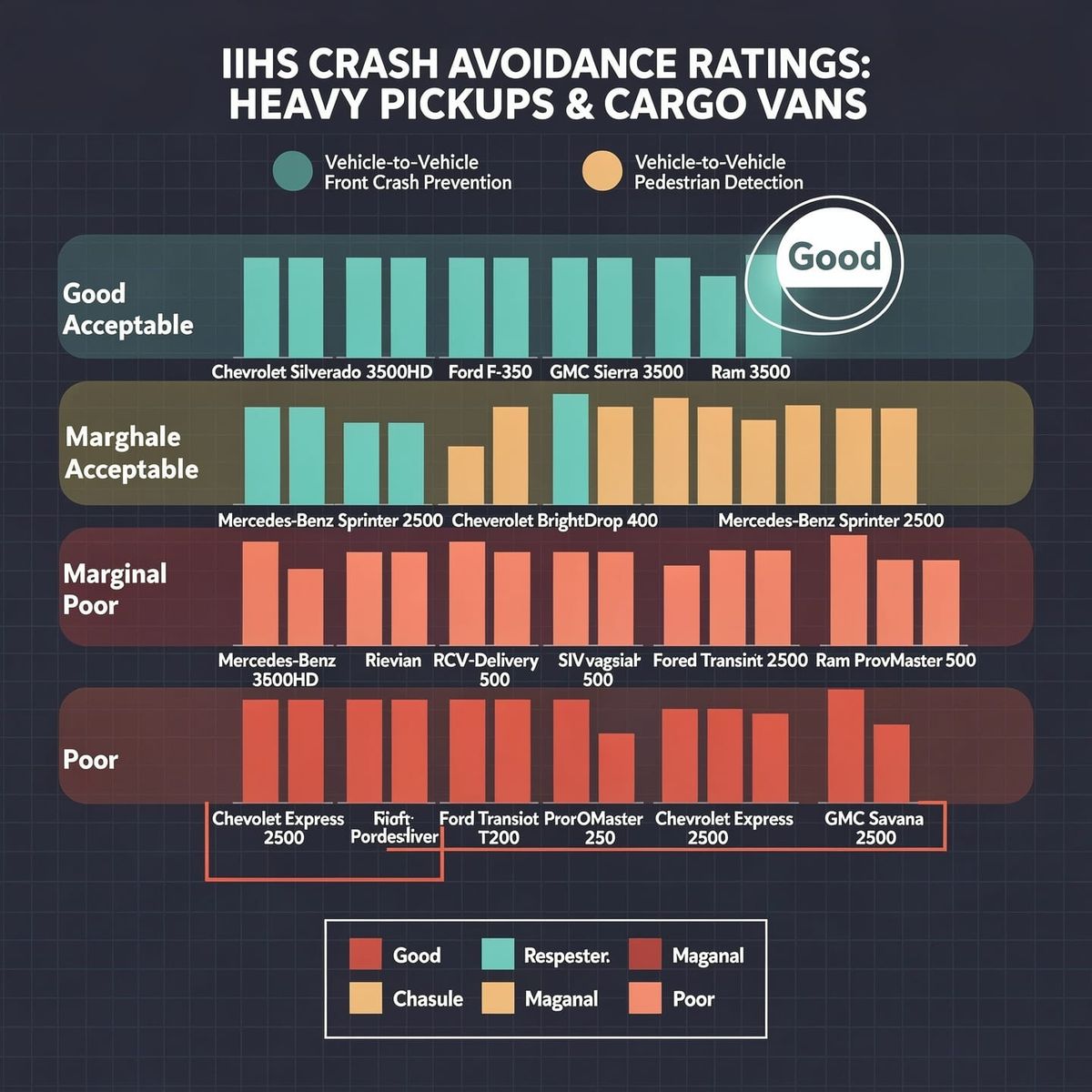
Eleven commercial vehicles got weak marks in the Insurance Institute for Highway Safety's first crash-avoidance ratings for the segment, published Oct. 8. IIHS President David Harkey called the results a wake-up call. This is a test-result story, not a recall or a fleet suspension. No defect has been established, no vehicles have been pulled from service, and no root cause has been identified. What IIHS measured is how these trucks behave under its own protocol, not how they perform in crashes on public roads.
Where the scores landed
The results don't sort into one "poor" band, and the pickups and vans didn't fail identically.
IIHS tested four Class 3 pickups. None earned a Good rating in either category. The Chevrolet Silverado 3500HD, Ford F-350 and GMC Sierra 3500 scored Poor on vehicle-to-vehicle front crash prevention, while the Ram 3500 managed Marginal. On pedestrian assessment the split was narrower than the pickup headline suggests: the F-350 and Ram 3500 drew Acceptable, and the Silverado 3500HD and Sierra 3500 drew Marginal.
Among cargo vans, the Mercedes-Benz Sprinter 2500 was the standout — Good on vehicle-to-vehicle, the only vehicle in the group to reach that rating, and Acceptable on pedestrian. The Chevrolet BrightDrop 400 and Rivian RCV-Delivery 500 earned Good pedestrian ratings. At the weak end, the Ford Transit T250 and Ram ProMaster 2500 scored Poor on vehicle-to-vehicle and Marginal on pedestrian. The Chevrolet Express 2500 and GMC Savana 2500 scored Poor in both categories; IIHS attributed those two results to missing automatic emergency braking.
What the sensing data showed
Two patterns point toward detection rather than braking hardware.
Motorcycle detection was the biggest failure, according to IIHS — trucks often didn't warn or slow down. Pedestrian detection also split by lighting and target size: systems often lost child-sized pedestrians in daylight, while nighttime runs were weak even for adults under everyday low-beam headlights. The released findings don't establish which component fails — sensor calibration, software thresholds, or scenario design. IIHS also notes commercial vehicles are exempt from some safety mandates, including airbag requirements.
What remains unknown
The evidence supports a pattern of underperformance in a controlled evaluation. It doesn't establish field failure rates, because no exposure denominator — crashes per mile, per vehicle, or per year of operation — was reported. IIHS cited a fleet-wide figure for context, not for these vehicles specifically: 6,215 deaths in 2024 in crashes involving medium- and heavy-duty vehicles or light vans, which IIHS put at about 16% of US roadway fatalities. That's a population of crashes, not a rate for the tested models, and it doesn't separate trucks from vans.
Two of the higher-scoring vans are also shifting beneath the results. GM ended BrightDrop production in October 2025, so the 2025–26 BrightDrop 400 tested is no longer being built. Rivian has said it's developing more autonomy for its Amazon vans — a change in operating role, not evidence about the tested system.
IIHS launched this assessment program in June 2026 and has said it plans additional testing through 2027, with later evaluations adding headlight and rear automatic emergency braking ratings for Class 3 vehicles and testing larger Class 4–6 trucks. That cadence creates a public record of whether these systems change. It won't by itself explain why a given system missed a given object.
Why the segment matters
Class 3 pickups and cargo vans aren't passenger cars with a big bed. At 10,001 to 14,000 pounds gross vehicle weight — IIHS's scope for the initial program — they're heavier and stop longer, and many run predictable routes in warehouses, delivery corridors and urban centers where pedestrians and cyclists share space with them. Automatic emergency braking is meant to cover the seconds a driver can't.
If pedestrian detection drops out after dark and frontal systems miss smaller objects and motorcycles, the coverage these vehicles deliver is narrower than the presence of a driver-assistance package suggests. IIHS's own comparison is that ADAS is common in passenger models but inconsistent across these commercial units.
What's documented is performance under the IIHS protocol. Whether the gap is a sensor limit, a software decision, or a design choice about which objects deserve detection remains open.
Comments ()