🪳 Cyborg Cockroach Rescue Lab Success Masks Real-World Gaps
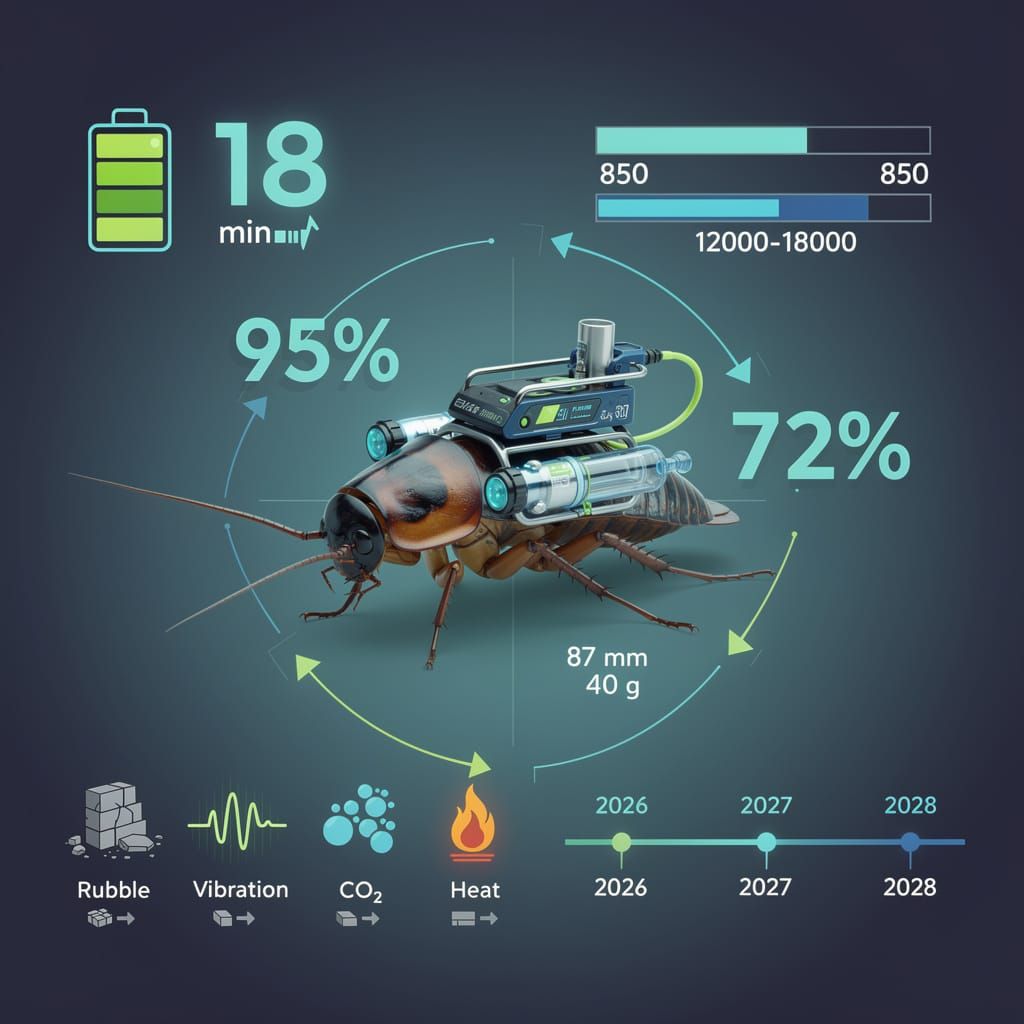
72% success on a 2.5-meter lab course. The cyborg cockroach drug-delivery system costs AUD 850 per unit vs. AUD 12,000–18,000 for a miniature robot. But the insect lasts 8–12 weeks, the battery runs 18 minutes, and Australian rescue teams declined adoption in August 2026. Clever biology, fragile field promise. Would you rely on an insect with an 18-minute battery in a collapsed building?
On September 9, 2026, researchers at the University of Queensland and UNSW unveiled a prototype that sounds like science fiction: a giant burrowing cockroach fitted with a backpack-mounted drug-delivery needle, capable of crawling through earthquake rubble and injecting medication into trapped victims. The team demonstrated navigation through fractured terrain, target location, and dose delivery at close range.
The mechanics are straightforward. The cockroach—Macropanesthia rhinoceros, up to 87 mm long and 40 g—carries a micro-syringe assembly and a battery-powered control board receiving directional signals from a remote operator via antennal electrodes. The insect's natural climbing ability enables access that wheeled robots and drones cannot reach. The auto-injection mechanism delivers up to 0.5 mL of liquid medication through a spring-loaded needle. The team reported a 95% close-range injection success rate within 150 mm.
Where the Numbers Fall Short
The university reported a 72% full-mission success rate across 25 controlled lab runs—18 of 25 trials where the insect navigated a 2.5-meter course past three checkpoints, stabilized, and injected successfully. But that phrasing obscures critical gaps. Navigation alone succeeded 100% of the time in static, pre-mapped environments with a single target at known depth. Real earthquake sites present shifting debris, multiple voids, chemical contamination, dust that clogs biological sensors, and thermal conditions exceeding a cockroach's survival range. No human trials have occurred; drug stability and clinical efficacy remain unevaluated.
The battery lasts approximately 18 minutes under load—insufficient for multi-story collapses where victims may lie 10 meters or more beneath the surface. The University of New South Wales, collaborating on the project, measured significant neural response degradation under sustained vibration, high CO₂ levels, or temperatures above 38°C—all common in post-earthquake environments. In one stress test responding to 50-second simulated aftershock vibrations, the insect became immobile for 14 minutes.
The Cost Argument vs. Reality
The researchers positioned the cyborg cockroach as a cost-effective alternative to miniature robotic crawlers, priced at AUD 12,000–18,000 per unit. Each cockroach system costs roughly AUD 850 to assemble, including the insect itself (bred in captivity at AUD 15 per specimen), the syringe backpack, and the control electronics.
That comparison ignores the lifecycle. Miniature robots can be recovered, recharged, and redeployed across hundreds of missions. A cyborg cockroach has a usable lifespan of 8–12 weeks before physiological deterioration compromises locomotion and orientation. The backpack must be surgically reattached each time the insect molts—every 3–4 weeks during active growth. Researchers are developing a quick-release mount, but no field-ready version exists. The 72% full-mission success rate, already marginal, applies only to the initial deployment window.
Institutional and Operational Gaps
Australian urban search-and-rescue teams have not integrated cyborg insects into any operational protocol. The Queensland Fire and Emergency Services reviewed the concept in August 2026 and declined immediate adoption, citing unproven reliability under real aftershock conditions and the absence of a decontamination procedure for biological agents entering a disaster zone.
The research teams project real-world deployment within five to ten years pending clinical validation and regulation—not months. One signal indicates a potential 1–2 year timeline for integration into emergency service protocols, but no concrete commitment from any agency exists. The ethical considerations regarding animal welfare in experimental development also remain unresolved, though researchers note anesthesia is used during deployment.
Outlook
- September 2026 – December 2026: Laboratory refinements focus on battery life (target: 35 minutes) and needle reliability. Field trials in non-disaster rubble piles scheduled for November.
- Q1 2027: Expected submission of a safety-and-deployment protocol to Australian disaster-response agencies. No timeline for operational clearance.
- 2028 at the earliest: Potential limited deployment in structurally stable collapse zones—masonry buildings with predictable voids, not steel-frame pancake collapses. Swarm coordination remains conceptual.
The cyborg cockroach represents genuine innovation in bio-mechanical system design. But bridging the gap between a 72% success rate across 25 lab trials—on a single 2.5-meter course—and a life-saving tool in an active disaster zone requires solving fundamental hardware, biological, and operational constraints that the current prototype does not address. The clock is not ticking—the cockroach's 18-minute battery is.
Comments ()