Saab A3 Loyal Wingman: European Autonomy Hedge or 2035 Pipe Dream?
🤖 Saab’s A3: Another Loyal Wingman, Same Old Promises
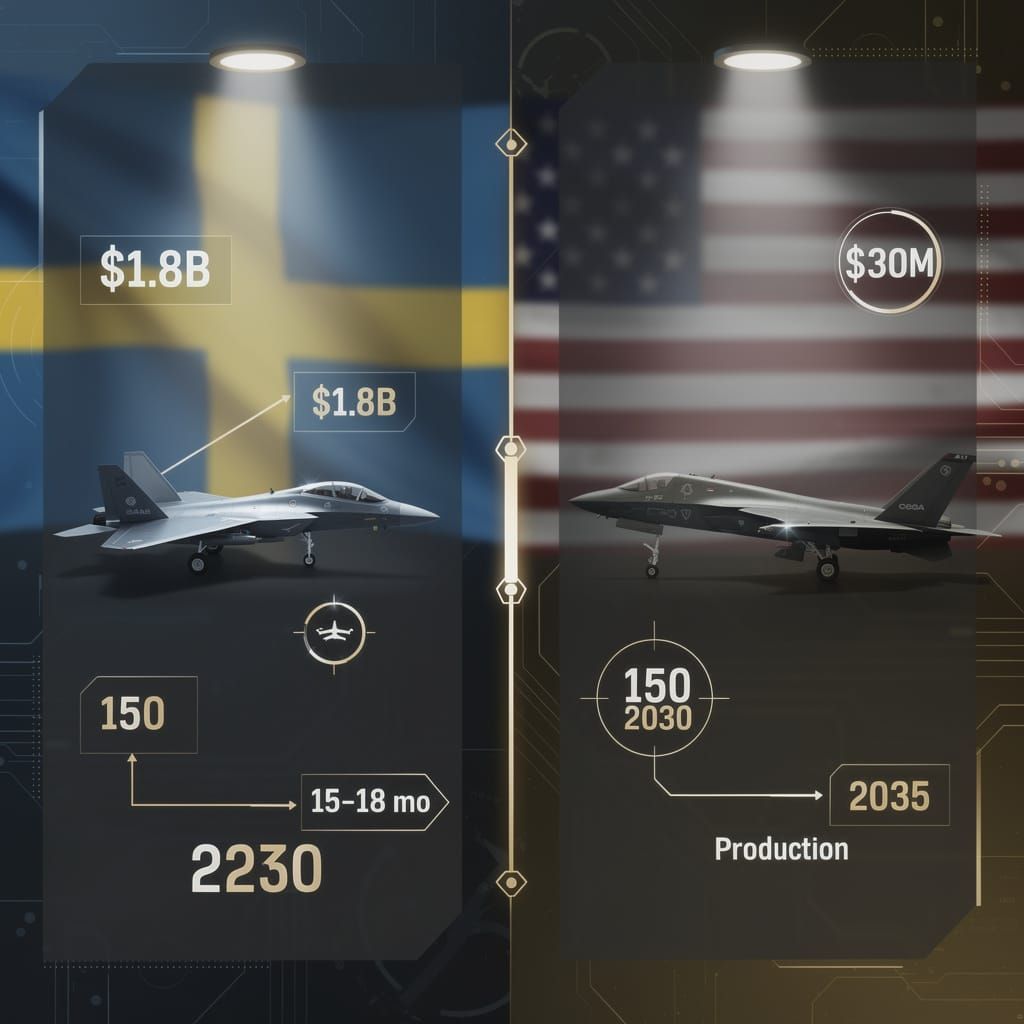
Saab's A3 "loyal wingman" promises supersonic autonomy for NATO allies — but after $1.8B in US CCA contracts and 150 aircraft slated by 2030, this is a marketing slide, not a programme. No price, no sensor specs, no orders. A first flight delayed until ~2028, production maybe 2035. By then, General Atomics and Anduril will have delivered the fleet. Sweden offers sovereignty without scale. But who buys a drone that won't fly for a decade when the US already has 150 in production? 🇸🇪🤖
Saab unveiled the A3 Collaborative Combat Aircraft at the Swedish Armed Forces Air Show on September 1, 2026, positioning it as the autonomous teammate for the JAS 39 Gripen E and a direct European alternative to the U.S. Collaborative Combat Aircraft (CCA) programme. The A3-001 demonstrator, powered by a GE F-414 engine, promises supersonic speed, collaborative autonomy, and networked operations. On paper, it checks every box NATO partners say they want.
The claims: Saab’s Peter Nilsson described a system designed for “independent but coordinated action” — a drone that flies ahead, absorbs threats, shares targeting data, and, if needed, sacrifices itself before the piloted Gripen enters contested airspace. The concept mirrors what the U.S. Air Force has been prototyping since 2023 under its CCA increment-one framework, what Boeing demonstrated with the MQ-28 Ghost Bat in Australia, and what Airbus is separately developing with its Wingman concept. Saab’s pitch: European sovereignty, open architecture, lower barriers to entry for allies who cannot buy American. General Atomics already demonstrated exactly that capability on May 29, 2026, when it completed an MQ-20 Avenger flight test controlled from an F-35 cockpit, marking a fully functional manned-unmanned teaming milestone Saab has yet to replicate even on a simulator.
What remains unanswered: No price point. No production timeline beyond “demonstrator flights in 2027.” No confirmed sensors, payload capacity, datalink protocols, or how the autonomous decision-making handles contested electronic warfare environments where GPS and satellite links degrade. The Swedish Ministry of Defense has not placed a public order. The Swedish Air Force has not committed to fleet numbers. Saab’s own roadmap shows A1 first flight targeted within 15–18 months (end of 2027 or early 2028), an A2 demonstrator by 2030, and a production A3 prototype only in the early 2030s — with service entry not expected until roughly 2035.
The market gap Saab tries to exploit: Countries such as Japan, Ukraine, Spain, and Canada face a choice — integrate into the U.S. CCA ecosystem (with its export restrictions, ITAR controls, and dependency on Washington’s release codes) or accept slower, costlier domestic development. Saab offers a middle path: a non-American supersonic loyal wingman that could theoretically plug into NATO standard data links without handing architecture control to the Pentagon. Saab claims acquisition cost at roughly half a Gripen E and life-cycle costs around one-third — figures that remain unverified against any production contract. By contrast, the U.S. Navy’s CCA RFI, posted September 1, 2026, targets a unit cost of $30 million per carrier-capable autonomous aircraft — a concrete procurement target backed by contract language, not a marketing slide.
Reality check: On June 21, 2026, the U.S. Department of Defense awarded $1.8 billion in contracts to General Atomics and Anduril to produce 150 operational CCA aircraft by 2030, shifting from prototype experiments to mass production. The U.S. CCA programme has flown multiple prototypes since 2024, accumulated hundreds of flight hours, secured budget lines exceeding $6 billion through 2029, and — as of May 2026 — selected Anduril’s YFQ-44A and General Atomics’ YFQ-42 for formal integration into the future combat air fleet. Meanwhile, the Gripen E fleet itself numbers roughly 60 operational aircraft across Sweden and Brazil — a small base from which to scale a collaborative drone ecosystem. The U.S. push is further reinforced by the F-35’s mission-capable rate dropping to 25% as of June 2026 (GAO confirmation), creating an urgent operational gap that unmanned platforms are being funded to fill. The business case depends on export orders from countries unwilling or unable to buy American, but those same buyers typically face long acquisition cycles, tight defence budgets, and political pressure to standardise within U.S.-led frameworks.
- 2027–2028: A3-001 flight testing begins, likely limited to basic handling and sensor integration — no autonomous combat manoeuvres expected before 2028. In the same window, the U.S. Navy expects first carrier-capable CCA prototypes within two years of contract award.
- 2028–2030: Saab targets an A2 demonstrator; competing against Airbus Wingman prototypes, Navy carrier-certified CCAs, and now-mass-producing U.S. CCA exports under firm Pentagon contracts.
- 2030–2035: Potential A3 production prototype emerges early 2030s; first operational units possible around 2035 if the Swedish government greenlights the programme and export orders materialise — by which point General Atomics and Anduril will have delivered 150 operational CCAs, and the Navy may have fielded its own carrier-based variant under Increment 1.
Saab’s A3 is not a breakthrough. It is a necessary hedge — a European attempt to retain industrial sovereignty in an unmanned combat air segment that the United States already dominates with locked-in production contracts, demonstrated multi-platform teaming, and firm unit-cost targets. Whether it reaches service before the U.S. CCA programme delivers 150 operational aircraft by 2030 and locks in allied customers through inertia and interoperability will determine whether the A3 becomes a real competitor or another demonstrator that flew, impressed, and faded into a museum hangar.



Comments ()