Wall Street's Reluctant Ceasefire: Markets Stabilize As Risk Premium Collapses Under Its Own Contradictions
TL;DR
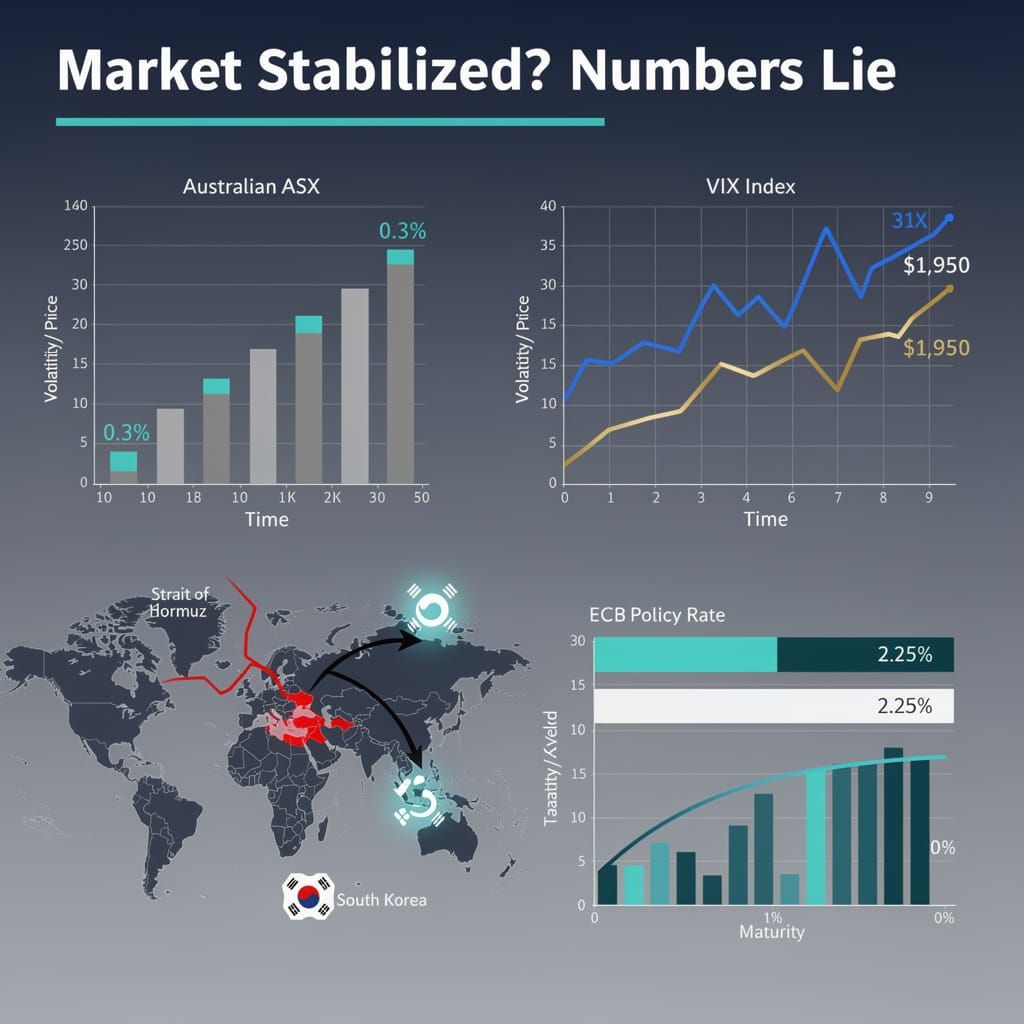
- Australian Markets Up 0.3%—Gold Hits $1,950: Ceasefire Masks Rot Beneath. If Australian markets rally while gold spikes and the VIX screams—is this recovery or the calm before the next shock?
- $31T U.S. Economy Hits Record While Gas Hits $100/Gallon and AI Delivers 0.3% Productivity. Does a $31 trillion economy that produces $100/gallon gas and 4.2% inflation actually reflect American economic health—or just concentrated capacity?
- Fed Rate Hikes Can't Fix What They Didn't Break: How Supply-Shock Inflation Busted Monetary Policy's Core Assumption. If the Fed's rate hikes can't unblock shipping lanes or fix energy supply—do they help at all, or just delay the pain for working families?
📉 Wall Street's Reluctant Ceasefire
Australian markets just had their first positive close in weeks. 📈 Up 0.3%. Meanwhile: VIX at 31. Gold at $1,950. Negative real yields across the board. A ceasefire that architects call 'prolonged interim arrangement.' Strait of Hormuz partially congested. Iranian missile production accelerating. South Korea is now entangled in Middle East diplomacy. That's not a market stabilizing. That's a market running out of fear to trade on.
The Numbers Say Stability. The Numbers Lie.
On July 1, 2026, the Australian stock market closed in positive territory for the first time in weeks. The headline sounds like cause for celebration. It is not.
The benchmark index managed a slight upward notch—the kind of gain that signals exhaustion rather than recovery. Markets stabilized, the briefings claim. Volatility normalized, economists assure us. The data tells a different story.
The Dual Shock That Should Have Broken Things
February 2026 delivered a textbook case study in compounding crises. On February 9th, open conflict between the United States and Iran reshaped Middle East security frameworks overnight. Geopolitical risk premiums spiked beyond any rational calibration. Then, on February 22nd, the Reserve Bank executed a tripartite tightening—three rate increases in succession—compounding the macroeconomic shock with aggressive monetary contraction.
The logic seemed straightforward: tighten financial conditions during uncertainty, watch capital flee risk assets, brace for correction. The market obliged. Except it didn't break cleanly. Instead, it entered a grinding, anxious stagnation—equities bleeding slowly while bond yields screamed conflicting signals.
The Ceasefire That Changes Nothing
Here is what analysts keep burying: the June 16 memorandum of understanding between the United States and Iran is not peace—it's a pause with paperwork.
The MoU extends the ceasefire, reopens the Strait of Hormuz nominally, and eases sanctions pressure just enough for both sides to claim victory without winning anything. Andreas Krieg described it precisely: "the war produced tactical degradation but strategic regression for the US." Iran endured what US and Israeli planners assumed would be strategically decisive pressure. The lesson for Washington's Arab allies is uncomfortable: the US can start wars but cannot protect them or end wars on their terms.
The July 2, 2026 briefing confirms what skeptics suspected. US presidential remarks discuss Iran deal progress while simultaneously urging Lebanese evacuation. Israel designated southern Lebanon a combat zone. Hamas confirmed leadership death during Israeli strikes. South Korea summoned the Iranian envoy over a Hormuz incident. South Korea—South Korea—is now entangled in Strait of Hormuz diplomacy. That is not a region stabilizing. That is a region burning in slow motion.
Meanwhile, the June 19 diplomatic collapse validates every doubt. Vice President JD Vance postponed his Switzerland trip for Iran peace talks, citing "logistical challenges." The Senate simultaneously blocked Pentagon travel funds pending release of unredacted reports on the February 28 attack killing three in an Iranian school. Hezbollah destroyed three Israeli tanks. Iran invited IAEA inspectors—transparently to generate diplomatic oxygen while the actual military situation remains unresolved. The ceasefire holds superficially while the architecture beneath it rots.
Global central banks ensured no genuine recovery could take root. The ECB raised rates to 2.25% on June 11, ending an era of zero rates. Staff forecasts project headline inflation averaging 3.0% in 2026 before falling to 2.3% in 2027 and hitting the 2.0% target only in 2028—three years out. Economic growth projection: a pallid 0.8%. The Fed, under newly confirmed Chair Kevin Warsh, adopted an inflation-dominant stance and signaled resistance to aggressive easing. Philippine authorities pushed rates to 4.50%. The $518 billion Treasury auction on June 19 drove 1-year yields to 4.0%—markets correctly interpreted "regime change" and "taskforce initiatives" as renewed tightening.
The June 13 Treasury data reveals the absurdity. The US issued $119 billion in new debt via three auctions—3-year, 10-year, and 30-year securities—amid inflation of 4.25% CPI and 6.46% PPI. Yet Treasury yields remained below inflation, producing negative real yields across the duration spectrum. The bond market simultaneously expects multiple Fed rate hikes over the next three years and is being offered securities that guarantee purchasing power destruction. The S&P 500 may have risen 26% in 2026, but the VIX peaked at 31.05—and gold spiked to $1,950 per ounce as rational investors priced geopolitical risk premium rather than economic fundamentals.
The Miners Who Refused to Fold
Mining stocks outperformed as supply chain fears overrode demand destruction concerns. Indigenous Australian infrastructure plays finally delivered when commodity cycles aligned. Capital rotated toward real assets perceived as inflation hedges.
Meanwhile, domestic equities faced an embarrassing recalibration. The 6.1 adverse dividend adjustment per AU$1 yield reveals the math investors performed: why hold Australian stocks when risk-adjusted returns pointed offshore? SEBI-compliant ETF horizons suddenly looked attractive to institutional allocators rebalancing away from perceived instability. National bonds attempted to anchor sentiment, but the 50% yield discount they commanded suggested something broken in the risk premium calculus.
The Briefings Promise Stability. History Disagrees.
"Markets stabilize within weeks as no new feed emerges." That confidence sounds reassuring. It should not.
The Strait of Hormuz remains partially congested. Iranian missile production accelerates. Hezbollah destroyed Israeli armor on June 19 alone. The regional architecture the conflict shattered has not been rebuilt—only papered over with an interim arrangement that neither side trusts.
Sovereign disengagement from perceived stable assets continues accelerating. Current capital flows point toward offshore blue-chips positioned as resilient. The domestic earnings narrative has not improved—only survival-based investing has replaced growth expectations. That is not a foundation for sustainable recovery.
The July 1st close marks not a turning point but a pause. Markets stabilized because traders lack new information to trade on, not because underlying conditions improved. When the next shock arrives—and the ceasefire's architects already warn of "mutually assured retaliation" and "prolonged interim arrangement rather than grand bargain"—these fragile gains evaporate.
🚗💸 America's $31 Trillion Economy Remains Unimpressive at the Individual Level
$31 trillion economy, $100 gallon gas, 4.2% inflation—yet AI promised productivity gains of just 0.3%. Markets priced in disinflationary magic. Reality: energy crisis + economic stagnation while 46 states slash services. The headline number celebrates capacity, not health. How does YOUR region's infrastructure hold up against this 'record' economy?
The United States economy hit $31 trillion in annual output on July 1, 2026—another record, another milestone, another reason to applaud aggregate growth while ignoring distribution. The nation has now produced trillion-dollar outputs for over two consecutive decades, and yet the celebration feels routine. These numbers indicate structural concentration of wealth rather than shared prosperity.
California Does the Heavy Lifting
California generated $4.25 trillion in 2025, representing 13.8% of national output—an efficiency unmatched by any subnational region globally. This dominance reflects deliberate industrial clustering along West Coast corridors where venture capital concentrates around artificial intelligence research hubs. The state added 101,500 nonfarm jobs year-over-year.
Yet Gavin Newsom's economic pitch to the Center for American Progress obscures a troubling undercurrent. The Public Policy Institute of California reports widening income inequality in the state despite headline growth. Newsom himself announced Medi-Cal eligibility reductions—a curious tradeoff for a governor highlighting global rankings. The technology sector enriches venture backers while AI-driven job losses hollow out traditional industries like film and television. While 46 other states reported flat spending for fiscal year 2027 and proposed cuts to public services, California's coastal corridors absorb the gains while exporting economic anxiety inland.
Texas posted over 19.5% real GDP growth from 2021–2025, suggesting the economic map isn't entirely coastal. But California's dominance remains structural: its tech corridors absorbed the bulk of the 10.6% surge in business investment that drove Q1 2026 GDP to $31.866 trillion—exceeding forecasts by $361.7 billion.
That Q1 figure looked respectable until the details emerged. The Bureau of Economic Analysis confirmed 2.1% annualized growth on June 25—a revision from the initial 1.6% estimate that left economists congratulating themselves for undershooting by half a percentage point. Real final sales to private domestic purchasers rose just 1.7%, down from 1.8% in Q4 2025 and a mere 1.7% in Q3 2025. Consumer spending barely budged, sustained only by declining savings and rising household debt. The information technology sector carried the load while retail, wholesale trade, and finance and insurance declined.
Built on Fragile Infrastructure
Federal authorities allocated billions toward intercity road upgrades to address congestion risks during peak travel periods. The dependency ratio on aging transportation networks threatens safety standards and public trust when systems overheat under demand spikes. Meanwhile, on May 21, 2026, a House subcommittee passed a transportation funding bill that slashed public transit and Amtrak budgets while imposing a $130 EV fee and $35 hybrid vehicle fee. The American Public Transportation Association's analysis projects funding shortfalls for rail and transit systems already operating beyond capacity.
Virginia's Commonwealth Transportation Board approved $28.5 billion for transportation projects, including $930 million for public transit and $500 million for bridge repairs. That sounds substantial until one considers it represents a 6.7% increase to a single state's budget—not a federal commitment to national infrastructure resilience.
What Analysts Refuse to Say Aloud
Federal Reserve officials Kevin Warsh and Alberto Musalem delivered a speech on June 1, 2026, that should have made headlines. Their message: AI may not boost productivity enough to curb inflation. Full stop. No caveats about future potential offsetting current pressures—just a direct warning that the technology currently consuming $7.6 trillion in projected investment might not deliver the disinflationary gains markets priced in.
The data supports their skepticism. Bank of America's research shows AI contributed a measly 0.1% to productivity. Major technology firms—Microsoft, Nvidia, Meta, Amazon—quietly reduced AI budgets after reporting disappointing token expenditures and uncertain returns. EY-Parthenon documented a persistent gap between client optimism and analyst reality. Meanwhile, bond yields climbed toward 4.5% as the neutral real rate outlook shifted higher, reflecting markets losing faith in the inflation-slayer narrative.
The May 2026 CPI rose 3.8% amid persistent energy prices. By June, it hit 4.2% year-over-year. Gasoline prices surged more than 40% above pre-2025 levels. Equity markets dropped 9.3% from all-time highs as the Supreme Court ruled IEEPA tariffs illegal, potentially raising future deficits.
This happened because Iranian strikes damaged critical energy infrastructure, closing the Strait of Hormuz and pushing Brent and WTI above $90 per barrel. U.S. gas prices breached $100 per gallon. The conflict cost the global economy losses exceeding $50 billion and shaved approximately three quarters of output from the world economy—yet somehow AI remained the dominant narrative in earnings calls and investor presentations.
The Conference Board's June 18 Leading Economic Index rose 0.1%, its Consequence Economic Index climbed 0.2%, and its Lagging Economic Index dipped 0.1%. These marginal movements reflect energy costs consistently outpacing wage growth—persistent inflation while the underlying economy decelerates.
The additional $1.2 billion in annual federal tax revenue sounds substantial until one divides it across 335 million people—roughly $3.58 per person yearly. The federal government ran deficits so significant that budget analysts flagged systemic risks requiring structural reform. The Congressional Budget Office projects escalating fiscal pressures from rapid federal debt accumulation.
Housing markets remained stagnant despite economic "resilience." California thrives while other regions flatten spending. The technology sector enriches venture backers while infrastructure deteriorates. AI investment concentrates in coastal corridors while 46 states cut public services.
The $31.866 trillion figure marks American economic capacity, not American economic health. That distinction matters more than any headline number.
⚖️ The Fed's Lonely Rate Hike Battle Against a Conflict It Cannot Win
The Fed hikes rates into supply-driven inflation it cannot solve. Geopolitical disruptions blocked the Strait of Hormuz—only 12 vessels transiting against a normal 21. Brent crude corrected from $96 to $78.58 before the rate decision, while households absorb higher energy bills across the UK, Ireland, South Africa. Raising interest rates doesn't unblock a strait. The policy theater continues.
The Federal Reserve raised interest rates in June 2026, confirming inflation remained stubbornly above 4 percent. Stock markets dropped accordingly. The Dow shed points. The S&P 500 retreated. Analysts invoked the usual vocabulary of crisis—correction, volatility, risk-off positioning. And yet, reading the signals carefully reveals a different story underneath the familiar choreography of monetary policy theater.
The Energy Paradox Nobody Wants to Discuss
Here is what the Fed's rate decision ignores: energy markets were already correcting, but the resolution was partial, fragile, and still in progress. The Strait of Hormuz never fully reopened during the June 2026 Fed meeting. Global oil throughput remained sharply reduced after the US-Iran conflict erupted on February 28, 2026. A partial reopening followed on April 14, but by June 21—five days before the Fed's rate decision—oil tankers remained anchored off Port Sultan Qaboos, with only 12 vessels transiting against a normal flow of 21. US Vice President JD Vance met Iranian officials in Switzerland that same week to clarify war termination terms under a 14-point memorandum of understanding. The reopening timeline moved to mid-July only after an intermediate US-Iran pact confirmed on June 30. Brent crude settled at $78.58 per barrel that day—corrected from May peaks near $96, but hardly the smooth recovery anyone promised.
But the timeline was actually accelerating before the Fed acted. On June 18, the United States and Iran signed an agreement formally ending the Middle East war, with both parties committing to normalized Hormuz commercial traffic and Swiss-mediated talks establishing implementation timelines. A formal memorandum signed on June 20 formalized the commercial transit framework. By June 27—three days after the Fed's rate decision—Saudi Arabia resumed full-scale crude export operations via Ras Tanura and Yanbu terminals. Giant tankers returned to Ras Tanura following months of diversion due to the Iran-Saudi war, marking the longest shutdown period since March. This move signaled confidence in long-term peace frameworks involving US-Iran cooperation, supporting increased daily volumes averaging 4.1 million barrels per day.
The Fed raises rates to fight inflation. But the inflation this time was supply-driven—geopolitical disruption, blocked shipping lanes, refinery constraints. Monetary tightening does not unblock a strait. It does not accelerate decommissioning of offshore platforms. It does not rewire a grid. The mechanism of transmission assumes demand-pull pressures that simply were not the primary driver here.
Meanwhile, households absorb the contradiction directly. UK consumers faced Ofgem's price cap increase—estimated at 15 to 20 percent through July 2026—as wholesale gas prices spiked on Iranian actions. The regulatory apparatus adjusted to volatility by permanently lifting baseline costs upward. The price cap that once promised protection now guarantees a floor above market rates. This is not inflation control. It is cost socialization dressed as consumer defense.
Policy Coordination Failure Across Geographies
Australia halved its wartime fuel excise discount from 32c to 16c per litre on July 1. The Treasury reports economy growing at 0.4 percent—modest, fragile, easily disrupted. Low-income households dependent on car ownership absorb the full impact. South African motorists faced record diesel highs after the government ended temporary fuel levy relief on May 18, with consumer inflation reaching 4 percent YoY that month. The rand weakened against dollar headwinds even as the government phased out support measures. Ireland phases out excise relief while electricity and gas bills simultaneously climb 8 to 11.8 percent. The sequencing reveals a pattern: governments remove support the moment markets soften, ignoring that household budgets reset at higher baselines and cannot absorb reversals without hardship.
The US situation compounds the incoherence. Donald Trump publicly pushes for rate cuts while inflation runs at 4.2 percent, driven partly by the same Iran-conflict energy shock now resolving. A US presidential deadline for ending sanctions had passed without resolution by May 1, 2026. UN monitoring of Iran's enrichment activities continued. The Fed raises. The President advocates the opposite. The diplomatic mechanics exposed during this period did not reassure. On June 13, Iranian officials refuted Pakistani claims of an imminent US-Iran treaty, citing unresolved technical details. On June 19, VP Vance canceled his planned trip to Switzerland for direct talks, forcing electronic signature of the framework agreement on June 18 instead of in-person ceremony. US Treasury authorized temporary Iranian oil imports until August 21, buying time while talks continue under Swiss mediation. Markets interpreted this not as technical disagreement but as institutional vulnerability—proof that rate decisions reflect political calculation, not economic calibration.
What the Market Actually Signals
Trading volume spiked during the June declines. The VIX climbed. Margin calls accelerated. Yet the drivers of those moves—supply disruptions—were already resolving as diplomatic normalization progressed. The market priced in political risk premium that had nothing to do with corporate earnings, interest coverage ratios, or credit fundamentals. It priced in the possibility that the Fed would either lose its nerve or its independence. It priced in a fragile ceasefire that was simultaneously escalating elsewhere: Israel-Hezbollah clashes continued in southern Lebanon, where UN monitoring confirmed destruction of over 11,000 buildings. The ceasefire involving Israel and Hezbollah remained contested even as US-Iran negotiations progressed.
Projections indicate further rate hikes through year-end if core PCE refuses to moderate. But core inflation components beyond energy—services, shelter, wages—show persistence that rate policy cannot efficiently target without crushing labor markets. The causal chain runs: rate increases → tighter credit conditions → reduced investment → slower hiring → higher unemployment → demand destruction. This takes twelve to eighteen months to materialize. The geopolitical shock already resolved in less than three.
The Verdict Nobody Will Say Aloud
Monetary policy did not cause the inflation. It cannot easily cure it either—not when the transmission channels are misaligned with structural drivers. What the Fed's rate hikes accomplish is political cover. They demonstrate action. They provide a villain—easy credit, loose policy, demand excess—that conveniently omits the Strait of Hormuz, the refinery bottlenecks, the cartel dynamics. The market decline satisfies the ritual of tightening without addressing the actual mechanism.
The signals suggest stabilization ahead if the intermediate US-Iran pact holds and Hormuz traffic normalizes through mid-July. But stabilization is not victory. It is simply the baseline returning after a geopolitical interruption that monetary policy neither prevented nor accelerated. The rate hikes look decisive. They are mostly theater.



Comments ()