China Beats US Drug Approval Rate—87 Days vs 501: Can Operation Trial Blazer Close the Gap?
TL;DR
- China's 87-Day Trials vs. America's 501: The Biopharma Speed Gap That Could Redefine Global Medicine. How will the US close a 5.7x clinical trial speed gap with China before global pharma rules tilt eastward?
- Half of Small U.S. Businesses Now Navigate Global Supply Chains, But Regional SMBs Still Struggle. Is your small business absorbing hidden FX costs that bigger companies have treasury teams to manage?
- Allium's $40M Series B + Visa Deal Signals Compliance Infrastructure's Wall Street Moment. Can Allium scale its Visa partnership into an industry standard, or will this funding round become just a footnote?
💊 The Red Pill of Medicine: How China Is Racing to Win the Biopharma Future
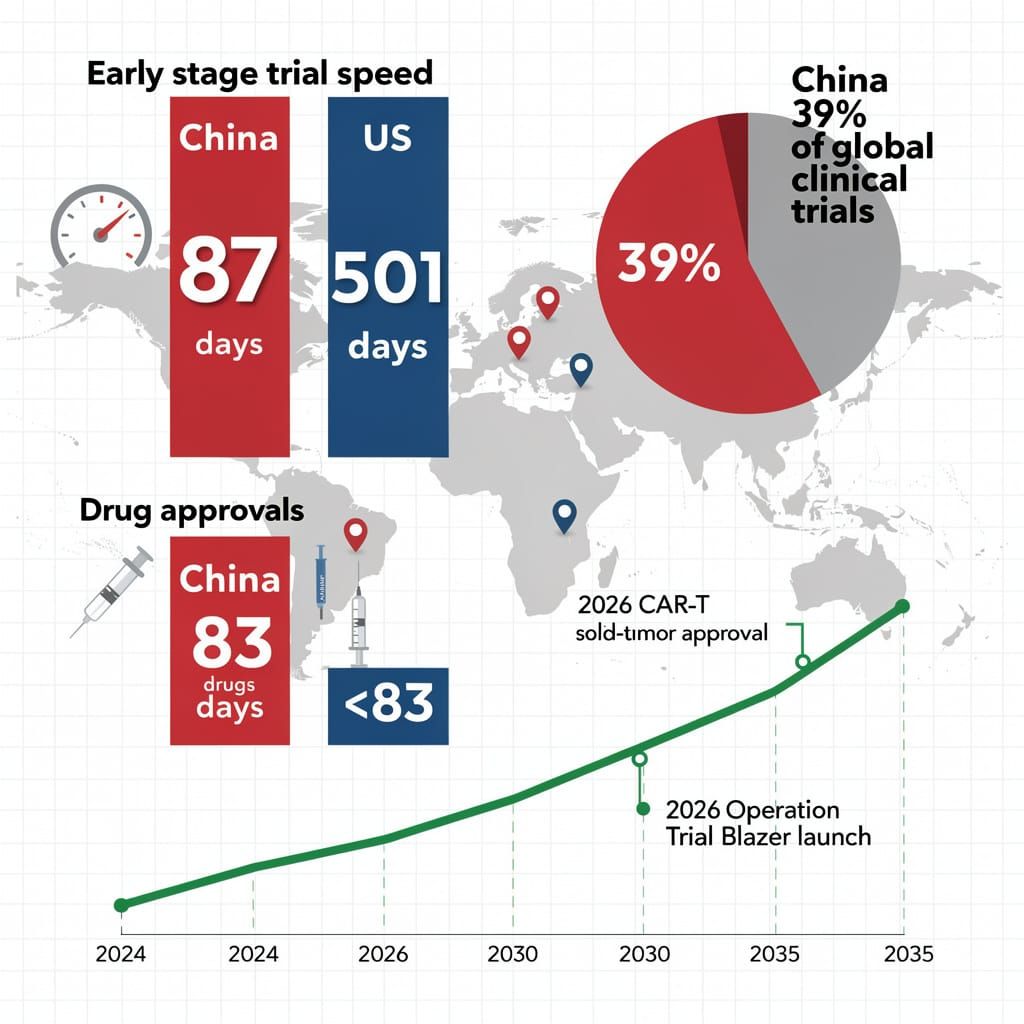
China approves early-stage trials in 87 days. The US takes 501. That gap just became a matter of life and death. With China's first-ever CAR-T solid tumor approval and 83 new drugs greenlit in one year, the biopharma race isn't hypothetical—it's here. The question: can Operation Trial Blazer close a 5.7x speed deficit before the rules of global medicine tilt eastward? Who's feeling this in their pipeline right now?
The Plot Twist Nobody Saw Coming
So here's the thing—while Washington debates tariff TikTok and Silicon Valley fights over GPU allocations, China has been quietly running the most aggressive pharmaceutical playbook since the space race. On June 29, 2026, Beijing confirmed what industry insiders have whispered for years: it's going all-in on biopharmaceutical dominance by 2035. Not "trying." Not "investing." Dominance.
The numbers now make that ambition harder to dismiss. China averaged 87 days for early-stage clinical trials in 2024, compared to 501 days in the United States. It approved 83 new drugs that same year—exceeding the US count. The pipeline? Over 1,250 new candidates in development, growing at roughly 7% annually in government-backed R&D investment. Here's the kicker: China now accounts for 39% of global clinical trial participation, a share driven by superior infrastructure and regulatory agility that makes Western competitors look like they're navigating a maze while Beijing runs a straight line.
Beijing's Biotech Blitz
The catalyst isn't just ambition. Tighter export controls have pushed China, South Korea, and Japan into building parallel biopharma ecosystems from scratch. Each country's sprinting down its own lane, but Beijing's head start—funded partly through state mechanisms like the NSFC's RMB 32.7 billion health research allocation and an expanding NMPA workforce—has widened the gap.
The mechanics are genuinely impressive. China has weaponized its state-backed funding machine toward one target: cutting clinical timelines in half. While Western pharma companies spend years navigating regulatory mazes, Chinese labs are steamrolling through approvals for cell and gene therapies.
On June 22, 2026, China approved satri-cel—a CAR-T therapy developed by CARsgen targeting Claudin18.2-positive gastric cancer—without a single US partner or regulatory checkpoint. This marked the first CAR-T approval for solid tumors globally, backed by Phase 2 data published in The Lancet and developed under CEO Dr. Zonghai Li and clinical lead Prof. Lin Shen at Peking University Cancer Hospital. That milestone flew under most headlines, which tells you everything about how fast this shift is happening.
Then on June 16, Antengene Corporation secured NMPA approval for ATG-201, a phase I ATTRACT study targeting B cell-related autoimmune diseases, before immediately granting UCB worldwide exclusive rights to develop, manufacture, and commercialize the CD19/CD3 bispecific TCE globally. That's China not just approving drugs domestically but licensing them outward—a sign of maturation, not just imitation.
The innovation sweet spot:
- Cell therapies: Engineering patients' immune cells to hunt cancer—China's approved more clinical trials here than any other nation.
- Gene editing: CRISPR-based treatments targeting genetic disorders, with accelerated pathways that would make US regulators twitch.
- Biosimilars: Cheap, effective copies of expensive biologics, aimed squarely at global market share.
Washington's Wake-Up Call
America noticed. Under Health and Human Services Secretary Robert F. Kennedy Jr., the federal government launched Operation Trial Blazer on June 22, 2026—a coordinated assault on regulatory drag. FDA Commissioner Kyle Diamantas and NIH Director Jay Bhattacharya are leading the charge, with explicit goals to halt reliance on Chinese early-phase R&D and reestablish domestic trial capacity. The reforms address instability caused by frequent commissioner turnover since January 2025, a revolving door that's cost the agency credibility and consistency.
The toolbox includes an expedited IND pilot program, a Phase 1 IND Navigator webpage, a Rolling IND submission platform, and pre-certified "trial-ready" sites embedded in routine healthcare via EHR connectivity. HHS simultaneously announced CMC barrier reductions and revised final-trial guidelines allowing reliance on a single robust pivotal trial plus confirmatory data. The FDA is also integrating AI-based NAMs and omitting redundant animal testing to cut 6–12 months off preclinical phases.
The NIH activated its own AI-driven reusable clinical trial network, betting that machine learning can compress design timelines while maintaining safety thresholds. Early projections suggest these reforms could deliver roughly eight months of average annual acceleration in early-stage trial completion, potentially adding nine million life-years saved annually and redirecting $12 billion of European venture activity into North American biotech.
But US firms still dominate late-stage trials. The advantage hasn't vanished—it's shifting earlier in the pipeline, where discoveries become intellectual property and licensing leverage.
The catch—what nobody's celebrating:
- Fragmented knowledge transfer: Collaboration stalls when geopolitics enters the lab.
- Delayed equity competition: Patients lose when innovation slows due to distrust.
- Duplicated effort: Three nations essentially rebuilding the same wheel.
What's Actually at Stake
Here's the uncomfortable truth: China's biopharma push isn't just about market share or national pride. It's about who writes the rules for how new medicines get made, tested, and priced globally. If Beijing hits its 2035 target, the entire architecture of pharmaceutical leadership tilts eastward—regardless of whether American patients, insurers, or hospitals are ready for that reality.
Congress is paying attention. Figures like John Moolenaar have engaged lawmakers on biotech regulation, fueling debates over trade safeguards and foreign investment restrictions. Whether those conversations lead to legislation or just more panel discussions remains to be seen. The structural efficiencies from US reforms combined with China's maturing platforms will likely cap further timeline reductions below twelve months—meaning this race comes down to execution, not just speed.
The good news? Faster competition often means faster cures. The bad news? We're watching the fracture of a global scientific community that spent decades building trust, sharing data, and racing together toward the same finish line. The outlook favors sustained trust-building over competitive mimicry—positioning whoever gets there first as a leader in ethical, scalable innovation.
So, yeah. The biopharma race is on. And unlike some tech competitions, this one actually matters for humanity.
💸 The Dollar's Long Shadow: How U.S. SMBs Are Rewriting the Rules of Global Trade
Over half of U.S. SMBs under $150k now source globally — inheriting FX risks once reserved for multinationals. The fintech revolution is real, but regional small businesses in the NY Fed's Second District are still watching revenues and employment decline. Are your margins absorbing the currency conversion costs? 💸
The Hidden Tax on Going Global
For years, accepting that a small business in Ohio might source components from Vietnam or sell artisanal goods to a buyer in Frankfurt seemed like a problem reserved for multinational corporations with dedicated treasury teams and Bloomberg terminals. That assumption is crumbling.
As of mid-2026, over half of U.S. SMBs with revenue under $150k source globally, triggering FX and liquidity risks once reserved for multinationals. But here's the wrinkle: despite diving into global markets — not dipping a toe — using foreign exchange-integrated payment platforms as their de facto infrastructure, a June 2026 New York Federal Reserve briefing documented significant revenue and employment declines for regional small businesses in the Second District, with analysts flagging persistent pessimism even as national metrics show slightly improved profitability and employment stability. The structural shift toward global sourcing is real, but the financial strain is unevenly distributed.
The shift traces back to a quiet revolution in fintech tooling. Chase launched its Business Credit Journey app and expanded Customer Insights analytics; PYMNTS reports document growing SMB demand for digital financial tools. Enterprise-grade financial platforms have sliced and diced their services into products micro-businesses can actually afford. Treasury functions that once required a team of analysts now run as embedded workflows inside platforms small business owners use without ever hearing the term "FX hedging."
But mundane does not mean cheap.
When a Tulsa-based manufacturer pays a supplier in Mexican pesos, the conversion from USD runs through layers of correspondent banks and market makers. Each layer takes a cut. For a business running thin margins on custom furniture or specialty food ingredients, those percentage points compound fast. The reliability of getting funds where they need to go — especially across time zones and banking systems with different clearing cycles — introduces operational risk that larger buyers have historically absorbed more gracefully. And the stakes are rising: an April 2026 analyst report from Bank of America flagged tariff-driven earnings misses, rising interest rates constraining borrowing capacity, and Iran-linked geopolitical tensions pushing fuel costs higher — all compressing margins for U.S. small businesses already navigating global supply chains.
The Flip Side for Global Vendors
The friction is not one-directional. Foreign suppliers receiving USD payments face their own dilemma. They operate in local currency environments — paying local staff, renting local space, buying local inputs. When a U.S. buyer sends dollars, the supplier must convert those dollars and absorbs the same conversion costs. More subtly, they lose immediacy. Their local currency reserves fluctuate between the moment the deal is struck and the moment funds clear, creating a form of embedded currency exposure that most small international vendors have no tools to manage.
This asymmetry has long been masked by the dollar's reserve status. The USD remains the dominant vehicle currency for global transactions, even as U.S. SMBs expand their footprint in ways that would have been unimaginable a decade ago. The dollar's role gives American buyers a structural advantage in negotiations and settlement speed — but that advantage is unevenly distributed, and it faces new pressure.
On June 14, 2026, China announced a major e-CNY framework upgrade effective January 1, 2026, allowing interest-bearing accounts to support global payment ambitions. Project mBridge aims to enable peer-to-peer settlements between national central banks, reducing reliance on SWIFT-linked correspondent banking. This shift counters U.S. pressure on digital currency expansion, though domestic hurdles like capital controls and limited international bond market liquidity temper its impact. The dollar built the system. New challengers are now probing its flanks.
Where Platforms Step In
The interesting action is happening at the intersection of ERP integration and fintech automation. Modern payment platforms are absorbing foreign exchange functions directly into the checkout and procurement layers SMBs already use. Instead of routing a payment through a wire service with a visible FX margin, businesses can now execute cross-border settlements with embedded conversion at competitive mid-market rates, often with same-day clearing for major currency corridors.
Stablecoins are accelerating this shift. On June 11, 2026, Ripple integrated Bitso's MXNB peso-backed stablecoin into the XRP Ledger, boosting regulated peso-USD liquidity and slashing settlement times for U.S.-Mexico cross-border transactions. Visa expanded its stablecoin card rollout to 18+ countries — adding Argentina, Colombia, Ecuador, Mexico, Peru, and Chile to its footprint — driving a 230% surge in European card users' monthly transactions. OKX launched its own stablecoin card via the Mastercard network, targeting APAC and MEA regions. Jupiter Global launched a USDC-backed Visa debit card covering over 175 million merchants worldwide, signaling mainstream consumer adoption. The Orbital and Banking Circle partnership expanded stablecoin settlement across Europe under MiCA compliance, while Project Agorá — a BIS-led initiative involving central banks from Europe, Japan, and South Korea — explored tokenized reserve settlements for faster, more efficient cross-border payments. Visa's integration with ChatGPT is embedding AI agents into payment rails, letting merchants deploy chatbots that handle checkout while maintaining manual approvals and spend caps, lowering entry costs and improving fraud detection across the network.
This integration collapses the historical divide between global procurement and domestic cash flow management. When a small business in Phoenix buys packaging materials from a supplier in Shenzhen, the payment, currency conversion, and receipt reconciliation can happen inside the same dashboard the business uses to track inventory and manage vendor payables. Local vendors who previously bore the cash flow burden of waiting for international ACH cycles now receive funds faster, with less exposure to conversion loss.
The Road Ahead
The structural forces driving this expansion show no signs of reversing:
- 2026–2027: Hybrid payment adoption accelerates as domestic systems like FedNow and SEPI raise efficiency benchmarks, while SMB treasury functions increasingly embed into ERP and accounting integrations. Stablecoin micropayments via x402 protocol enable machine-to-machine transactions, while full-stack payment orchestration improves approval rates and reduces operational friction.
- 2028–2029: Cross-border payments converge toward near-instant processing globally; SMBs compete based on treasury agility, not just sourcing quality. Synthetic identity fraud using deepfakes forces new verification methods, raising stakes for security infrastructure.
- 2030+: Tokenized money and stablecoin settlement become standard infrastructure; businesses treating FX as an operational lever capture efficiency that competitors treating it as noise leave on the table.
The practical implication cuts both ways. U.S. SMBs inherit enterprise finance functions whether they're ready or not — and they must manage multi-currency transactions via ERP integrations instead of traditional banks. This embeds treasury into daily ops like procurement, increasing efficiency but transferring cost burdens to suppliers. The businesses that treat foreign exchange not as an accounting afterthought but as a competitive weapon will rewrite who benefits from the dollar's long shadow.
The forces reshaping global payments — fintech platforms democratizing treasury tools, stablecoins collapsing settlement times, AI embedding into fraud detection and checkout — are undeniable. But so are the headwinds: regional SMB revenue and employment continue to slide, geopolitical flashpoints like U.S.-Iran tensions drive fuel costs higher, and rising interest rates tighten borrowing capacity. The tools are getting sharper. The stakes are getting higher.
🏦⚡ When Compliance Gets a Brain: Allium's Big Bet Pays Off
Allium just landed $40M AND Visa as a customer—in ONE day. Fintech compliance just got 8 hours faster. Boring? Maybe. Profitable? Apparently very. Can they turn one partnership into the industry standard? 🏦⚡
What's better than a startup landing a $40 million Series B? A startup landing a $40 million Series B and snagging Visa as a customer on the same day.
That's exactly what happened to Allium on June 29, 2026, when Amplify Partners led a funding round that signals Wall Street's growing appetite for tools that actually fix fintech's most annoying problems—rather than just papering over them.
The Problem Nobody Talks About
Regulatory compliance in modern finance is a mess. Financial institutions juggle multiple reporting frameworks, manual reconciliation processes, and verification workflows that eat up days—sometimes weeks—of back-office bandwidth. The friction isn't just operational; it's structural. Traditional banking rails and emerging digital payment networks have historically operated as separate universes, each with its own language, data standards, and oversight mechanisms.
Allium built its platform to be the universal translator. Their analytics dashboard creates a "single source of truth" across all regulated pathways, bridging what the company calls identity bridging—essentially a unified layer connecting legacy financial infrastructure with newer, permissioned network variants.
The Visa Seal of Approval
The Visa integration is the real story here. When a company the size of Visa plugs your tool into its compliance workflow, markets listen. Allium's dashboard now enables real-time monitoring within Visa's emerging regulated frameworks—a stark departure from the manual, batch-reporting cycles that dominated compliance tech just three years ago.
The numbers back up the pitch: financial institutions using Allium's integrated solution cut compliance decision latency by an average of 8 hours. That's nearly a full business day shaved off processes that previously stalled in verification limbo. Meanwhile, enterprise SaaS subscription conversions climbed 22%—suggesting that when compliance becomes frictionless, customers actually sign.
Time-to-resolution for regulators has dropped sharply through automated reconciliation. Early engagement among top-tier clients has, in Allium's words, "increased sharply." Translation: the enterprise sales pipeline is healthy.
Why This Matters Now
Amplify Partners' decision to lead this round signals that compliance infrastructure—long considered boring, back-office, and unglamorous—is experiencing a valuation re-rating. The logic is simple: as financial markets globalize and regulatory scrutiny intensifies, institutions that can prove compliance instantly rather than eventually will capture market share.
The urgency isn't theoretical. On June 10, 2026, Canada and Australia passed digital safety bills imposing fines on non-compliant platforms—part of a broader tightening of regulatory oversight on digital services. Meanwhile, global tech markets fell 9.3% from all-time highs on May 27, driven by AI-driven earnings reports and heightened US-China trade tensions, with semiconductor shortages persisting across the supply chain. Against this backdrop, compliance costs for fintech firms climbed as regulatory frameworks became more complex. A parallel shift is playing out in AI infrastructure: enterprises are increasingly demanding on-premises, self-hosted solutions to keep sensitive data local and avoid cloud telemetry risks. Tools like Cortex's zero-telemetry memory engine and Sidekick's persistent agent platforms reflect the same impulse driving Allium's growth—organizations want control over their data, not just visibility into it.
Allium's forecast? Expect deeper integration of compliance tooling across the industry. If the Visa partnership is a template, the next 18 months likely see similar integrations from Mastercard, Stripe, and legacy banking platforms scrambling to close the compliance gap. Kyber, an AI-native document platform targeting insurance firms, achieved profitability through $40x revenue growth in 18 months—demonstrating that automating regulatory workflows at scale is no longer experimental. It's table stakes.
The $40 million gives Allium runway to prove this isn't a one-partner story. Whether they can scale the model—convert early adopters into industry standard—will define whether this funding round becomes a footnote or a turning point.
One thing's certain: compliance just got a lot smarter.



Comments ()