🛸 U.S. Lasers Down 300 Cartel Drones. Mexico Has Zero Interceptions
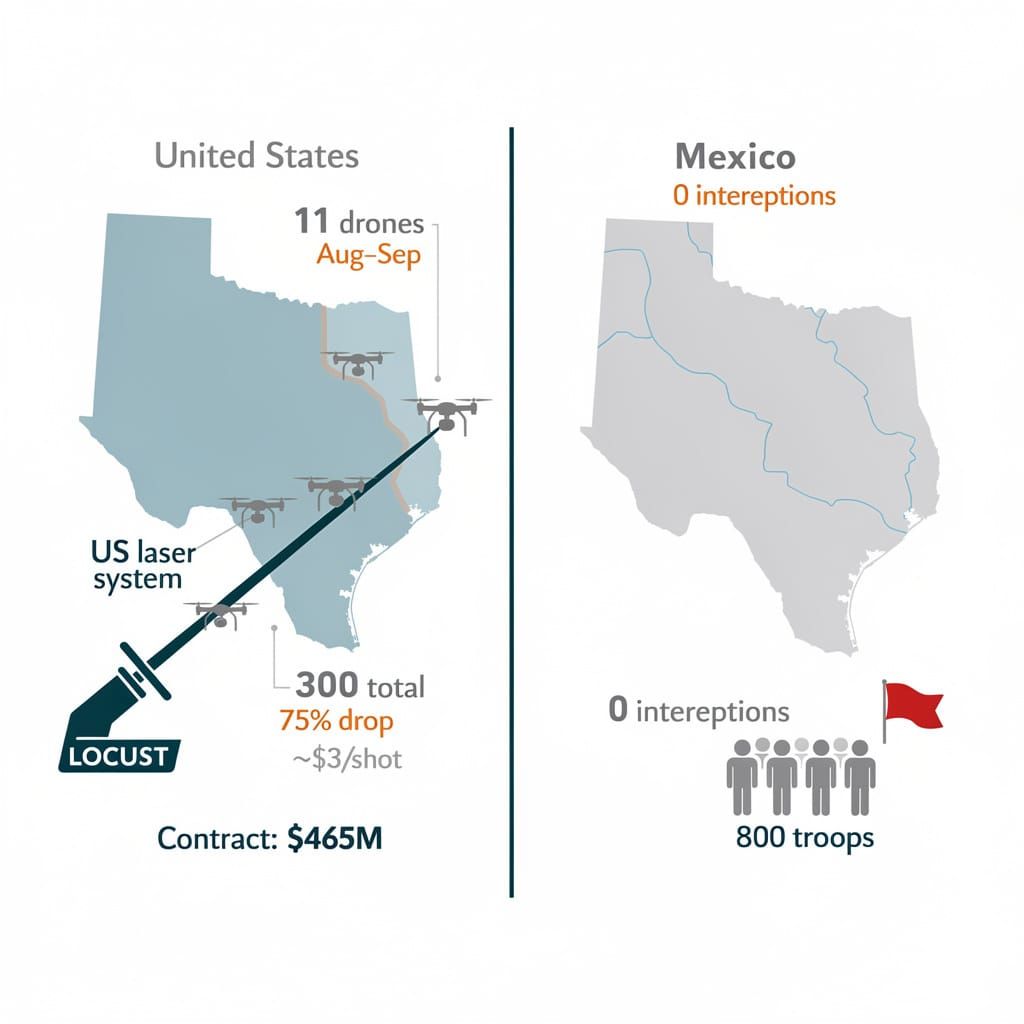
U.S. lasers have destroyed ~300 cartel drones this year — at ~$3 per shot. Mexico's Operation Águila Alta has intercepted zero. 🛸 The asymmetry: cartels treat drones as expendable ($2k each vs. cartel revenue), and Mexican territory remains a sanctuary for relaunch. Can tactical kills win a strategic air war when one side can't even play? Border airspace is contested — and the cartels aren't replacing lost drones. What changes?
How the U.S. Border Laser Campaign Works
On the night of August 25, 2026, Joint Task Force–Southern Border teams deployed the Army's multipurpose high-energy laser near the Rio Grande Valley, Texas. By the early morning of August 26, the directed-energy weapon had destroyed three cartel-linked drones — the first field engagement of the system against actual hostile threats, confirmed by the task force as a successful defense of U.S. military personnel and CBP assets.
The system in use traces to AeroVironment's LOCUST Laser Weapon System. In late August, AeroVironment delivered two 20kW-class LOCUST units to the U.S. Army's RCCTO as part of the AMP-HEL prototyping effort, following integration at its Albuquerque facility and testing at Yuma Proving Ground. Army units trained on the systems at Fort Sill, Oklahoma. The vehicles mount the laser onto a General Motors Defense Infantry Squad Vehicle (ISV), creating a mobile, expeditionary counter-drone platform.
By September 7, the laser had destroyed eleven drones total between August 25 and early September. The broader U.S. campaign — using kinetic and electronic warfare methods alongside the laser — had stopped approximately 300 cartel-linked drones this year. The military reported a roughly 75% decrease in drone activity in the Rio Grande Valley since the laser's debut, though critics note the absence of a baseline measurement and the possibility that traffic shifted locations rather than disappeared.
The Army has already authorized its first production contract for the LOCUST X3 laser system under the Enduring High Energy Laser (E-HEL) program, valued at $465 million. The system is designed with 11 modular interfaces for integration across permanent installations, temporary bases, and mobile vehicles. At roughly $3 per laser shot versus multi-million-dollar missile intercepts, the economic logic is clear — but only if the attrition actually disrupts cartel operations.
The Mexico-Side Vacuum
Mexico's Secretary of the Army reported on September 12 that Operation Águila Alta has produced zero cartel drone interceptions or arrests on the Mexican side of the border. Mexican authorities have not seized a single drone from cartel operators, nor detained a pilot or spotter. Mexico deployed 800 troops to the western border region for the operation, but the hardware and tactical methodology remain mismatched.
This is not for lack of activity. Mexican police and military have attempted to take drones down, but the aircraft remain airborne after those efforts. The gap is technical: Mexico lacks directed-energy or dedicated counter-drone systems comparable to the U.S. laser. It also appears to be tactical — Mexican forces have not matched the U.S. ability to detect, track, and engage small drones in real time.
The asymmetry is embedded in the operation's structure. On September 7, Mexico's National Defense Secretariat (Sedena) announced Operation Águila Alta as a joint U.S.-Mexico effort running from August 31 to September 21, focused on the Tijuana-San Diego border. Phase one tracked commercial drones. Phase two, beginning September 7, deployed anti-drone systems. An agreement with the U.S. Department of Defense grants Mexican military access to U.S. anti-drone systems — but access to hardware does not equal field capability. As of mid-September, the Mexican side had not executed a single interception.
Capability, Not Incentive
Brandon Darby, who has tracked border drone activity closely, noted that despite the U.S. laser campaign's high kill count, there has been no detectable increase in cartel drone uptake. The cartels are not rushing to replace downed units with newer or more capable models. Nor are they altering their operational patterns in response to the losses.
This suggests two possible mechanisms. One: the cartels treat drones as expendable, cheap assets. A downed $2,000 quadcopter is a minor cost against the revenue of a single cross-border load — and the U.S. military's $3-per-shot cost makes the exchange economically favorable to the U.S. but irrelevant if the cartels do not feel the attrition. Two: the cartels may have already saturated the operational area with drones beyond what U.S. forces can track or engage. Three hundred kills sounds decisive, but at the roughly 1,000 incursions per month previously reported by Air Force Gen. Gregory Guillot, the attrition rate may not reach a threshold that forces behavioral change.
The Mexican government's zero-interception figure reinforces this reading. The cartels can rearm, re-task, and relaunch from Mexican territory without hindrance. As long as that sanctuary exists, U.S. laser kills may suppress drone overflight in specific time windows but fail to eliminate the surveillance capability. The U.S. has not demonstrated that shooting down drones degrades cartel smuggling capacity.
What Follows
Staff meetings for Operation Águila Alta are scheduled through October, at which point the task force will report operational updates and likely recommend next steps. The U.S. command structure's confidence level appears high — the lasers work, the kill chain is validated, and the policy framework permits lethal engagement of unmanned systems over U.S. territory. But high confidence in a tactical weapon does not equal strategic success.
The laser technology itself has known limits. Earlier incidents in February 2026 revealed targeting coordination problems — the system accidentally shot down a party balloon and a CBP drone in separate events. Weather interference and the single-target constraint remain unresolved. The current operational system delivers approximately 20 kW of energy, sufficient to damage drone structures and electronics but not a multi-target wide-area defense.
A second increment of AMP-HEL delivery is planned for next month with additional vehicles and systems, indicating the Army intends to scale the capability. The production contract for the LOCUST X3 at $465 million suggests dozens of units annually. But scaling a tactical platform does not resolve a strategic asymmetry.
The most immediate implication: the airspace above the border is contested in a way that benefits the cartels. They accept losses in U.S. airspace in exchange for persistent coverage from Mexican airspace. The laser campaign provides a technological edge but not a strategic closure. Until the Mexican side develops a comparable interception capability — or until U.S. rules of engagement expand to allow action against ground-based operators — the drones will keep flying, and the kills will keep accumulating without measurable effect on the smuggling network itself.


Comments ()