🔍 State Laws Block Citizen Air Data as Federal Monitoring Grants Shrink
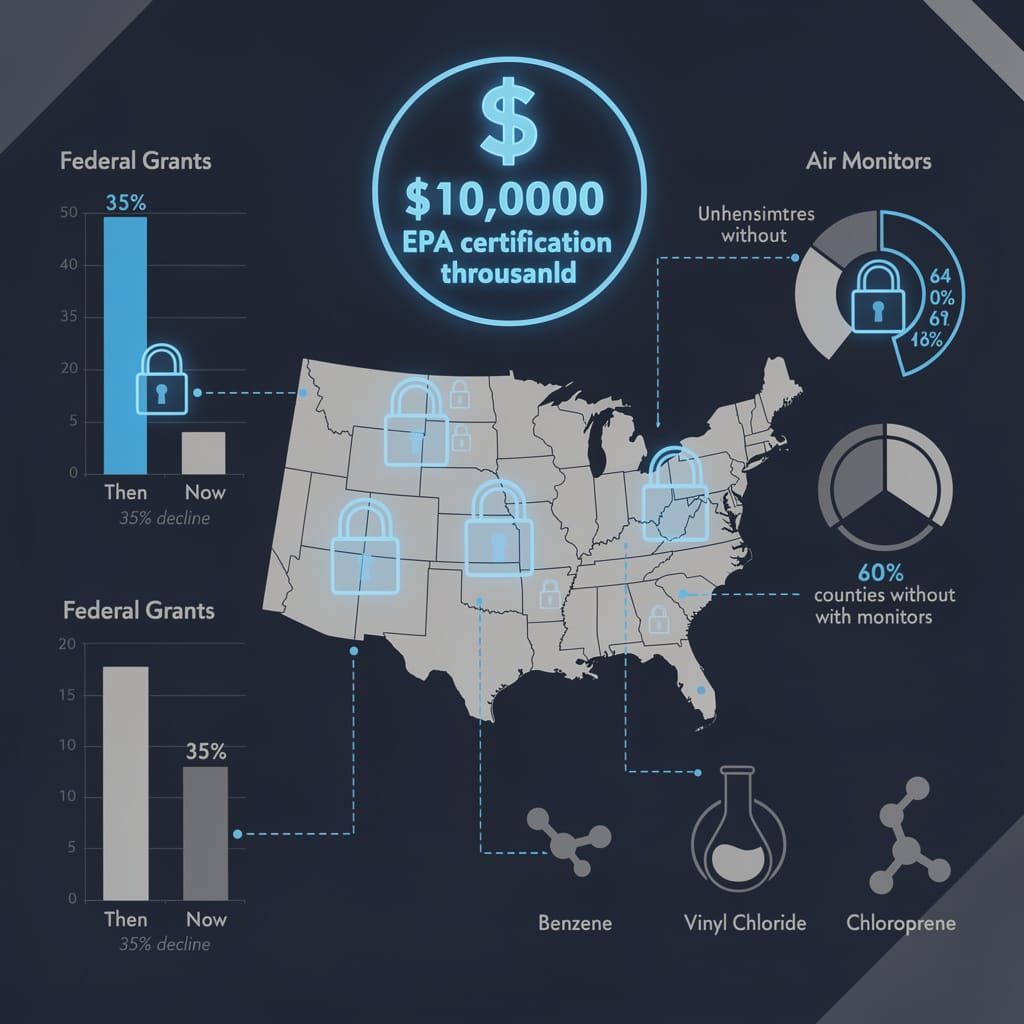
60% of U.S. counties now have no public air monitor. Five states bar citizen-collected readings unless sensors cost $10,000+ and carry EPA certification. Federal grants dropped 35%. Near Cancer Alley and Ohio River Valley, 71 of 100 largest industrial emitters discharge chemicals state networks don't measure at all. Can communities prove exposure without admissible data? 🔍
A coalition of state laws now prohibits regulators from using community-collected air-quality readings — unless the sensors cost $10,000 or more and carry EPA certification. With federal grants down more than 35% and nearly 60% of U.S. counties lacking any active public monitor, large industrial emitters across five states are effectively unmeasured for carcinogens including benzene, vinyl chloride, and chloroprene.
What happened
On September 10, 2026, a coalition of state and local officials reported that Indiana's restrictive air-monitoring statute blocks all citizen-sensor alerts unless the device is EPA-certified and priced above $10,000. Similar laws are already in force in Kentucky, Louisiana, and Ohio, with West Virginia adopting comparable restrictions, and legislation pending in Texas.
The legal mechanism is straightforward: state "no use" provisions bar regulators and courts from treating citizen-collected air data as evidence of exceedances under the Clean Air Act's National Ambient Air Quality Standards (NAAQS). Unless a sensor meets the EPA certification threshold — a process that typically lifts device cost to $10,000 or more — readings from handheld or community-mounted units have no legal standing in enforcement actions, permit reviews, or injunctive relief filings.
Kentucky's H.B. 137, passed in the 2024 legislative session, codified these restrictions. Louisiana and Ohio enacted closely aligned bills in the same year, creating uniform regulatory barriers across a three-state industrial corridor. The laws' supporters, led by chemical-manufacturing trade associations and transport-industry lobbying campaigns, argued that low-cost sensors produce "unreliable data" that could trigger unwarranted enforcement actions against facilities operating within permits.
The grant arithmetic
The enforcement gap has widened as federal funding for air monitoring has declined. For the federal program year ending FY 2024, total grants stood at $850 million — a 35 % decline after adjusting for inflation from the baseline set in the prior decade. Meanwhile, government air monitors have been reduced by nearly half.
The result: Nearly 60% of U.S. counties now lack any public air monitor, according to a 2025 study. Toxic pollutant monitoring networks have declined sharply — vinyl chloride, chloroprene, and benzene each dropped more than 50% between 2004 and 2025. Among the 100 largest industrial polluters in Kentucky, Louisiana, Ohio, and West Virginia, 71 emit chemicals that state monitors do not measure at all.
Transmission path to affected operators
The legal and funding constraints create a chain of consequences for residents near large industrial sources:
- No independent flagging: Without affordable sensors, communities cannot produce legally admissible evidence when benzene, vinyl chloride, or chlorocarbon compounds exceed NAAQS thresholds.
- No rapid response: During emission spikes exceeding two times baseline levels — typical of unplanned releases or equipment failures — state and local agencies lack the data to mobilize response teams or issue public alerts.
- No enforcement leverage: Even where exceedances are suspected, state regulators cannot cite citizen readings in notices of violation or permit amendment proceedings.
- State-court avenue remains open: Residents retain the right to file for injunctive relief within six months of an alleged violation, but they must now rely on the government's own monitors — which may be absent or too few.
Who is affected
The restrictions hit hardest in industrial corridors already known for elevated cancer risks. In "Cancer Alley" in Louisiana, along the Ohio River Valley, and near refinery complexes in Texas and Kentucky, large industrial emitters now discharge into counties with no active public monitoring coverage. Among the 100 largest industrial polluters across the four-state region, 71 emit chemicals that are entirely unmeasured by state monitoring networks.
These areas disproportionately house Black and low-income populations. Legal challenges have continued — courts have recognized that skipping an outside-grade standard is "not okay" — but without admissible data, plaintiffs struggle to meet evidentiary thresholds for injunctions or penalties.
The citizen-suit front: xAI and the Southaven turbines
While the state-level data bans were advancing, a separate legal battle in Mississippi demonstrated how the same monitoring gaps intersect with the rapid expansion of AI infrastructure. On August 3, 2026, the NAACP filed a citizen suit under the Clean Air Act against xAI Corp for operating unpermitted gas-powered turbines near Southaven, Mississippi — a facility that emits nitrogen oxides and formaldehyde at levels the NAACP's complaint linked to potential cancer risks.
The Justice Department moved to dismiss the filing, arguing that the action threatened "national energy" security amid declared emergencies. However, on July 15, 2026, the DOJ had already intervened in a related Clean Air Act lawsuit targeting the same xAI power operation, alleging that 59 mobile gas turbines emit 2,500 tons of nitrogen oxides annually. Of these, 30 active turbines operate at the Colossus 2 data center, and 27 of 28 surrounding census tracts show asthma rates elevated above regional baselines. A federal judge must now decide whether plaintiffs can halt the turbines despite Mississippi's state permit approval for 41 permanent units.
The case tests a critical question: whether mobile-unit emissions fall under federal permit authority or can be greenlit by state-level approvals alone. If judges reject the DOJ's dismissal motions, climate change mitigation could stall across all sectors; if they accept them, regulators lose leverage even before another lawsuit is lodged. The outcome could set a precedent limiting citizen enforcement under the Clean Air Act.
The Gary Works permit fight
While the state-level data bans were advancing, a separate legal battle in northwest Indiana demonstrated how the same monitoring gaps play out in individual facility permits. On July 6, 2026, environmental NGOs sued U.S. Steel and the EPA for violating the Clean Air Act by exceeding the 60‑day window to evaluate a 2025 permit for the Gary Works steel mill.
Plaintiff attorneys — including Max Lopez of the Environmental Law and Policy Center, Lisa Vallee of Just Transition Northwest Indiana, and Dorreen Carey of Gary Advocates for Responsible Development — argued that the permit issued in April 2025 by the Indiana Department of Environmental Management lacked mandatory real-time monitoring provisions. The coalition had first filed a Clean Air Act violation claim with the EPA on July 3, 2025, but the agency failed to respond within the mandated timeline.
On July 12, 2026, northwest Indiana residents publicly protested the lack of air protection measures. The plant announced a $475 million upgrade project on July 7, 2026, but community advocates noted the enhancements did not resolve demands for immediate ecological safety and real-time emission monitoring.
If the judge rules against the EPA, the agency will be ordered to certify the permit within six days. A ruling is expected within weeks.
The D.C. Circuit and the PM2.5 standard
Adding tension to the monitoring debate, on July 1, 2026, the U.S. Court of Appeals for the D.C. Circuit denied state-led challenges to the EPA's 2024 "soot" air quality standard, upholding the rule that mandates 9 µg/m³ PM2.5 levels by 2032 — tightened from the prior 12 µg/m³. Ten states, plus New York City and Houston counties, had sued the EPA, arguing the agency exceeded its statutory authority.
The D.C. Circuit's ruling keeps the stricter standard in place, requiring mandatory emission reductions via upgraded plant technology and stack height increases over a six-year implementation window. However, the monitoring infrastructure gaps described above mean that even where federal limits tighten, the data needed to detect violations is increasingly unavailable in the five restricted states. The gap between regulatory obligations under the Clean Air Act and the actual ability to detect violations continues widening.
The Garden Grove chemical spill: a gap the data bans did not cause but reveal
On June 7, 2026, residents of Garden Grove, California, filed a class-action lawsuit against GKN Aerospace after a methyl methacrylate storage tank overheated on May 22, triggering evacuation orders for approximately 40,000 residents. The incident revealed a different regulatory blind spot: the chemical methyl methacrylate is not classified as a regulated hazardous substance under federal air standards, meaning no continuous monitoring requirement existed at the facility.
The tank was cooled and evacuation orders lifted by May 27, but the class-action lawsuit escalated pressure for regulatory reform. The incident underscores a broader pattern: even where no state data ban applies — California has no such statute — gaps in chemical classification and monitoring requirements can leave communities without early warning systems. The overlap between these regulatory gaps and the active data bans in the industrial Midwest and South creates a patchwork where exposure detection depends less on risk and more on state legislative choices.
Settled versus open
The state "no use" provisions are settled law in the five enacting states. The federal funding trajectory — an $850 million program that continues to shrink in real terms — is also settled for FY 2024. The D.C. Circuit's July 1, 2026 denial of challenges to the PM2.5 standard is settled for the current rulemaking cycle. What remains open:
- Whether the EPA will revise its certification criteria for lower-cost sensors, potentially bringing devices under the $10,000 threshold into compliance.
- Whether Western states — governors discussed regional air-quality coordination on September 13, 2026 — will adopt reciprocal data-use rules that bypass state-level bans.
- Whether the new legislative sessions in Texas and other industrial states will adopt similar restrictions, potentially covering the bulk of U.S. refining and chemical capacity.
- Whether federal courts will permit citizen-suit enforcement against AI infrastructure operators — the xAI Southaven case and the NAACP's August 3, 2026 filing remain pending, with a ruling on the DOJ's dismissal motion expected within months.
Outlook
If federal grant appropriations remain at or below FY 2025 levels, the monitoring network faces "full collapse" in major industrial clusters, including Cancer Alley, according to the coalition that reported the Indiana law. The gap between regulatory obligations under the Clean Air Act and the actual ability to detect violations would continue widening.
Manufacturer-led lobbying campaigns continue to emphasize "data unreliability" as the rationale for restrictive laws, while the underlying weakness in sensor network design — current certified monitors cannot capture sub-parts-per-million volatile organic compounds across large geographic areas — remains unaddressed.
The xAI Southaven case adds a further dimension: as AI data centers proliferate, their energy demand drives deployment of gas-powered turbine arrays that may bypass traditional permitting pathways by classifying units as "mobile." The July 15, 2026 DOJ intervention reveals that federal agencies themselves acknowledge the emissions magnitude — 2,500 tons of nitrogen oxides annually — while simultaneously arguing that citizen suits threaten energy security. The outcome of this case will determine whether state-level permits can preempt federal enforcement against behind-the-meter generation.
The federal appellate ruling upholding the stricter PM2.5 standard demonstrates that ambition at the federal level may be undercut by the disappearance of the monitoring infrastructure needed to enforce it. In the five restricted states, regulated facilities now operate in zones where the data needed to hold them accountable simply cannot be generated by the people most affected.
Three unresolved questions
- Can the EPA certify a sub-$1,000 sensor under current procedural rules, or would that require a formal rulemaking that faces industry legal challenge?
- Will federal courts in the xAI Southaven case accept the DOJ's "national energy emergency" argument to preempt citizen-suit enforcement, or will the NAACP's Clean Air Act citizen suit provision survive?
- Can state courts in restricted jurisdictions accept expert testimony estimating emissions from facility metadata when direct monitoring data is inadmissible, or will plaintiffs be forced to rely entirely on EPA monitors that three out of five restricted states no longer field?
This article is reporting and analysis, not legal advice. Readers should consult qualified counsel for compliance, enforcement, or litigation strategies.

Comments ()