🛩️ Red Sea corridor airspace degraded, not closed
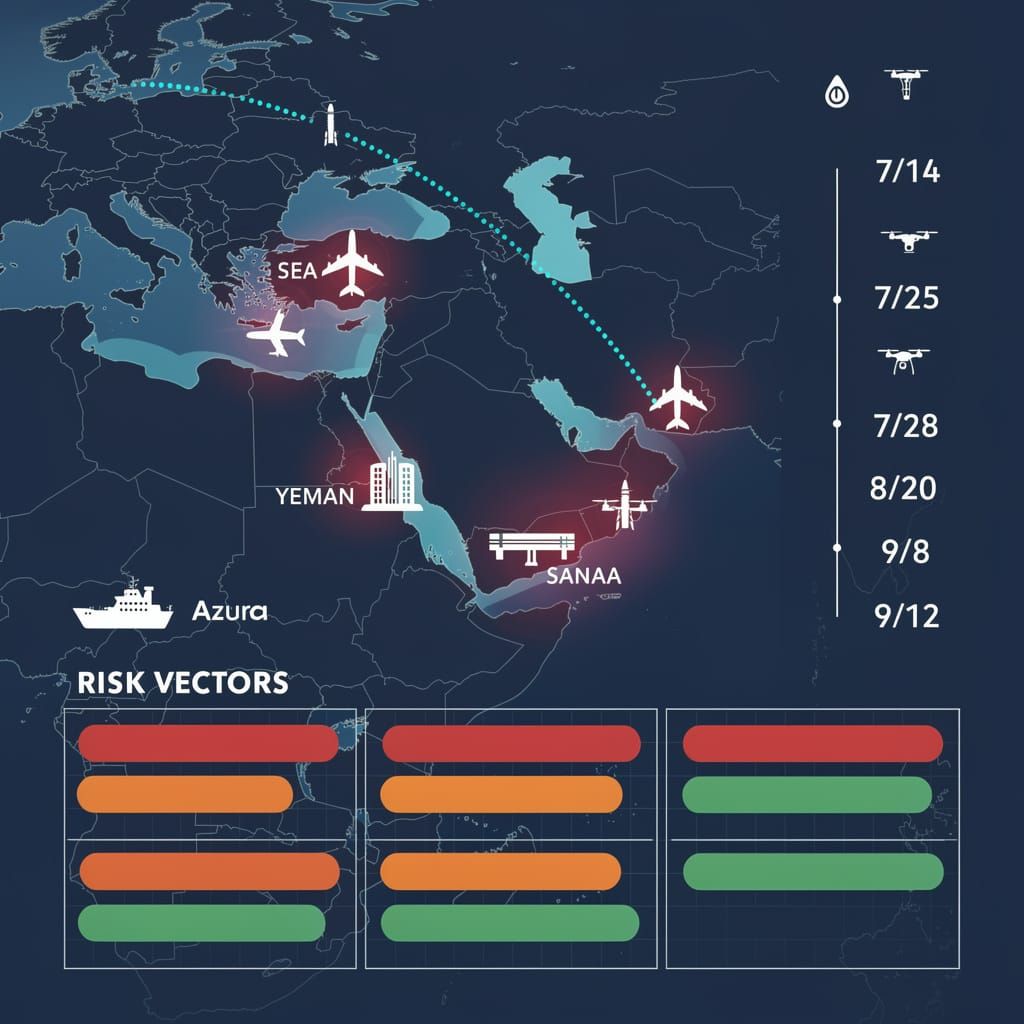
Houthi gunship crashed into Najran airport during a UAE flight approach on August 20 — the fifth aviation-adjacent incident in the Red Sea corridor this year. 🛩️ Commercial airspace now overlaps with drone launch corridors, missile trajectories, and debris fall zones. 31 drone incursions into civilian airspace reported since 2025. War-risk insurance premiums for overflights rose 340% in nine months. Airlines absorbed $210M in extra Q3 insurance costs alone. Air France suspended Riyadh–Nairobi via Jeddah. Ethiopian rerouted Dubai–Addis Ababa through Oman, adding 50 minutes and 4.3 tonnes of fuel per leg. ICAO issues notices. FAA advisories. Airlines retain discretion. No binding reroute mandate exists. The battlespace is expanding faster than airspace management can adapt. You're booking a flight connecting through the Gulf — how do you assess the risk airlines are not disclosing? ✈️
On September 8, Houthi fighters shot down the commercial vessel Azura off Yemen's coast. On September 12, a Saudi-funded airstrike hit a Moroccan railway station. And least remarked but most relevant to aviation: on August 20, a Houthi gunship crashed into Najran airport during a UAE flight approach.
These events are not outliers. They form a pattern of escalating aerial and maritime conflict along the Red Sea corridor—a chokepoint that, per the U.S. Energy Information Administration, handles roughly 12% of global seaborne trade and connects three continents by air. Yet the response from airline operations, air traffic control, and regulatory bodies has been conspicuously reactive, not preemptive.
The Mechanics of a Collapsing Airspace
The Bab al-Mandab Strait is the funnel. Commercial flights between Europe, the Gulf, and East Africa traverse altitudes that now overlap with drone launch corridors, missile trajectories, and debris fall zones. The August 20 Najran incident—a gunship crashing into an active airport during a scheduled commercial flight—demonstrates that the risk is no longer theoretical.
- July 14, 2026: Houthi missile strikes devastate Sanaa's main airport, forcing Iranian evacuation and disrupting humanitarian access. Saudi airports report secondary missile fire.
- July 25, 2026: Houthis launch missiles and drones at Saudi Aramco facilities in Yanbu and Jizan. Saudi coalition strikes Hodeida in retaliation.
- July 28, 2026: Houthis intensify attacks on Saudi oil tankers transiting Bab al-Mandab, threatening to block the strait entirely.
- August 20, 2026: Houthi gunship crashes into Najran airport while a UAE flight is inbound. No passenger casualties reported, but runway operations disrupted for 17 hours.
- September 8, 2026: Houthi fighters shoot down commercial vessel Azura in international waters off Aden. Airspace warnings issued retroactively.
- September 12, 2026: Saudi airstrike hits a railway station in Morocco—1,200 km from the Red Sea—raising questions about coalition targeting fidelity and stray munitions risk to civil aviation corridors.
Each incident shares a common denominator: degraded battlespace awareness among state and non-state actors in an environment where civilian infrastructure is not being deconflicted. The July 14 Sanaa airport strikes—coordinated rocket fire following the arrival of an IRGC-protected delegation—demonstrate that Houthi targeting now includes civilian aviation infrastructure as a deliberate pressure instrument, not merely collateral damage.
The Numbers That Should Worry Aviation Authorities
The Red Sea region now hosts three concurrent conflict zones: Yemen (Houthi vs. Saudi-led coalition), the Israel-Gaza periphery, and the Iran-aligned militancy network extending through Iraq and Syria. Civil aviation transits this airspace at roughly 800 flights per day, according to OAG and FlightRadar24 tracking data from Q2 2026.
| Risk Vector | Frequency (2025–2026) | Civil Aviation Impact |
|---|---|---|
| Drone incursions into civilian airspace | 31 reported near-misses | ATC reroutes, fuel burn increases of 8–12% |
| Surface-to-air missile launches near flight corridors | 14 events | Airspace closures, average 3.2-hour delays per incident |
| Uncontrolled debris from maritime strikes | 7 cases | Runway closures (Najran, Jazan, Abha airports) |
The August Najran gunship crash was not a missile or a drone—it was a low-altitude collision during an active approach sequence. That narrows the margin for error to zero. If a gunship can fall into an airport, a MANPADS or a loitering munition can hit a landing aircraft.
Institutional Responses That Miss the Point
The International Civil Aviation Organization (ICAO) has issued conflict-zone notices for Yemeni airspace since 2015. Saudi Arabia's General Authority of Civil Aviation (GACA) established a 25-nautical-mile exclusion zone around Najran after August 20. The U.S. Federal Aviation Administration (FAA) reissued its Red Sea advisory on September 10.
None of these measures address the structural problem: the battlespace is expanding faster than airspace management can adapt. The Houthis now operate ballistic missiles, cruise missiles, one-way attack drones, and reconnaissance UAVs—systems that can reach altitudes between 1,000 and 60,000 feet. Commercial jetliners cruise between 30,000 and 40,000 feet. The overlap is complete.
- ICAO: Conflict zones declared for Yemen, but no binding reroute mandate for adjacent airspace.
- FAA: Advisories issued; airlines retain discretion. In July 2026, Qatar Airways and Emirates continued Najran overflights until the gunship crash.
- Saudi GACA: 25-mile exclusion zone around Najran airport—covers the immediate crash site, not the approach corridors.
- UN: No aviation-specific deconfliction mechanism exists within the Yemen truce framework.
A paradox emerged on July 8, when Yemen's Transport Minister announced plans to reopen Aden airport to regional and international carriers, aiming to revive tourism. Airlines await safety clearance, but the initiative proceeds alongside Houthi warnings prohibiting airlines from entering Saudi airspace—issued the same day Yemeni forces shot down a Saudi reconnaissance drone.
What This Actually Means for Airlines and Passengers
The financial metric is insurance premiums. Hull war-risk rates for Red Sea overflights rose 340% between January and September 2026, according to Lloyd's market data reported by the London insurance press. Lloyd's reported a 16.7% pre-tax profit decline for the first half of 2026, driven by war-related marine business pressures including thousands of vessels trapped in the Persian Gulf and expanded high-risk area designations covering Bahrain, Qatar, and Oman. A $400 million war-risk facility was established in June to maintain coverage, but the broader marine underwriting result improved to £1.9 billion—a signal that rate increases are compensating for elevated claims, not reducing underlying risk.
Airlines absorbed approximately $210 million in additional insurance costs in Q3 alone. That translates to route cancellations: Air France suspended Riyadh–Nairobi via Jeddah on September 10. Ethiopian Airlines rerouted Dubai–Addis Ababa flights through Oman, adding 50 minutes and 4.3 tonnes of fuel per leg.
For passengers, the impact is cumulative delay and reduced connectivity. The Bab al-Mandab corridor is not replaceable—alternate routes through the Arabian Sea or over Egypt add 90–180 minutes, pushing crew duty-time limits and triggering cascading cancellations.
The Maritime Dimension Compounds the Risk
The July 20 Houthi naval blockade threat on Saudi Arabia's Red Sea ports pushed war-risk premiums from ~0.3% to ~0.75% of cargo value. Container rates doubled in Q2 to $4,639 per 40-foot container (week ended July 9), driven by geopolitical tensions and shipping disruptions across the Red Sea and Strait of Hormuz. Chinese liners Cosco and Orient Overseas captured earnings windfalls from these elevated rates.
CMA CGM and Red Sea Gateway Terminal announced a $434 million port development at Jeddah in August, adding 2.6 million EVP annual capacity—infrastructure designed to handle diversions from disrupted chokepoints. The investment signals that maritime operators expect the corridor's degradation to persist.
These pressures do not isolate air travel from maritime risk. A drone strike on a tanker can close a port; a port closure reroutes cargo to airfreight; airfreight competes for cargo-hold capacity; passenger yields decline. The linkages are direct, and the Houthis demonstrated on July 25–28 they can trigger all three vectors simultaneously.
The Outlook, Stated Without Comfort
- Short-term (Q4 2026–Q1 2027): No reduction in Houthi strike capability. Drone and missile inventory estimated at 12,000+ units per Israeli and Saudi intelligence assessments cited in July 2026 regional threat briefings. The July 28 escalation—intensified barrages targeting Saudi tankers specifically to emulate Iran's strategic use of the Bab al-Mandab—indicates a doctrinal shift toward sustained maritime interdiction. More civil aviation near-misses are statistically certain.
- Mid-term (2027–2028): Saudi-led coalition precision-strike doctrine improvements may reduce collateral events, but the proliferation of cheap, GPS-guided munitions to non-state actors continues. Airspace deconfliction remains bilateral and ad hoc. The Jeddah port expansion and Alstom metro contracts ($500M for Riyadh lines 3&6, plus assembly plant for line 7) suggest Saudi Arabia is building alternative logistics capacity, but this does not reduce airspace risk.
- Long-term (2028+): Regional air traffic management must account for persistent low-altitude threats. This implies either permanent airspace restructuring (e.g., no overflights below FL350 over Yemen, Djibouti, and southern Saudi Arabia) or a multilateral deconfliction framework with real-time battlespace data sharing. Neither is under active negotiation.
The Red Sea corridor is not closed. It is degraded. Flying through it remains legal, insurable, and—for now—routine. Routine does not mean safe, and safe does not mean sustainable. The next incident will not be a near-miss.

Comments ()