✈️🔻 Airbus Spain workers walked off as profits surged
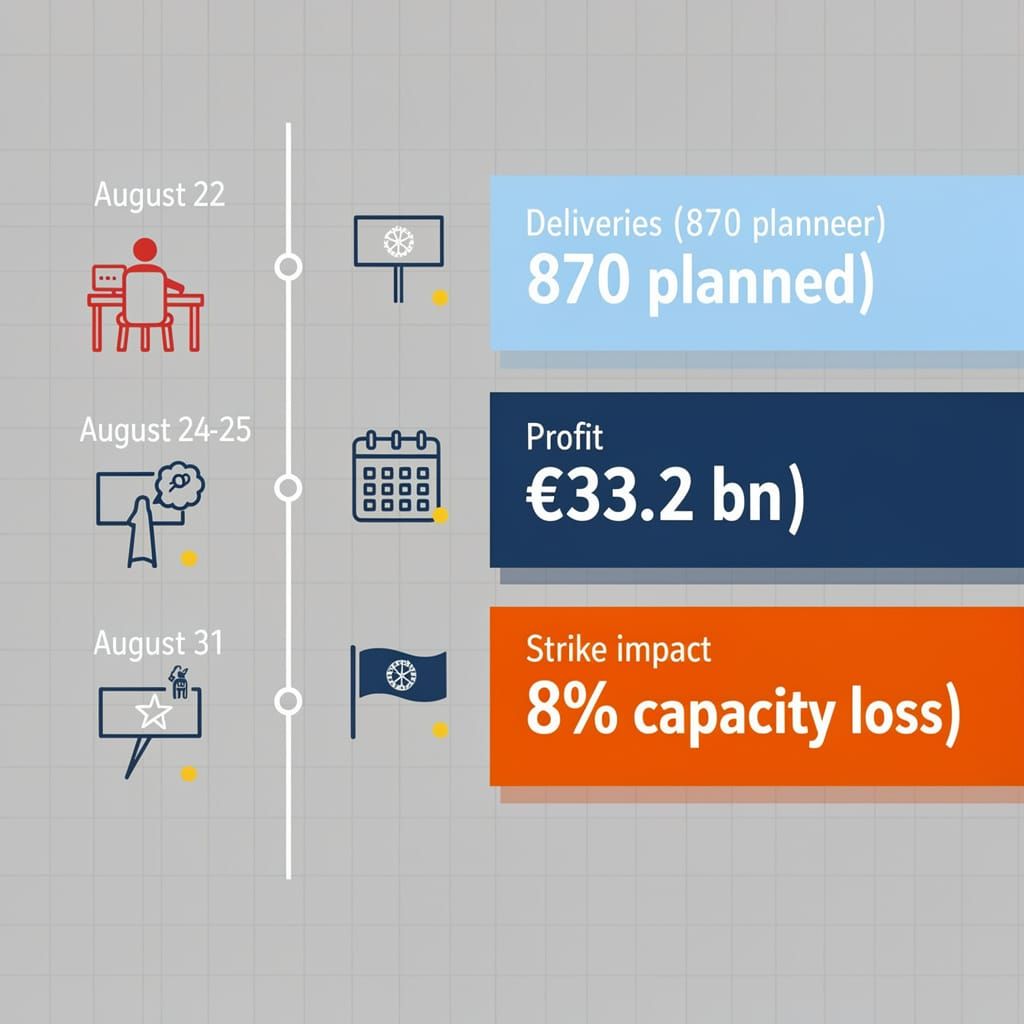
Airbus hit €33.2B revenue and 54% EBIT growth, yet 14,045 workers walked off for 34 days over telework cuts and insufficient wage offers. ✈️🔻 A €5B buyback was announced July 22. The strike didn't start until August 22. The gap between profit and pay policy isn't a union issue—it's management signaling. Airbus Spain will normalize production by Oct 2026, but Q3 took a 5–7% revenue hit and the wage-indexation gap remains unresolved. Next trigger, same conditions. Are Spanish aerospace workers getting a fair share of the recovery—or is this a permanent structural mismatch?
The numbers look straightforward until they aren't. Airbus reported €33.2 billion in consolidated revenue for the second quarter of 2026—a 12% year-over-year gain. Net profit rose 47% to €2.2 billion. On July 29, the company announced 870 planned deliveries for the year, exceeding the 2019 peak. On August 22, 14,045 workers at seven Spanish sites walked off the job indefinitely. The trigger: management proposed reducing telework and offered wage adjustments that unions calculated as insufficient after workers had already absorbed two years of inflation-eroded purchasing power.
The sequence demands attention.
- August 22: Strike notice filed. CGT, UGT, and CCOO majorities back a 34-day indefinite shutdown across Madrid, Getafe, Illescas, Albacete, Cádiz, Sevilla, and Tablada.
- August 24–25: CGT and UGT skip SIIMA mediation. Strike begins.
- August 28: Airbus Spain president Carmen Maja warns of "operational cuts" if the strike persists. Workers vote to continue.
- August 31: Minister of Industry Jordi Hereu announces a "principle agreement" that excludes CGT and UGT signatories.
That last point is where the narrative frays. Airbus hit 351 deliveries in the first half of 2026—a 40% increase year-over-year that lifted adjusted EBIT to €2.43 billion, up 54%. The company is on track to deliver 870 aircraft for the full year. Yet the same management that oversaw that surge could not preempt a labor dispute that cost production days. The partial agreement arrived only after workers walked, and unions rejected it by an 80%+ margin. That sequencing transforms a procedural disagreement into a credibility breach.
What the strike actually demonstrates
| Factor | Direct Impact |
|---|---|
| Production holds | Up to 8% quarterly capacity loss across Airbus Spain assembly lines |
| Delivery risk | 870 planned 2026 deliveries threatened; August saw just 57 deliveries, requiring ~99/month for the final four months |
| Regulatory scrutiny | Spanish Ministry oversight committee now embedded at Airbus HR |
| Brand erosion | Recurring labor conflict signals structural misalignment between profit growth and wage policy |
Management's proposed remedy—a 7.6% raise through 2030, a €2,000 bonus starting 2027, and reduced canteen tariffs—reads as a concession. But even after that offer, the strike continued because workers had already voted indefinitely. The gap between corporate profitability and wage stagnation provided the structural precondition. The telework reduction notification acted as the proximate trigger.
What the partial settlement masks
The September 12 referendum likely ratifies the deal. CGT and UGT will negotiate separately. But the agreement's architecture—Minister Hereu's direct involvement, the exclusion of dissenting unions—institutionalizes a two-tier resolution that neither addresses the purchasing-power erosion nor establishes a forward-looking wage indexation mechanism. Over 6,000 of the 14,000 site employees remain actively striking, and the previous 12% two-year raise was rejected before the walkout began.
Why the strike should not have happened
The EBIT number answers that question directly. Adjusted operating profit rose 54% on a delivery surge that pulled Airbus ahead of Boeing in market share. The company announced a €5 billion share buyback on July 22, targeting €12–13 billion profit by 2029. Yet wage adjustments required a strike to materialize. That is not a union provocation problem. It is a management signaling problem—one that will surface again when the next labor cycle begins, even without a telework trigger.
The forecast is unremarkable
Production normalizes by October 2026. The Q3 financials will show a 5–7% quarterly revenue dip at Airbus Spain, partially offset by inventory drawdown at Hamburg and Toulouse. The reputational damage registers in delayed deliveries for 2027 narrowbody slots. The structural problem—profit growth outpacing wage growth without a clear recalibration—remains unresolved. The next strike will require a different trigger, but the conditions will still be there.


Comments ()