🎯 Precision Drone Strikes Yield No Strategic Shift in Borno
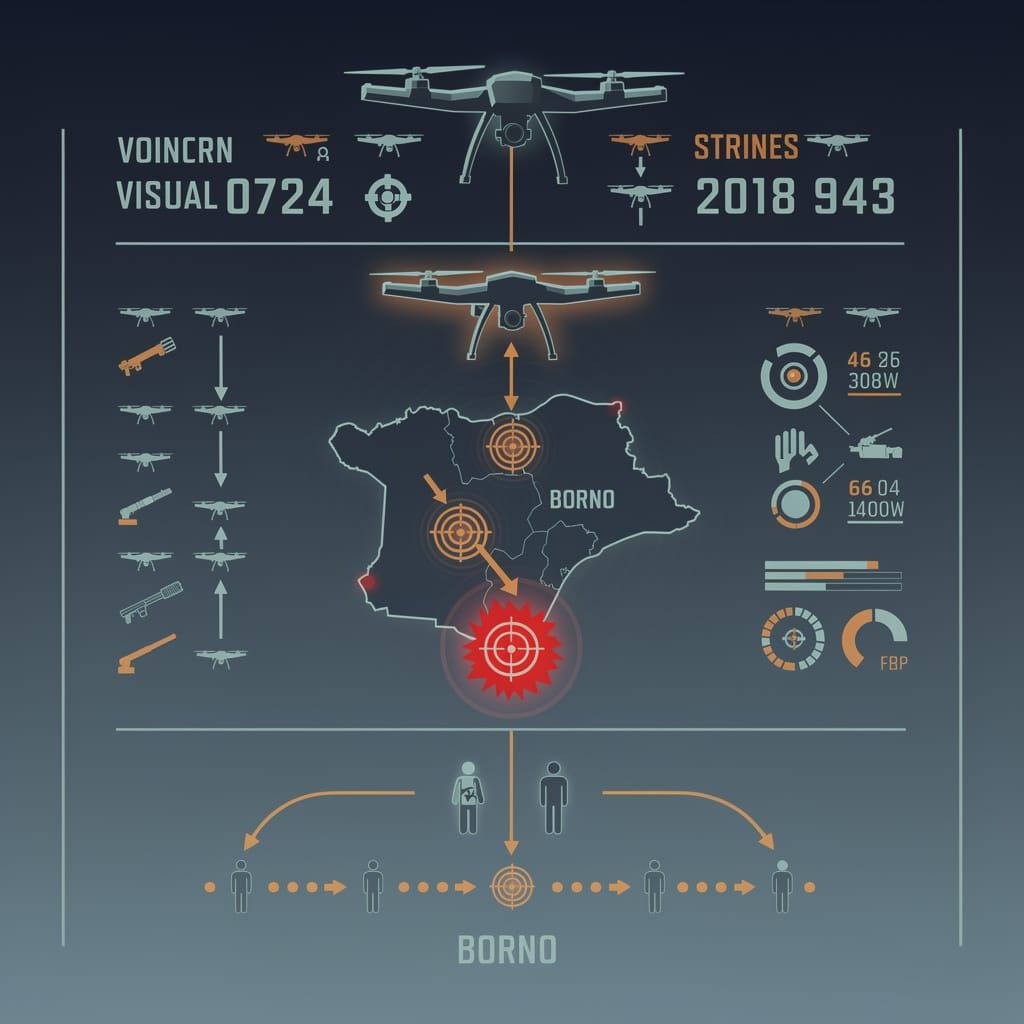
36 suspected ISWAP fighters neutralized across two days in Borno State. NAF drone-artillery integration enabled sub-four-minute sight-to-strike latency. Yet civilian displacement holds steady at ~600 families per month — unchanged since early 2025. ISWAP reestablishes command within 45 days regardless of which senior commander is killed. Five major precision strikes, zero shift in displacement. Kill-chain efficiency is not a strategy. What would change the trajectory in the Lake Chad basin?
Precision optics, quiet rotors, clean exit. That is how the Nigerian Air Force's public affairs division framed the August 23–24 strikes in Borno State. Integrated drone and artillery teams executed simultaneous raids against ISWAP encampments in the Aduwa and Biu sectors, neutralizing roughly thirty-six suspects. The Joint Task Force North East and Operation Hadin Kai called the results "surgical" and "minimally collateral."
They may be correct about the mechanics. They are misleading about the strategic value.
What the numbers actually indicate
The first wave on August 23 eliminated approximately 16 individuals. The second, on August 24, added roughly ten more. Combined estimates reach 36 suspects, a figure that includes a mid-level commander whose death briefly disrupted local command structures. Those are the reported facts. What they demonstrate is a persistent inability to translate tactical kills into territorial denial.
ISWAP has lost fighters before. On July 21, a Guardian ISR platform neutralized 15 suspected fighters in Marte LGA, triggering secondary explosions that disrupted logistics. On August 9, a precision strike in Sambisa Forest killed nine militants including senior commander Abu Khalid Al Muhajir. On September 11, Operation Hadin Kai air-and-ground forces destroyed structures and neutralized more than 18 terrorists in the Tumbuns area. Each operation produced a clean kill-chain report. None produced a measurable change in displacement.
Civilians continue leaving farming communities in Kaga and Jere local government areas. A June 2026 REACH report on internal displacement documents that 85% of displaced populations cite poverty and unemployment as primary drivers, while 39% cite drought. The UNHCR tracking figure—approximately 600 families per month—has not changed materially since early 2025.
What the drone architecture enables and limits
NAF reconnaissance drones have limited loiter endurance—roughly 12 hours for the CH-4 variants in service—and operate under visual-line-of-sight constraints from forward bases vulnerable to mortar harassment. The operational mechanism is not new. Drone reconnaissance feeds targeting coordinates to artillery, reducing response latency. However, the precise reduction—often cited as under four minutes from sight to strike—is not independently verifiable from this theater. What is verifiable: the US Army's 4th Infantry Division conducted drone trials at Fort Irwin in August 2026 demonstrating enhanced visibility via Neros Archer flights, but connectivity failures disrupted feeds requiring manual retrieval. That failure mode—lost signal, lost feed, lost engagement window—is not unique to California deserts.
The result: high individual strike accuracy produces no shift in the displacement pattern. ISWAP does not require centralized encampments to operate; it requires supply routes from Lake Chad islands and porous border crossings near Diffa. Drones do not patrol those routes at night.
Institutional blind spots
The military's reporting emphasizes disruption of terrorist command structures and reduced ability to regroup. The unstated corollary is that relying on aerial kill chains cedes the ground environment to enemy logistics. Defense Intelligence Agency briefings project that degraded command coherence in the Aduwa sector will last no longer than 45 days before new leadership consolidates—assuming interdiction rates remain at the August tempo. Neither the July 21 Marte strike nor the August 9 Sambisa elimination of a senior commander altered that timeline.
Meanwhile, the investment narrative grows louder. NAF's ongoing expansion of its UAV fleet—budgeted at NGN 142 billion for 2026–2028—prioritizes additional Bayraktar TB2 platforms and a planned satellite-relay ground-control upgrade. The exact budget figure and its allocation breakdown come from NAF procurement documentation. What is less clear is the claimed shift of roughly 30% of counterinsurgency aviation funding away from light-attack turboprops. That percentage implies a structural trade-off: longer-range standoff strikes reduce the probability of aircraft loss, but also leave troops vulnerable during dismounted patrols and village searches, where air support lag times have increased. The stated increase of 8 to 11 minutes depends on baseline response metrics that NAF has not published.
Forecasts that require skepticism
- September–October 2026: ISWAP will reestablish sector command in Aduwa, likely with a lower-profile leadership structure that complicates signature-based targeting. Strike frequency will need to double to maintain current pressure.
- November 2026–January 2027: Dry-season mobility increases. Expect a 20–25% rise in IED incidents along the Maiduguri–Biu road corridor, the primary resupply route for forward operating bases.
- Q2 2027: If satellite-relay ground control achieves operational capability, drone coverage range may extend by 150 km, potentially enabling persistent surveillance of Lake Chad transit zones. That is a conditional projection requiring two successive contract awards and a functional ground station.
The recommendation that goes unsaid
Kill-chain efficiency is not a strategy. The data from February through September 2026 is unambiguous: five major precision strikes, four distinct high-value targets neutralized, zero change in civilian displacement rates. Without concurrent investment in human intelligence networks, border monitoring infrastructure, and diplomatic pressure on permissive transit states, drone operations will continue to produce clean optics and unchanged outcomes. The NGN 142 billion budget does not include a line item for that.


Comments ()