✈️ Pentagon Logs $7B Aircraft Loss in Iran After F-15E Shootdown
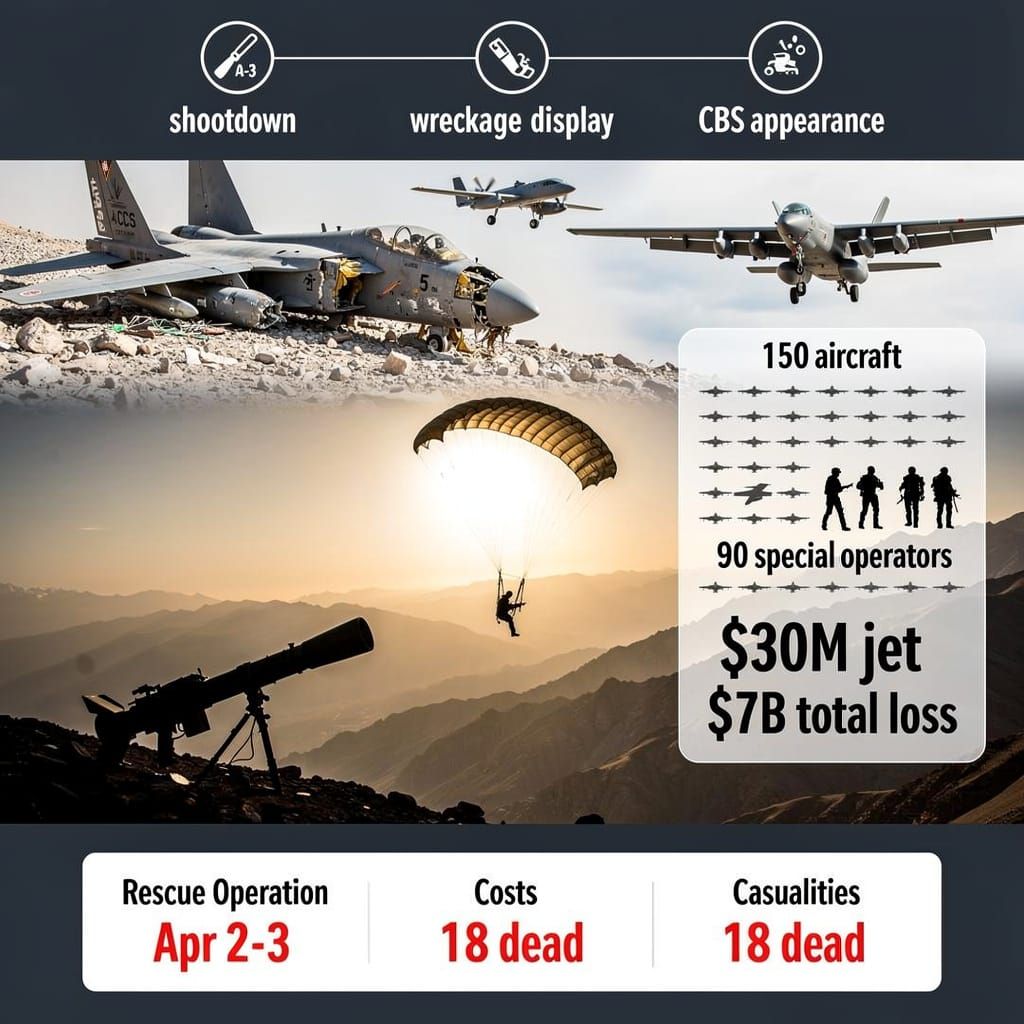
$7B to replace 42 aircraft lost in Iran — a squadron per week for six weeks ✈️ One shoulder-fired missile triggered a 150-plane rescue inside Iranian borders. 138 new F-15Es are ordered but delays cap delivery at six. Could your region's budget cover that?
A single shoulder-fired missile, fired from Iranian positions south of Isfahan, ended the air career of a $30 million F-15E Strike Eagle and exposed how much ground truth changes when a fighter jet drops into hostile terrain.
The shootdown, logged April 2–3, 2026, marks the first loss of a U.S. fighter jet over enemy territory in more than two decades. Iran displayed the recovered wreckage—confirmed as DUDE 44, tail 00-3000—on August 7, 2026, highlighting ACES II ejector seats alongside multiple MQ-9 and MQ-1 Reaper platforms, a move that reads less like a trophy display than a capture intent.
The August 18 Pentagon review of Persian Gulf footprints, which logged the loss of 45 MQ-9 Reaper drones—about a quarter of that fleet—reinforces how quickly a single incident compounds into systemic exposure.
What Actually Happened
The mission profile reads straightforward on paper: a four-ship strike package targeting an Iranian industrial facility tied to the drone and missile program.
One of the F-15Es, callsign DUDE 44, took a hit from an Iranian man-portable missile. Pilot “Alpha” and weapons systems officer “Bravo” ejected. The parachute on Bravo’s side was damaged, sending him into a 70–100 mph free-fall through mountainous terrain.
He landed with a broken back, a broken arm, a broken shoulder, a sprained ankle, and head and face lacerations. Alpha was recovered within six hours; Bravo stayed hidden for roughly 48 hours.
The rescue that followed scaled quickly. U.S. forces committed more than 150 aircraft in the second-phase surge alone:
- 64 fighters
- 4 bombers
- 48 tankers
- 13 dedicated rescue platforms
- 26 ISR assets
More than 90 special operators went to ground inside Iranian borders; hundreds of additional personnel supported the air operation.
Two MC-130J Commando II transports—$200 million combined—were destroyed to prevent capture. The loss was corroborated by the May 22 Pentagon damage report, which logged 13 service members killed and 381 injured across the same operation. A-10 Thunderbolt II aircraft and an MH-6 Little Bird were hit during recovery flights.
The Scale Question
Defenders of the operation point to the successful extraction of both crew members. Critics press on the price tag: two downed F-15Es, two MC-130Js, multiple helicopters, and 339 munitions spent in a single retrieval window.
The Pentagon framed the mission as the first major U.S. ground insertion into Iran since 1968—a 46-year gap that, in its own words, signals a materially changed risk environment.
The broader Operation Epic Fury tally has climbed to 42 aircraft lost, with a $7 billion replacement cost. The FY2027 budget approved expansion of the F-15EX fleet from 129 to 267 units, but the September Pentagon report now projects production delays that cap Lot Three at roughly six airframes by year-end and push Lot Four further out, with per-unit costs exceeding $94 million.
What Still Needs Explaining
Three gaps persist.
First, the initial four-ship strike lost one airframe to a shoulder-fired weapon during what the service characterized as a nighttime operation, raising questions about Iran’s short-range air-defense positioning and U.S. electronic-warfare coverage.
Second, Alpha declined a public interview, citing security concerns, while Bravo agreed. The asymmetry complicates any single-narrative account.
Third, Bravo’s own description—a “modern-day miracle”—reads less like a technical assessment than a survival story. The Air Force has not released the wreckage forensics that would confirm whether the parachute failure was a manufacturing defect or a battle-damage casualty.
Meanwhile, the August 19 casualty disclosure—18 confirmed dead and 430 injured—undermines the neat damage-report arithmetic the Pentagon preferred in May.
Until those records surface, the operation stands as a successful rescue wearing a costly warning label.
Timeline
- April 2–3, 2026: F-15E DUDE 44 is shot down south of Isfahan; the crew ejects.
- April 3, 2026: Alpha is rescued within six hours; Bravo remains isolated for approximately 48 hours.
- April 4, 2026: The surge begins, involving more than 150 aircraft and more than 90 ground operators inside Iran; two MC-130Js are destroyed.
- August 7, 2026: Iran displays DUDE 44 wreckage, tail 00-3000, alongside MQ-9 and MQ-1 remains.
- September 13, 2026: Bravo makes his first public appearance via CBS’s 60 Minutes.
Comments ()