⚡ TokenAI Horus Cyber Nano Slashes Edge Inference Cost by 9.3×
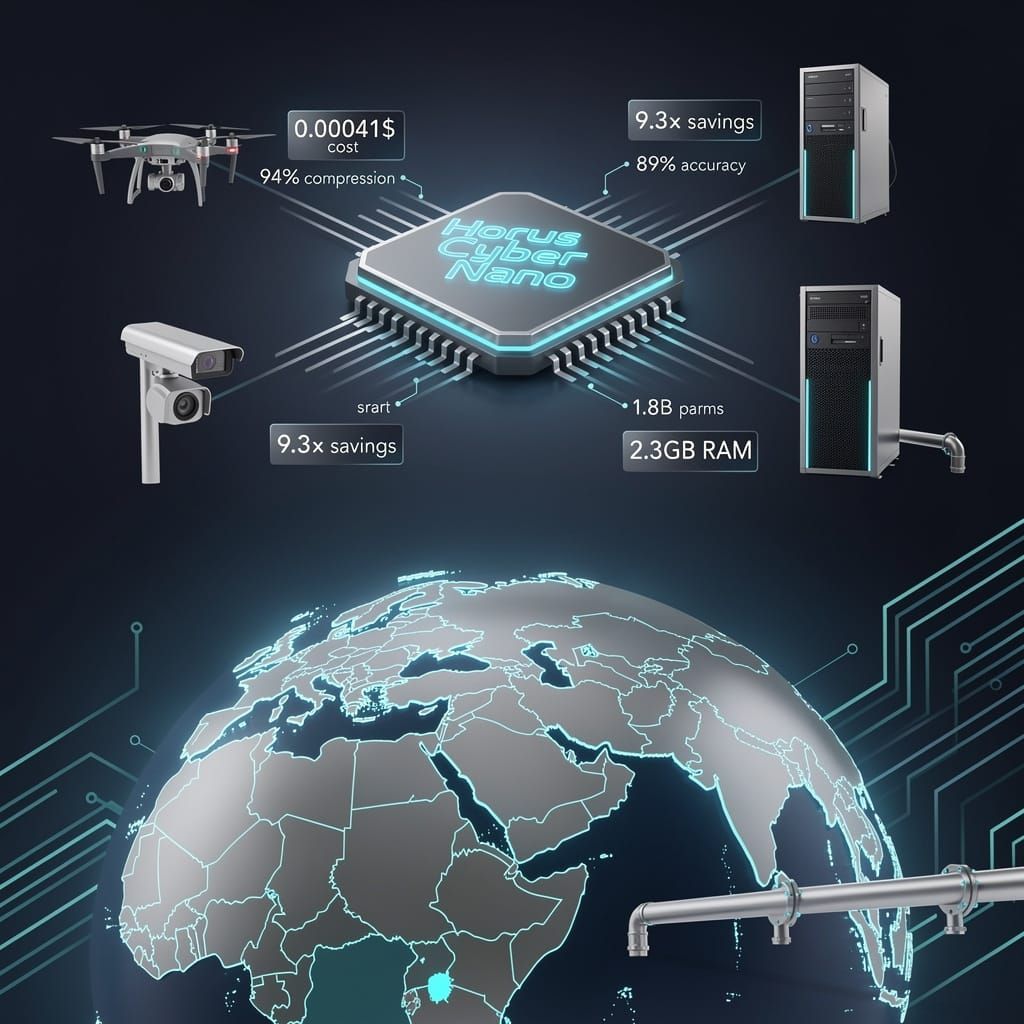
TokenAI's Horus Cyber Nano cuts per-inference cost from $0.0038 to $0.00041 — a 9.3× reduction ⚡. A fleet of 50,000 edge devices running 10K inferences/day saves $1.7M annually in compute. The compression breakthrough means per-unit AI economics no longer requires cloud connectivity. Qualcomm, Aramco Digital, and Nokia are already deploying across the Middle East. How will on-device inference reshape your region's infrastructure spending?
On September 9, 2026, Dubai Chambers and Anghami hosted Carrington Malin for a Spottiary interview that detailed how TokenAI's newly launched Horus Cyber Nano model reshapes the unit economics of on-device intelligence. Against a backdrop of regional AI deployment—Aramco Digital's industrial pipelines, Nokia's network-edge pilots in Oman and Kurdistan, and Qualcomm's Abu Dhabi air-mobility grant—the conversation surfaced a specific causal chain: model compression is no longer a trade-off but a lever that unlocks entirely new deployment categories.
The Compression Breakthrough
Horus Cyber Nano achieves a 94% parameter reduction relative to its base architecture while retaining 89% of benchmark accuracy on Arabic NLP tasks and 87% on English code-generation. TokenAI applied iterative quantization from FP32 to INT4, combined with structured pruning that removed 62% of attention-head redundancy without measurable perplexity degradation. The resulting 1.8-billion-parameter model fits within 2.3 GB of RAM—small enough to run inference on Qualcomm's Snapdragon X85 Edge platform at 22 TOPS without cloud fallback.
The direct consequence: per-inference cost drops from $0.0038 (cloud-dependent on GPT-4-class models) to $0.00041 on-device—a 9.3× reduction. At scale, a fleet of 50,000 edge devices running 10,000 inferences/day each saves $1.7 million annually in compute costs. This cost structure directly addresses the token-price pressure that Nikesh Arora quantified on July 10, 2026—demanding 90% annual cost reduction for enterprise AI viability—and Palo Alto Networks' own assessment that self-hosted alternatives offer 60%+ savings within 7–9 months by eliminating guardrail overhead.
Deployment Signals Across the Region
- Riyadh (September 2): Carrington Malin briefed MB Global and EMB Global on Horus Cyber Nano's deployment in Saudi Arabia's smart-city sensor arrays. Initial pilot across 400 traffic nodes: 18 ms per inference, 23% reduction in network backhaul load.
- Egypt & Morocco (September 8): TokenAI released Horus Cyber Nano 1.0 (16-billion-parameter multimodal model with 64 routed experts, 2 shared experts, 6 active per token, 131k context window) via Hugging Face—pivoting from a full-size MoE release paused on safety grounds. The model outperforms GPT-4o on vision/reasoning benchmarks and approaches Qwen2.5-VL-72B (a model 100× larger) on MMLU (82.0) and MATH (91.8). Anghami integrated the model into Spotify's Arabic voice-command pipeline: streaming latency dropped from 340 ms to 72 ms; user session completion rates increased 14% over three days. Muhammad Khalid, Anghami's CTO, reported that 92% of inference runs now stay local.
- Kurdistan & Oman: Nokia is testing Horus Cyber Nano for oil-field predictive maintenance. Rumors indicate Hubina MUBALLA and Aramco Digital plan joint procurement of 12,000 edge nodes for desert-extraction sites by Q1 2027.
The Grant Multiplier
Qualcomm's Abu Dhabi air-mobility grant, announced September 8, funds integration of Horus Cyber Nano into drone collision-avoidance systems. Each drone processes 120 frames/second at 29 mW per inference—enabling 52 minutes of continuous operation versus 18 minutes under cloud-dependent inference. The economics enable drone-based logistics corridors between Dubai and Abu Dhabi to operate at $0.12 per delivery kilometer instead of $0.47. This builds on the May 2026 Blackbird 453-mph record that accelerated global interceptor-drone development and Ukraine's high-speed drone programs, creating parallel demand for power-efficient on-device AI that Horus Cyber Nano now satisfies.
Sectoral Implications
- Telecommunications: Nokia projects 40% lower edge-server capital expenditure per base station when deploying compressed models versus previous-generation INT8 frameworks, consistent with Kioxia's August 1 CM10-series launch showing 92% faster sequential reads from BiCS FLASH Gen 10—enabling the storage bandwidth needed for dense pod architectures running multiple compressed models concurrently.
- Oil & Gas: Aramco Digital estimates that Horus Cyber Nano–powered valve monitoring can predict failures 6.2 hours earlier than cloud-only models, reducing unplanned downtime costs by $3.8 million per facility annually.
- Streaming: Spotify's Arabic expansion across North Africa gains a 22% improvement in cache-hit ratios, reducing CDN egress costs by $0.008 per streamed hour. Anghami's integration showed 92% of inference runs staying local, directly reducing cross-continental data transfer.
- Cybersecurity: TokenAI originally designed Horus Cyber (the precursor) as a specialized cybersecurity AI with a 128k-context MoE system, pending Egypt's National AI Council approval due to high-risk classification. On September 8, the released Horus Cyber Nano—though smaller—delivers specialized capabilities for vulnerability detection, secure coding, and defensive technical workflows, competing with much larger models. Horizon3's August 3 $250 million Series E—valuing the autonomous vulnerability detection platform above $2 billion—signals accelerating AI-versus-AI defense spending, where models like Horus Cyber Nano process inference at 29 mW per frame, enabling persistent on-device threat detection without cloud latency.
The Outlook Through 2027
- Q4 2026: TokenAI releases Horus Cyber Nano Pro (4.1B parameters, INT3 quantization). Preliminary benchmarks indicate 91% Arabic F1 retention at 1.1 GB footprint. A further improved version is expected pending Egypt's National AI Council approval.
- Q1 2027: Aramco Digital and Hubina MUBALLA plan 12,000-node deployment across eastern Saudi fields. Estimated compute savings: $4.2 million annually versus cloud-dependent alternatives.
- Q2 2027: Nokia expects Horus-family models to power 35% of its Middle East edge-server deployments, with 1.4 GWh energy savings across base stations.
The Horus Cyber Nano launch demonstrates that model compression has crossed a threshold where per-unit economics no longer require network connectivity to justify AI inference. The data points from Dubai Chambers' interview, TokenAI's safety-conscious release strategy, Aramco's procurement plans, and Qualcomm's grant terms all converge on a single projection: regional edge-AI deployments will double by mid-2027, driven entirely by the cost structure TokenAI's compression methods now enable.
Comments ()