⚖️ 86% Deploy AI Agents, 13% Understand Sovereign AI
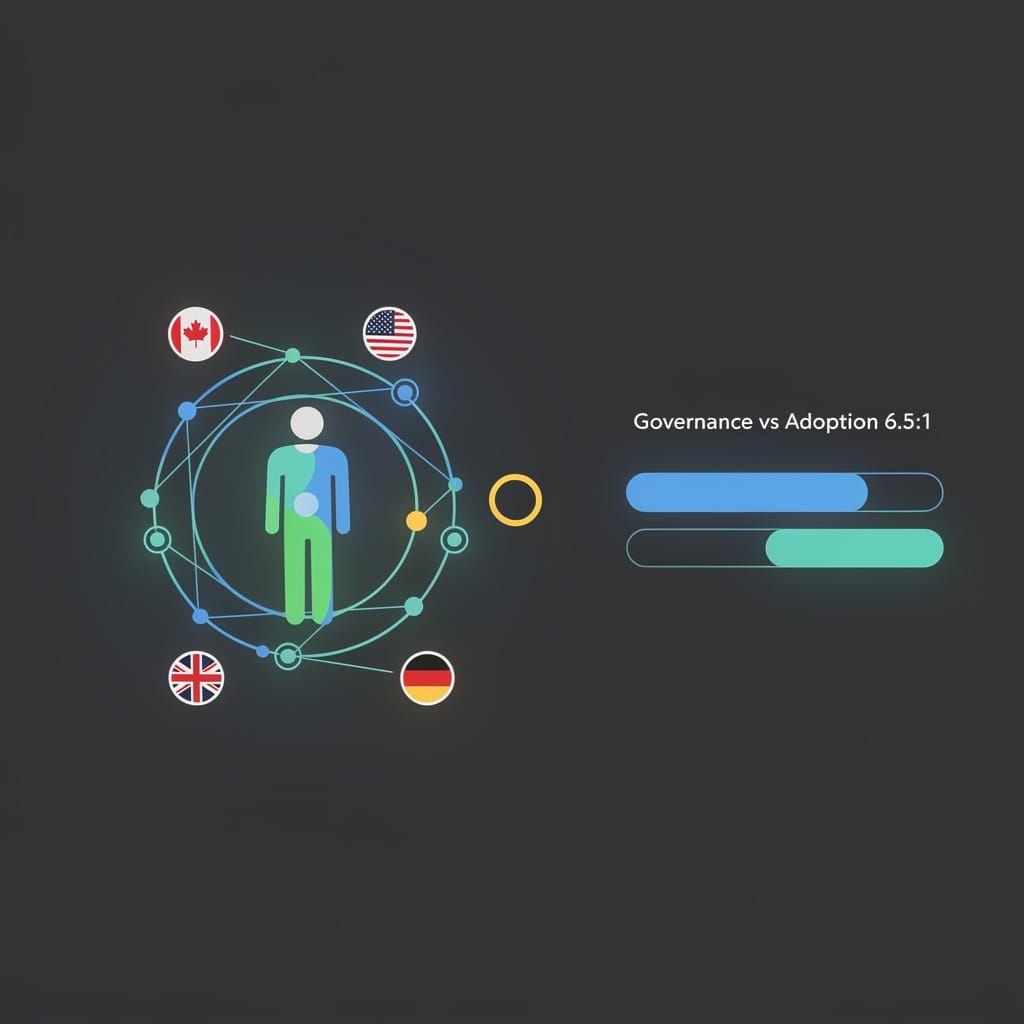
13% of IT leaders fully grasp sovereign AI — yet 86% have already deployed embedded agents into production. That's ~73 out of every 100 organizations running autonomous AI without clarity on data ownership, inference jurisdiction, or legal accountability. Canada lags at 10% comprehension; the US sits at 28%. With GDPR, PIPEDA, and BDSG compliance deadlines looming by October 2026, the gap between deployment and governance is now a liability timer. Is your organization counting its agents before regulators do?
A September 8, 2026 survey of IT leadership across Canada, the United States, the United Kingdom, and Germany reveals a striking disconnect: 13% of decision-makers demonstrate full comprehension of sovereign AI principles, yet 86% have already deployed embedded AI agents into production environments. Among all respondents, 99% report using generative AI.
The data, drawn from an IDC study of 508 IT and business decision-makers across four countries, indicates that organizational adoption of autonomous AI systems has outpaced governance frameworks by a ratio of roughly 6.5 to 1. Each deployed agent creates what analysts describe as an accountability niche—a decision-making space where responsibility for outputs, data handling, and compliance remains undefined.
The Ownership Gap
13%: IT leaders who can define sovereign AI—systems where data, models, and inference remain under jurisdictional control rather than external vendor infrastructure. One-third of surveyed IT leaders struggled to describe the concept at all. Only 12% said sovereign AI risks are widely understood in their organizations.
86%: Organizations actively running embedded agents—autonomous software components that process data, trigger actions, and interface with enterprise systems without real-time human supervision.
The arithmetic produces a governance vacuum: roughly 73 of every 100 organizations operate agents without the foundational understanding of who owns the data, where inference occurs, or which legal frameworks govern model behavior.
Canada recorded the lowest sovereign AI awareness (10% high comprehension, 89% low) compared to the US (28%) and Germany (23%). Across all regions, 35% of Canadian respondents cited competitive advantage as the primary driver for pursuing sovereign AI—suggesting market pressure, not regulatory clarity, is the dominant motivator.
Regional Divergence and Emerging Alternatives
Hong Kong's Votee AI demonstrated a localized model expansion on September 4, 2026, positioning its infrastructure as an alternative to cloud-based providers that route data through jurisdictions outside user control. The move follows parallel developments in Indonesia (Indosat's Arabic-language model deployment) and across Africa, where orthopedic-specialized AI projects run on regionally hosted infrastructure.
These projects share a common structural logic: independence from the five dominant cloud suppliers that collectively control approximately 72% of global AI inference capacity—a figure derived from the $600–700 billion in AI infrastructure capital expenditure projected for 2026, with JPMorgan confirming $5.5 trillion in AI-related capex through 2030.
New infrastructure models reinforce this shift. Neoclouds like Crusoe deploy AI-first, purpose-built architectures using disaggregated shared-everything (DASE) designs, while Cisco's Secure AI Factory partnership with Nvidia delivers rack-scale, liquid-cooled data centers for enterprises that cannot upload IP to public frontier models. On May 28, 2026, IBM launched the Cloud Sovereignty Risk Profile tool and KYOK encryption, providing granular visibility into AI workloads and compliance verification, targeting enterprises amid rising demand for data transparency.
Where Responsibility Falls Through
The embedded agent deployment rate at 86% introduces a cascading accountability problem:
Data provenance: Each agent accesses, transforms, and potentially transmits data. Without sovereign AI controls, 100% of that data may traverse jurisdictions where legal protections differ from the originating country.
Decision traceability: Agents acting on inference outputs create audit trails that conventional logging tools do not capture. In July 2026, 77% of U.S.-based organizations reported AI deployment exceeding governance capacity, with documented control failures and audit deficiencies surfacing across finance, healthcare, and logistics sectors.
Compliance exposure: Organizations under GDPR, Canada's PIPEDA, or Germany's BDSG face escalating risk. An agent that processes personal data on non-sovereign infrastructure violates data localization requirements—even if the operator never intended cross-border transfer.
A June 2026 CIO survey of 662 IT leaders and 249 department heads found that only 19% met their AI goals, with unclear ROI metrics identified as the primary barrier. Further, 41% of enterprises lack unified AI governance oversight protocols, amplifying the risk that ungoverned agents operate outside compliance boundaries. Gartner's 2026 Hype Cycle projects that 40% of Fortune 1000 organizations will experience loss of AI agent control by 2028.
The Regulatory Clock
Adoption of sovereign AI principles is becoming a procurement-line item. IBM's May 2026 announcement of Sovereign Core extended the definition of digital sovereignty beyond data residency, designed to reduce deployment timelines for agentic AI systems. Red Hat simultaneously expanded on-premise and regional deployment options to meet regulatory compliance needs. Regulated-sector leaders—banking, healthcare, critical infrastructure—have initiated compliance transitions scheduled for completion by October 2026. For the 73% of organizations that deploy agents without understanding sovereignty, the timeline compresses options:
- Immediate: Conduct agent inventory and map data flows. Most organizations underestimate embedded agent count by a factor of 3× to 5×.
- 30–60 days: Align procurement contracts with jurisdictional data control requirements. Vendor lock-in reversal becomes exponentially more expensive after 90 days.
- By October 2026: Full sovereignty compliance for regulated entities. Non-compliant agents must be decommissioned or migrated.
The Opportunity in the Gap
Market volatility—driven by tariff realignments, semiconductor supply constraints (the Core Ultra 7 270K Plus rose from $299 to $349 in July 2026, while Intel maintains a dual-track strategy with Nova Lake CPUs for desktops), and shifting AI export controls—creates openings for regional providers. IBM's $240 million partnership with Together AI (August 2026) deploys an open-source inference cluster on Nvidia HGX B300 hardware, demonstrating that sovereignty is commercially viable. The neocloud segment, including Crusoe, Vultr, and Rafay Systems, offers purpose-built AI infrastructure at a 5–15% cost premium over hyperscaler alternatives, according to market analysts tracking inference-specific infrastructure spending.
For IT leadership, the September 2026 survey data delivers a binary choice: learn the 13% definition of sovereign AI before the regulators teach it, or watch 86% of deployed agents become compliance liabilities.
The accountability niches will not remain empty. Someone will fill them—either the organization, or the regulator.



Comments ()