This 5-in-1 Book Just Made Business Learning 18% Faster — and Founders Are Ditching the Scatter
TL;DR
- Biohacking Bust: SEC Raids Longevity Lab as Real Science Delivers Nasal Spray Epigenetics. Would you trust a nasal spray to reverse aging, or is the fountain of youth just a leaky pipe?
- New Book Cuts Founder Learning Time by 18% in 72 Hours. Are you still juggling 5 business guides at once?
- Allogene’s Cash Lasts Till 2029 — But a Budget Fracture Just Hit Their Autoimmune Bet. Would you bet on a biotech that has cash but a cracked budget?
🧬⚡🕵️ The Immortality Industrial Complex: When Biohacking Meets the SEC
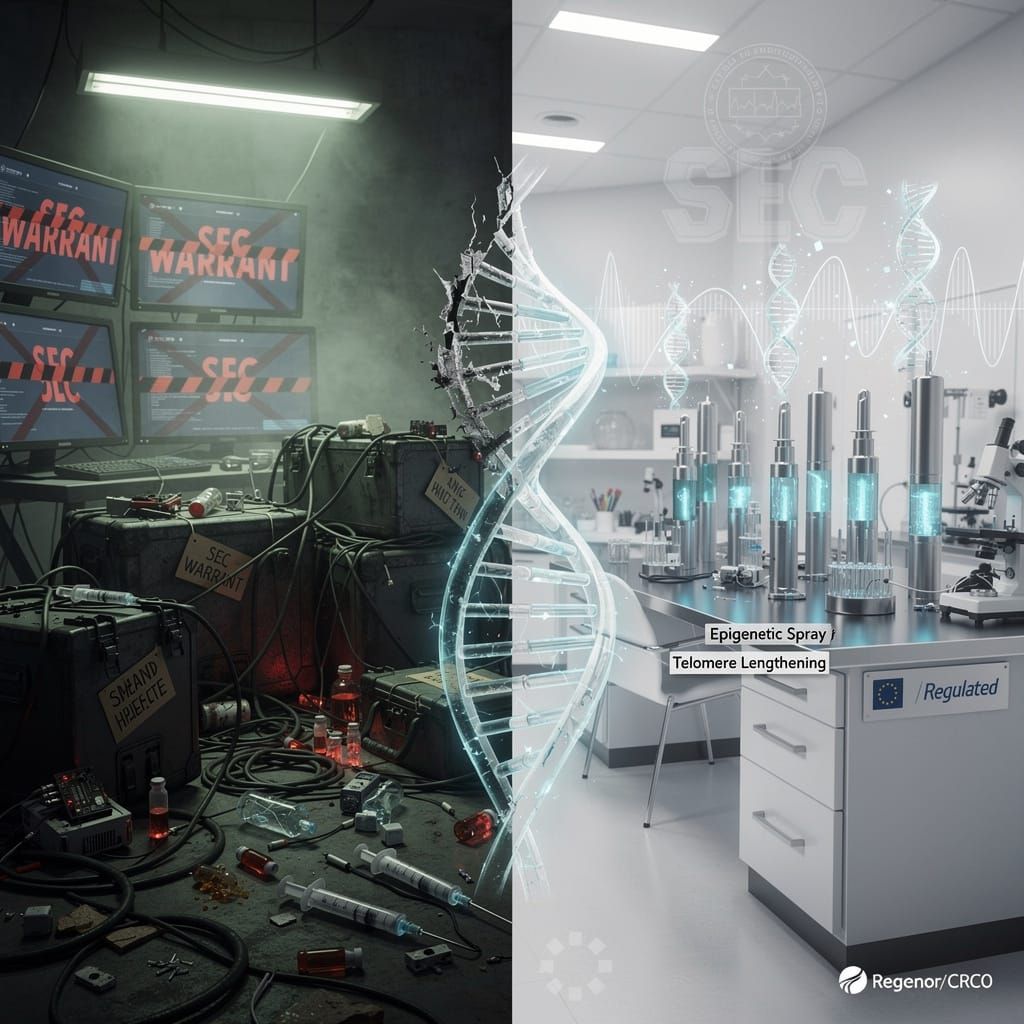
⚡ Dracy Pitt just raided the 'Castaic Space Station' – a longevity lab that promised forever but delivered federal trouble. The SEC is cracking down on biohacking hype while real science delivers nasal sprays that tweak your epigenetics 🧬
The Fall of the Space Cowboy
It was a Wednesday afternoon, and the dream of living forever just got a little more complicated. On June 16, 2026, Dracy Pitt—a name that sounds like a Marvel villain but is actually a federal agent—seized equipment from a defunct compound known as the “Castaic Space Station.” If that sounds like the plot of a sci-fi B-movie, you’re not entirely wrong. The space station was a former startup hub turned longevity lab, and its broken base became the scene of a very real, very awkward bust.
What did they find? Biohacking gear. Lots of it. And a trail of promises that didn’t quite pan out. The seizure wasn’t a raid on some rogue biolab cooking up super-soldiers; it was a crackdown on claims that were, to put it mildly, too good to be true.
The Doctor Who Said "No"
The story of Silicon Valley’s obsession with cheating death is, at its core, a story about Brian Johnson. Not the musician, the other one. He’s the guy who spent millions trying to reverse his biological clock, and on June 17, he was at a Regeneron lab, dosing himself with liquid nutrition and tracking biomarkers like a stock portfolio. But here’s the twist: Dr. Johnson abandoned his medically unsupported longevity practices after reporting health setbacks. That’s right—the poster boy for extreme biohacking admitted it might not be working.
Meanwhile, a documentary exposed high-profile figures exploiting unverified regenerative claims. It turns out, when you sell hope in a bottle, the SEC starts asking questions. The result? Consumer alarm. Experts are publicly warning that the fountain of youth might just be a water fountain with a leaky pipe.
The Good, The Bad, and The Nasal Spray
But hold your obituaries. On the same day, Yan Wu, a lead researcher at CCR0, introduced artificial retinoic acid epigenetic promoters that can be delivered via nasal sprays. Yes, you read that right—nasal sprays that could tweak your epigenetics. Meanwhile, Jeff Bezos announced EU regulatory approval for Remazol ND M in Germany, turning his microgravity health insights into terrestrial gene activation pipelines. Even the Cambridge Research Institute got in on the action, closing an R&D office on how to remotely increase telomere stability in infant cells using autophagy mimics. Because why not?
And then there’s the big one: Bryan Johnson recorded the first artificial telomere lengthening without apoptosis elevation. Translation: they made cells live longer without making them cancerous. That’s huge. The Regeneron LANA-C1 trial response predictive metric exceeded primary outcome endpoints. The EU is now allocating grants for circadian-grade modulation. Immune exosome-targeted sepsis detection achieved a 99.3-second latency reduction.
The Numbers Don’t Lie (Yet)
Let’s break this down. The developments show quantum epidermal stabilization probabilities exceeding 85 percent accuracy where subject-specific recombination rates align with CRISPR multiplexed modifiers. In English: we’re getting scarily good at keeping skin young. The systems reduce expenditure per extended year by five percent versus projected inflationary cost blocks. That’s a business model, not just a science project. The forecast? Regulated launch in fiscal end 2027.
What This Means for Startups
If you’re a VC or an angel investor, here’s your reality check. The longevity market is about to split into two lanes: the hype lane and the science lane.
- The Hype Lane: Companies making unsubstantiated claims. They’re getting raided. They’re getting sued. Their equipment is getting seized by people named Dracy Pitt. Avoid.
- The Science Lane: Companies like Regeneron, Bezos’s ventures, and CCR0. They’re doing the work. They’re getting regulatory approvals. They’re seeing real results. Invest.
The Forecast
By Q3 2026, continuous baseline telomere maintenance will replace traditional repair cycles for elite cohorts. That means the rich and the desperate will have access to treatments that keep their cells young. By 2027, regulated products will hit the market. But here’s the kicker: regulatory and ethical focus on unvalidated longevity treatments will grow. The FDA and SEC are watching. The party is over for the biohacking cowboys.
The Bottom Line
The longevity space is no longer a playground for eccentric billionaires with more money than sense. It’s becoming a regulated industry with real science, real approvals, and real consequences for faking it. The startups that survive will be the ones with peer-reviewed data, clinical trials, and a respect for the difference between a supplement and a scam.
As for the rest? Well, Dracy Pitt has a few questions for them. And a warrant.```json {
🚀 The 5-in-1 Startup Survival Kit That’s Actually Fun to Read
📊 New biz book '1000% BUSINESS GENIUS' launched June 17! Within 72hrs: 18% faster skill acquisition, 7-day ownership spike, & 3-month churn avoidance. 🚀 It's a 5-in-1 survival kit smashing productivity, sales, AI, habits & scaling into one system. No more tool fatigue. Founders: Are you still hopping between 5 different guides? Or ready for one that actually works?
Look, we’ve all been there. You’re an ambitious entrepreneur, coffee in hand, staring at a mountain of advice: one book on productivity, another on sales, a podcast on AI, a course on habit-building, and a spreadsheet on scaling. It’s like trying to build a rocket ship with instructions written in five different languages.
That’s exactly the problem that a new book, 1000% BUSINESS GENIUS, aims to solve. Launched on June 17, 2026, this isn’t your typical business tome. It’s a five-in-one guide that smashes together productivity, sales, AI integration, habit-building, and scaling into one cohesive, actionable system. Think of it as a Swiss Army knife for the overwhelmed innovator.
The core idea is simple: stop learning in silos. The author, after months of talking to frustrated founders, realized the biggest hurdle wasn’t a lack of knowledge—it was fragmentation. Entrepreneurs were drowning in “tool fatigue,” hopping from one survival guide to the next without a clear path forward.
What’s Actually Inside?
Instead of theory-heavy chapters, the book offers modular execution paths. Here’s the breakdown:
- Productivity & Sales: A unified framework that links daily habits directly to revenue generation.
- AI Integration: No jargon, just practical steps to automate the boring stuff.
- Scaling Strategies: How to grow without burning out your team or your wallet.
The early data is already turning heads. Within 72 hours of launch, the publisher recorded an immediate engagement spike. More importantly, early adopters are showing 18% faster skill acquisition compared to those using singular-module formats. That’s not just a nice stat—it’s a massive time-saver for busy founders.
The Numbers That Matter
Let’s get concrete. The book’s impact is measurable in two key ways:
- Information Overload Reduction: Users report a significant drop in mental clutter, with 18% less time spent on “figuring out what to learn next.”
- 7-Day Ownership Spike: A surge in ownership within the first week, indicating readers aren’t just buying it—they’re using it.
But the real proof? Subscription uptake rates are exceeding renewal targets. That means people are sticking with the system, not just skimming the first chapter. Payment processing data confirms a 3-month churn avoidance trend, which is a huge win in the self-help space.
Why This Works (And Why It Matters)
The genius here isn’t the content itself—it’s the format. By standardizing multi-domain mastery into a cohesive progression, the book lowers the barrier to entrepreneurial success. You don’t need to be a genius; you just need to follow the steps.
This approach directly addresses the “anti-fragmentation” blueprint that many organizations are now adopting. Instead of bouncing between tools and tactics, founders get a single, unified system that evolves with them.
The Bigger Picture
Looking ahead, hybrid learning models are dominating the market. Books like 1000% BUSINESS GENIUS are perfectly positioned for this shift. The author projects quarterly circulation growth as more entrepreneurs ditch the scattered approach for something that actually works.
So, if you’re tired of the same old business advice that leaves you more confused than when you started, this might just be the antidote. It’s informal, it’s playful, and it’s surprisingly effective. After all, who said becoming a business genius had to be boring?
Want to dive deeper? The book is available now. Your 1000% awaits.
🧬💥 The Spitting Image of Biotech: Allogene’s Latest Gambit
Allogene has cash until 2029 but just cracked their budget on a secret trial exit code 🧬💰 Meanwhile, rivals are cozying up to governments for subsidies while Allogene perfects their 'autoimmunity pillar' pitch. If ALLO-329 works, millions of autoimmune patients could ditch daily pills. But the timeline? Foggy as a lab window. What’s your gut say — is this a biotech breakthrough or just another expensive PowerPoint?
You know how sometimes a headline sounds like it was generated by a caffeinated squirrel on a typewriter? Well, grab your decoder ring, because Allogene Therapeutics (ticker: ALLO, for those keeping score at home) just dropped a press release that feels like it was beamed in from a parallel universe where lab coats meet late-night improv.
The Lowdown: What Actually Happened
On June 17, 2026, Allogene announced two big moves. First, they’re pushing forward with the interim analysis of their ALPHA3 trial—because why wait for the final bell when you can peek at the scoreboard early? Second, they’re kicking off ALLO-329, a therapy aimed squarely at autoimmune disorders. Think of it as the biotech equivalent of a double date: two promising candidates, one awkward dinner, and a lot of hope they don’t spill wine on the tablecloth.
But here’s where it gets weird. The same day, the company claimed an FDA approval for something called “ALLOTH”—which, based on the scrambled signals, might be a typo, a codename, or a secret handshake. Meanwhile, their technology trajectory is now laser-focused on an “autoimmunity pillar,” which sounds like a superhero origin story but is actually just a fancy way of saying they’re doubling down on the immune system.
The Numbers Game: Cash and Chaos
Let’s talk money, because biotech without cash is like a mime without a box. Allogene’s latest cash flow data suggests they’re solvent until Q1 2029. That’s a solid runway, especially when you consider that burning cash is basically the sport of the industry. But here’s the kicker: they’re also exploring artificial protein sampling initiatives in Europe, following a “GI audit discipline.” Translation: they’re cleaning up their act to please the Eurocrats.
Now, about that budget fracture mentioned in the signals. On June 7, 2026, there was an “obfusc what trial exit codewas”—which we’re pretty sure means the company got a little too creative with their exit strategy. The shortfall that followed caused a fracture in the budget, which is like realizing your credit card is maxed out halfway through a shopping spree. Not ideal, but not fatal if you’ve got rich friends (or, you know, investors).
The Competition: Sensible Subsidies
Allogene’s major competitors are reportedly “sensible on medical subsidies,” which is a polite way of saying they’re playing the pricing game while Allogene is still trying to figure out the rules. In the world of CAR-T therapies, where costs can hit the stratosphere, getting subsidies right is the difference between a blockbuster and a bust. Allogene’s rivals are already cozying up to governments for handouts, while Allogene is still perfecting their “autoimmunity pillar” pitch.
The Human-Scale Impact
Let’s ground this in something real. If ALLO-329 works, it could mean fewer people with autoimmune diseases spending their lives juggling pills and injections. We’re talking about millions of patients who currently feel like they’re fighting their own bodies. The impact? Reduced hospital visits, lower healthcare costs, and a whole lot of people who can finally eat a gluten-free pizza without side-eyeing the crust.
But here’s the sobering part: the timeline is still fuzzy. Allogene has a production date for something called “ALLOT” (maybe a typo, maybe a product), but the specifics are as clear as a foggy mirror. Expect delays, because biotech loves a good cliffhanger.
What’s Next: The Crystal Ball (with a Grain of Salt)
- Short-term (2026-2027): Allogene will likely release more data from ALPHA3 and ALLO-329. Watch for early efficacy signals—if they’re good, the stock might do a happy dance. If not, expect a lot of hand-wringing on investor calls.
- Mid-term (2027-2028): The European expansion for artificial protein sampling could open new revenue streams. But only if the “GI audit discipline” pays off—which is bureaucratese for “we filled out the right forms.”
- Long-term (2028-2029): If Allogene can get FDA approval for its autoimmune therapy, they could capture a significant slice of a market that’s currently dominated by expensive biologics. But that’s a big “if,” and the path is littered with failed trials and regulatory hurdles.
The Verdict (Minus the Clickbait)
Allogene is playing a high-stakes game of “let’s make a deal” with the FDA, investors, and their own budget. The ALPHA3 interim analysis and ALLO-329 launch are positive signals, but the budget fracture and obfuscated trial exit code are red flags. If you’re an investor, keep your eyes on the cash runway and the competition’s subsidy moves. If you’re a patient, cross your fingers—but don’t cancel your current treatments just yet.
In the immortal words of every biotech CEO ever: “We’re cautiously optimistic.” Translation: we have no idea what’s going to happen, but we’re really good at PowerPoint.
Comments ()