28-Paise Rupee Rally: RBI Rents Stability by the Week — Q1 Fiscal Deficit at 18.2%
TL;DR
- Indian Rupee's 28-Paise Twitch: Rally or RBI Lifeline Expiring September 30?. Is the rupee's rally real or just RBI's swap window expiring?
- 0.03 Points: The Philippine Peso’s Phantom Crisis of 2026. Was the peso 'crisis' real risk or just media theater?
🛑 The Rupee's Little Vacation: Enjoy It While It Lasts
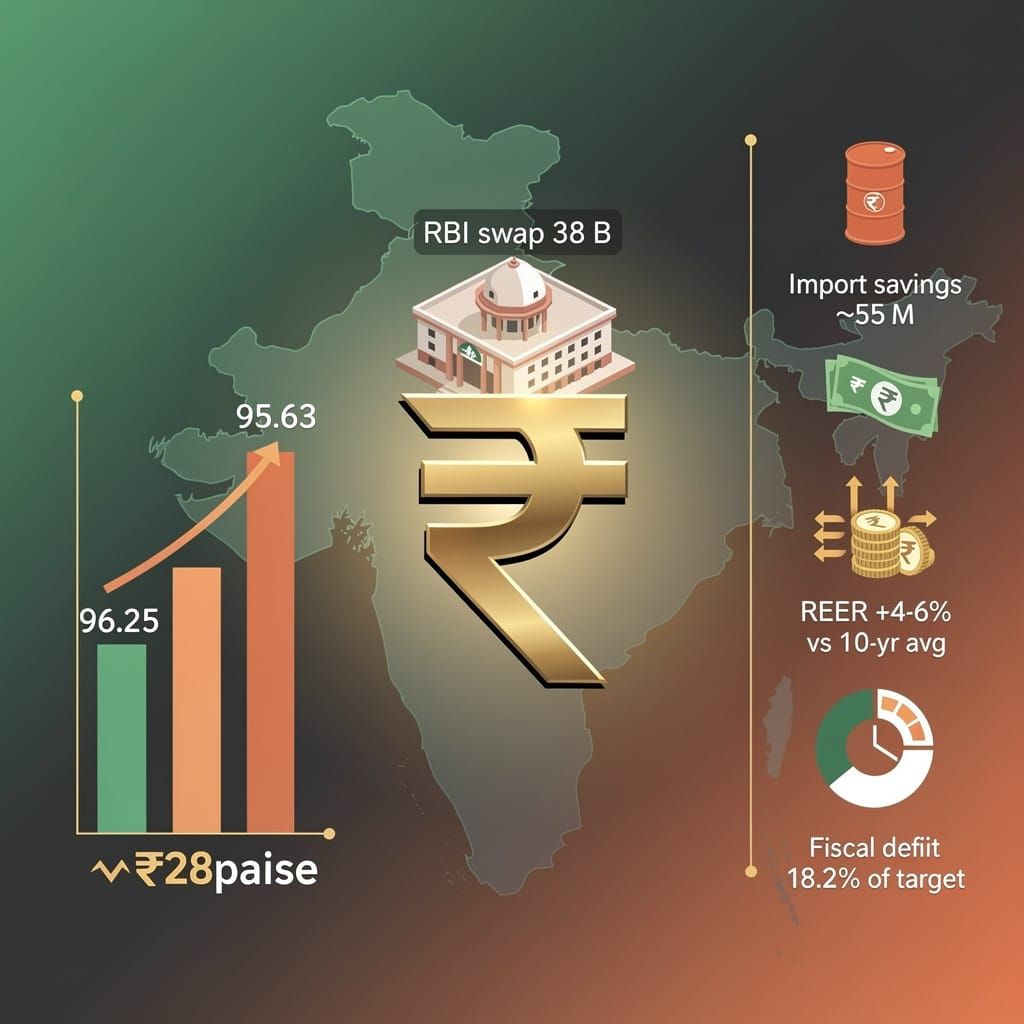
The rupee gained a whopping 28 paise — a 0.3% twitch — and suddenly it's a rally. 🛑 Brent is above $78. The current-account deficit hasn't moved. The RBI has thrown $38 billion in swap gimmicks at the exchange rate just to hold this line. The facility expires September 30. Import savings? ~$55 million — in a $3.5 trillion economy. REER is still 4–6% above its decade average. Fiscal deficit already chewed up 18.2% of the annual target in Q1 alone. This isn't macroeconomics. It's a central bank renting stability by the week. So, India — enjoying the 28-paise breather, or watching the expiry date on your currency support?
The Indian rupee staged a modest rally last week—28 paise here, 16 paise there—creeping from 96.25 to 95.63 against the dollar by July 30. Markets celebrated. Analysts cheered. The subtext, however, deserves a skeptical eyebrow.
What Actually Moved?
The drivers were textbook, not transformative:
- Middle East de-escalation: After Brent fell to $72.24 on June 25, vessel traffic through the Strait of Hormuz doubled—before Israeli strikes on July 6 triggered a blockade, hoisting Brent back to $79 and shoving the rupee toward 95.50.
- Fed policy expectations: Markets priced a higher probability of a September rate cut, weakening the dollar broadly and lifting emerging-market currencies.
Foreign portfolio inflows ticked up—Rs 20,200 crore into Indian equities by August 2. So far, so conventional.
The Fine Print
A 28-paise gain over four trading sessions—roughly 0.3%—is not a trend. It is a twitch. The rupee's trajectory remains pinned to forces that haven't changed:
- India's current-account deficit: Still running at roughly 1.8–2.0% of GDP. Oil above $78 a barrel erodes any currency gain faster than it arrives.
- Reserve Bank of India intervention: The central bank launched a concessional FX swap facility and FCNR(B) deposit scheme that collectively pulled in roughly $38 billion by late July. That is not market momentum—it is a central bank throwing everything it has at the exchange rate. The facility expires September 30. After that, gravity reasserts itself.
Foreign exchange analysts who penciled in 95.6–95.9 as the near-term range aren't so much forecasting as reading the RBI's playbook back to you.
What the Rally Doesn't Fix
| Factor | Reality check |
|---|---|
| Import relief | Each 1-rupee gain cuts India's crude bill by roughly $1.8 billion annually. The current gain delivers about $55–60 million in savings—noise. |
| Export competitiveness | The real effective exchange rate (REER) remains 4–6% above the 10-year average. Indian goods aren't getting cheaper. |
| Fiscal arithmetic | The central government's fiscal deficit hit 18.2% of its annual target in Q1 alone, versus a 4.3% GDP ceiling. Net tax revenue reached just 22.2% of budget estimates. A 28-paise rally does not fix that. |
Forecast Reality, Not Hype
- August–September 2026: 95.5–96.5 range, held aloft by RBI swap facilities and the $7 billion FII surge from July's tax-exemption package. September Fed decision is the trigger—any hawkish surprise pushes the rupee back toward 97.
- Q4 2026: 96–97.5. The RBI's swap window closes. Oil imports sustained by 19% GST revenue growth won't offset structural trade frictions—India's MSCI EM weight just fell below 11%.
- H1 2027: Risk of 98+ if U.S. rates stay higher for longer. The current "rally" won't be remembered.
The Bottom Line
A 28-paise rupee move makes headlines. A 28-paise rupee move does not make macroeconomics. Foreign portfolio flows are fickle, oil is volatile, and the RBI's intervention corridor is real—and scheduled to expire. Meanwhile, a central government that has already blown 18.2% of its fiscal target in one quarter cannot afford to pretend a 0.3% currency twitch changes anything. Call this what it is: a temporary reprieve, propped up by policy gimmicks and fleeting geopolitics, not a structural shift. Enjoy the breather—the next leg of pressure is already forming.
📉 The Great Peso Panic of 2026, or How to Lose 0.03 Points With Dignity
The Philippine peso "crisis" of July 2026 added exactly 0.03 points per month to CPI. That's three one-hundredths. 📉 The currency wobbled, the BSP sterilized ₱1.3T, rates went to 4.75%, and by August 3 the peso was back at 61.028. Markets overreacted, analysts panicked, and inflation barely blinked. So when the next geopolitical headline hits and everyone screams contagion—are we supposed to take them seriously, or has this become performance art for the 24-hour news cycle?
Let's rewind the tape on the Philippine peso's mid-2026 "crisis." If you blinked, you missed it—though the media certainly didn't.
What Actually Happened?
- July 22: U.S.–Iran tensions escalate. The peso allegedly hit a record-low close. Analysts cue breathless forecasts of emerging-market contagion.
- July 28: The central bank intervenes, having already absorbed P1.3 trillion in excess liquidity the week prior and raising the 28-day bill yield to 4.73%. Currency stabilizes. The panic subsides in roughly six days.
- August 2–3: Peso strengthens to 61.028 per dollar, beating expectations. The won, by contrast, sinks below 1,428 KRW. Apparently the apocalypse can wait.
The Aggregated Damage
The entire episode—geopolitical scare, commodity shock, panic flows, central bank firefighting—produced a cumulative inflation bump of exactly 0.03 percentage points per month to CPI. Not 0.3. Not 0.1. Three one-hundredths.
One assumes the nation's households will notice immediately.
The Real Story
What this episode actually demonstrates is the market's remarkable ability to overreact to Middle East headlines, then promptly forget them. The peso strengthened to 61.028 by August 3, and by August 5, headline inflation had cooled to 6.2%—the lowest in four months. The BSP had already raised its policy rate to 4.75% in June and was sterilizing over a trillion pesos in surplus reserves, keeping the overnight RRP stable. The central bank's intervention worked exactly as designed, which is inconvenient for anyone who predicted a currency collapse.
The inflation impact: negligible. The volatility: noisy. The analyst panic: theatrical.
Meanwhile, south of the border, the Mexican central bank's July 6 decision to fund its government indefinitely pushed the peso 0.51% higher—the kind of macro "confidence" that signals deepening fiscal dependence rather than market strength.
What This Tells Us
- Geopolitical risk remains the preferred excuse for short-term currency moves, even when actual fundamentals haven't budged—the peso remains near P60 as of August 3.
- The peso's vulnerability to external shocks is real but shallow: recovery mechanisms kick in faster than doomsayers expect, though analysts continue to predict weakness through late 2026.
- 0.03 pp/month to CPI is the statistical equivalent of a shrug, especially against a headline rate that was already running above 7%.
So yes, the peso weakened. Then it stabilized. Then it strengthened. Markets roiled, analysts opined, and the inflation needle twitched by less than a rounding error. Through June, the BSP reported bank assets had reached P30.12 trillion—up 12% year-on-year—while lending grew 10.7% in March alone. The central bank raised rates to 4.75% in June, inflation moderated to 6.2% in July, and the peso is now stronger than the South Korean won.
Philippine macroeconomics: all the drama of a telenovela, with approximately 0.03% of the consequences.
Comments ()