💸⚖️ Celsius Estate Sues BitMEX for $495 Million in 2020 Liquidations
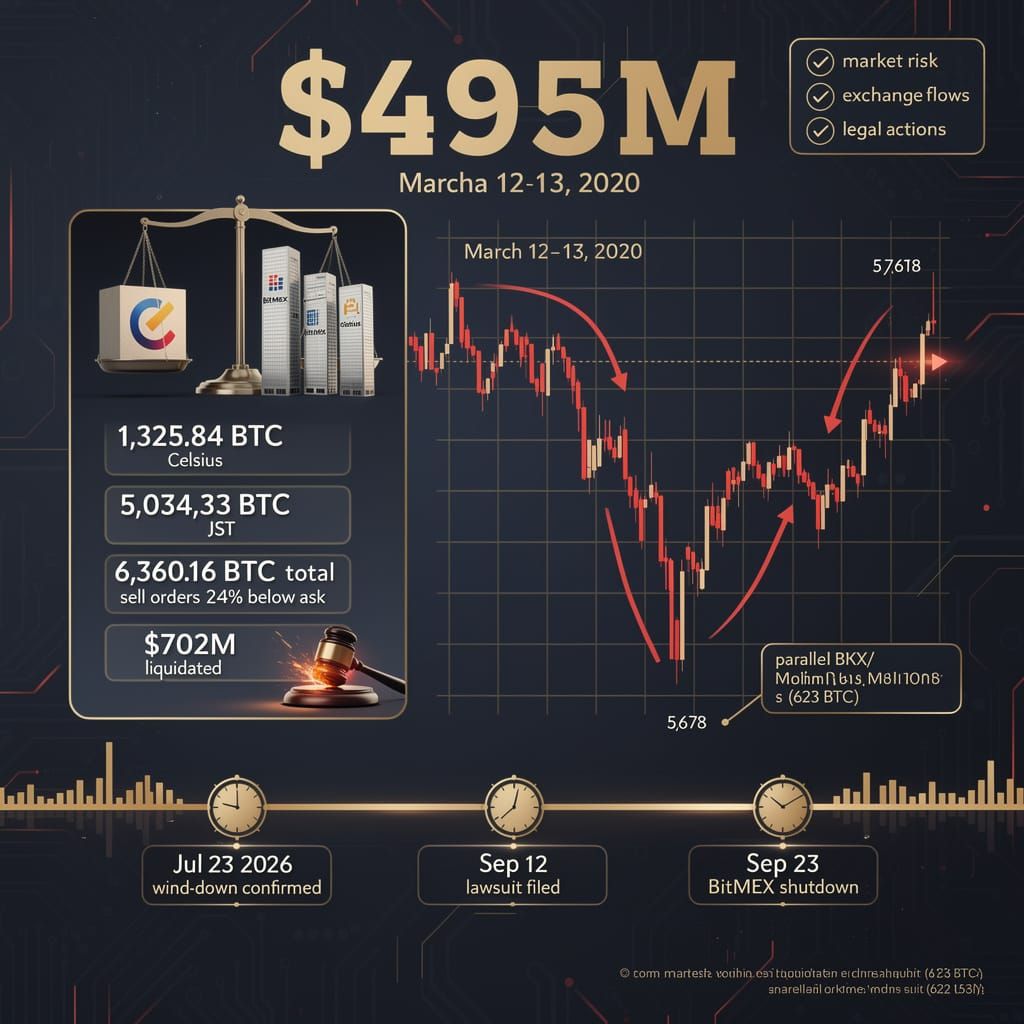
Celsius's estate is suing BitMEX for $495M—or 6,360 BTC—over March 2020 forced liquidations. 💸 The estate says BitMEX ran both the liquidation engine and the insurance fund that pocketed the proceeds, with some sell orders placed 24% below the next ask. The filing lands 11 days before BitMEX's Sept 23 shutdown. If it wins, Celsius creditors recover ~$495M, but courts must separate exchange misconduct from ordinary market collapse. Does an exchange's control over pricing make it liable for customer losses beyond market risk? ⚖️
Six years after the March 2020 crash, Celsius's bankruptcy estate is suing BitMEX-linked entities for $495 million, alleging the exchange's liquidation engine triggered and profited from forced sells. The case tests whether an exchange's control over pricing implicates it in customer losses beyond ordinary market risk.
What changed
On September 12, 2026, the Celsius Network estate—administered by Blockchain Recovery Investment Consortium—filed suit in U.S. Bankruptcy Court for the Southern District of New York against five BitMEX-linked companies: HDR Global Trading, ABS Global Trading, Shine Effort, 100x Holdings, and HDR Global Services. The estate claims BitMEX wrongfully liquidated 1,325.84 BTC from Celsius positions on March 12, 2020, and 5,034.33 BTC from investment fund JST the following day. Total claimed recovery: 6,360.16 BTC, roughly $495 million, plus punitive damages and return of Bitcoin in kind.
The filing lands 11 days before BitMEX's announced September 23, 2026 shutdown. The wind-down, confirmed by owner HDR Global Trading on July 23, 2026, sits atop a structure already degraded: a $100 million fine, prior founder arrests, and CEO departure. The closure forces remaining positions to settle by August 26, 2026 under imposed risk limits, with assets held in self-custody and no forced transfers. It follows a strategic review rather than regulatory collapse, but it compresses the recovery window into a single quarter.
How the mechanism works
The complaint centers on BitMEX operating both the liquidation engine and the insurance fund that receives proceeds from forced closes. Per the filing, some liquidation sell orders were placed more than 24% below the next-best ask, a pricing gap the estate argues suppressed Bitcoin prices and amplified the crash's forced-selling cascade. The stated mechanism: automatic triggers fire when collateral falls below required levels, and forced sales add further selling pressure that pushes more positions under the threshold.
Celsius's positions, the estate asserts, were structured as delta-neutral hedges designed to profit regardless of Bitcoin's direction. BitMEX, it claims, undermined that structure by controlling the pricing inputs that triggered liquidation. BitMEX has cited two DDoS attacks on March 13, 2020 (02:16 UTC and 12:56 UTC) as contributing conditions. The contested window saw Bitcoin fall from roughly $7,200 to about $5,678 in 15 minutes, with an estimated $702 million in positions liquidated on BitMEX during the initial crash.
Distribution of value, risk, and leverage
If the estate prevails, Celsius creditors recover roughly $495 million—6,360 BTC—in Bitcoin or equivalent damages, while five BitMEX entities face financial and reputational exposure at the end of their operational life. The case shifts leverage to bankruptcy estates seeking recoveries from counterparties before infrastructure changes. It also frames the commercial model: an exchange that prices liquidations, executes them, and receives the insurance-fund proceeds holds structurally aligned incentives the estate argues are inherently conflicting.
This mirrors the parallel BKX Services Inc. and David Namdar class action filed July 24, 2026, alleging misappropriation of 623 BTC through forced liquidations by U.S. perpetual-swap customers since July 23, 2018—adding a coordinated legal front as BitMEX winds down. Credit recovery of this size, if realized, would make Celsius a test case for estates reclaiming liquidation-generated revenue from exchange insurance funds.
Counter-signal and uncertainty
BitMEX's DDoS defense and the two-year gap between crash and liquidation raise questions about causation. The related July 2026 class action cites a 2020 case dismissed for lack of evidence, suggesting a coordinated legal push facing similar evidentiary hurdles. Courts must separate genuine exchange misconduct from ordinary market collapse where losing positions are liquidated at prevailing prices. The delta-neutral claim, if unproven, weakens the fraud argument, and the estate draws no direct cash benefits until a ruling. The case's progress depends on how bankruptcy courts interpret algorithmic trading intent under securities law.
Three monitoring indicators
- Court ruling on BitMEX's motion to dismiss (causation standard applied).
- Outcome of the BKX/Namdar class action for precedential weight.
- BitMEX's September 23 wind-down execution and whether it preserves assets against potential damages.

Comments ()