🚀 Factory's AI Coding Startup Jumps to $5B Valuation
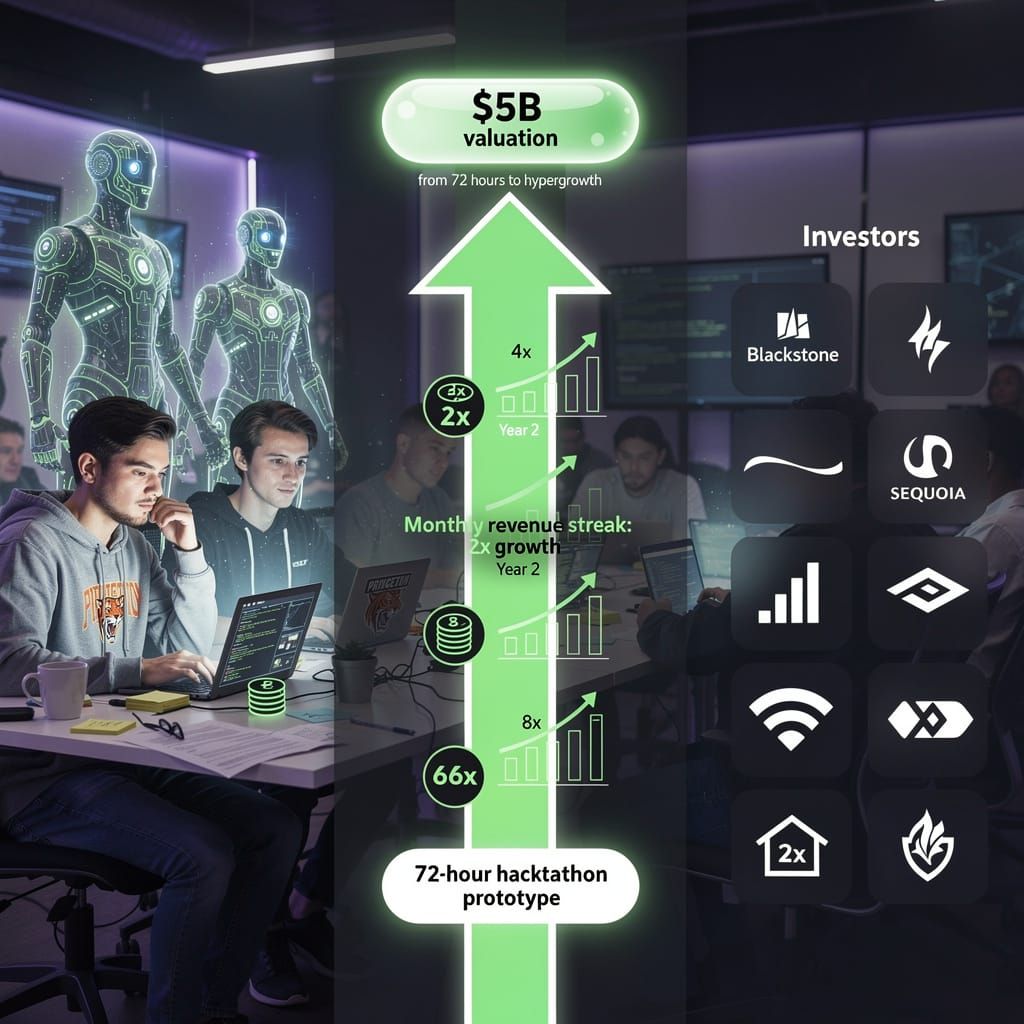
Factory went from a $1.5B to $5B valuation in just five months—tripling its worth. 🚀 The AI coding startup raised $200M led by Blackstone, Khosla, and Sequoia, barely three years after two Princeton grads met at a hackathon. Revenue doubled month-over-month for six straight months before its April round. Its "Droids" agents don't just write code—they run QA, security, docs, and incident response. Now it's chasing FedRAMP approval for the government market. But can every AI-coding unicorn capture enterprise budgets at once? The competition is piling up fast. Does tripling your valuation in a quarter signal durable infrastructure—or just a frothy market for AI code tools? 💻
Here's the part that made my coffee go cold: Factory raised $200 million at a $5 billion valuation on September 15 — and it did it barely three years after two Princeton kids met at a San Francisco hackathon. That's a 72-hour prototype growth curve that most founders would trade a kidney for.
Wait, let me redo the math, because the numbers are doing laps. Factory went from a $1.5 billion valuation in April to $5 billion by September. That's tripling your worth in five months. In most of tech, that kind of jump is a typo that somebody forgot to fix.
Who Actually Are These Guys?
Meet Matan Grinberg and Eno Reyes, the co-founders who started Factory in 2023. They didn't come out of nowhere swinging — they came out swinging from a hackathon, which is peak Silicon Valley energy. Their pitch: "What if we stopped trying to make AI write one piece of code and instead made it run the whole dang software factory?"
Their agents — charmingly branded "Droids" — don't just write code. They review pull requests, poke at your security, write your docs, run QA, and handle incident response. Basically, they do the chores your engineers have been procrastinating on since 2019.
The "Polymath" Trap
Here's my favorite part: Factory is open about targeting "unreasonably ambitious polymaths." Translation: they want the people who get bored doing only one thing. Which is a nice way of admitting that their Droids are built for the kind of developer who'd rather orchestrate a thousand agents than type a for loop by hand.
That ethos seems to be paying off. Paying off hard. The company says revenue doubled month-over-month for six straight months before their April round. For context, that's not growth — that's a hockey stick strapped to a rocket.
Who's Writing the Checks (And Taking Them)
The investor list reads like a who's-who at the AI gold rush: Blackstone, Khosla Ventures, Sequoia Capital, Insight Partners, NEA, and Clearlake, plus angels who apparently like watching code write itself. That includes Marc Benioff, Brad Gerstner, and former F1 champ Nico Rosberg, because why not.
Their customers list is equally un-humble: Nvidia, Adobe, Morgan Stanley, Royal Bank of Canada, Palo Alto Networks, Ernst & Young, T-Mobile. Hundreds of thousands of developers are reportedly using the software.
Why Everyone's Triple-Downing on AI Code
Factory isn't flying alone — the whole market's inflating. Cognition just closed a $2 billion Series E at a $48 billion valuation in September, with annualized revenue exploding from $492 million in May to roughly $900 million now — and it's projecting $4–5 billion by year-end. Cursor reportedly got acquired by SpaceX for a staggering $60 billion. GitHub Copilot, Google's Gemini Code Assist, and Amazon's suite are all breathing down each other's necks.
And here's the thing: the AI boom these code-bots are riding is not some niche fever dream. The global AI market is projected to reach $4.8 trillion by 2033 — a 25-fold jump from today — with AI expected to become the single largest frontier-tech segment, making up 30% of that market. The US captured 70% of global private AI investment ($67 billion in 2023), which is exactly the kind of check-writing environment that lets two hackathon kids triple a valuation in five months.
The agents themselves are getting expensive — Gartner clocked AI-coding platform charges jumping from $20 to $100 to $20,000 a month as consumption bloats — which is exactly the kind of bill that makes CFOs start shopping for a control layer. Someone's going to win that race, and the check-writers are betting Factory's "software factory" orchestration — not just a discrete coding tool — is the durable infrastructure play.
The FedRAMP Flex
One quietly smart move: Factory is chasing FedRAMP authorization for secure GovCloud deployment. That's a government-grade security certification that most consumer AI startups couldn't spell. Why does it matter? Because the only way to sell to the federal government and heavily regulated industries is to clear that bar. They're also offering cloud, self-hosted, and air-gapped options, which means they're already thinking about clients who'd sooner eat their keyboards than put code in a public cloud. Smart, since only 11% of enterprises run AI agents at scale generating actual measurable value.
What's Next?
Factory plans to spend the new cash on research, product, and global expansion — offices in London and Tokyo are reportedly coming. The founders are also pledging deep investment in the kind of multi-step, across-the-org automation that makes individual coding tools feel quaint.
- Short term: Scale sales and gov-ready infrastructure.
- Medium term: Land-and-expand with more Fortune 100s.
- Long term: Make the "software factory" a category that owns enterprise dev ops.
The Skeptic's Corner
Real talk: five months is a blink in enterprise software. Those monthly-doubling revenue numbers are gorgeous in a pitch deck, but the future-outlook question marketers avoid is whether everyone in this race can capture enterprise budgets simultaneously. The market's growing, but so is the pile of unicorn-shaped competition. And a valuation that tripled in a quarter puts a target on any founder's back.
Still, for two hackathon kids who started with a 72-hour build, going to $5 billion with $420 million raised says one thing clearly: the check-writers smell a durable software factory — not just a clever autocomplete. Whether the Droids hold up under government scrutiny remains the fun part to watch.
Comments ()