🇮🇪 Board Chair Quits Twice in 24 Hours Over Broken Timetable
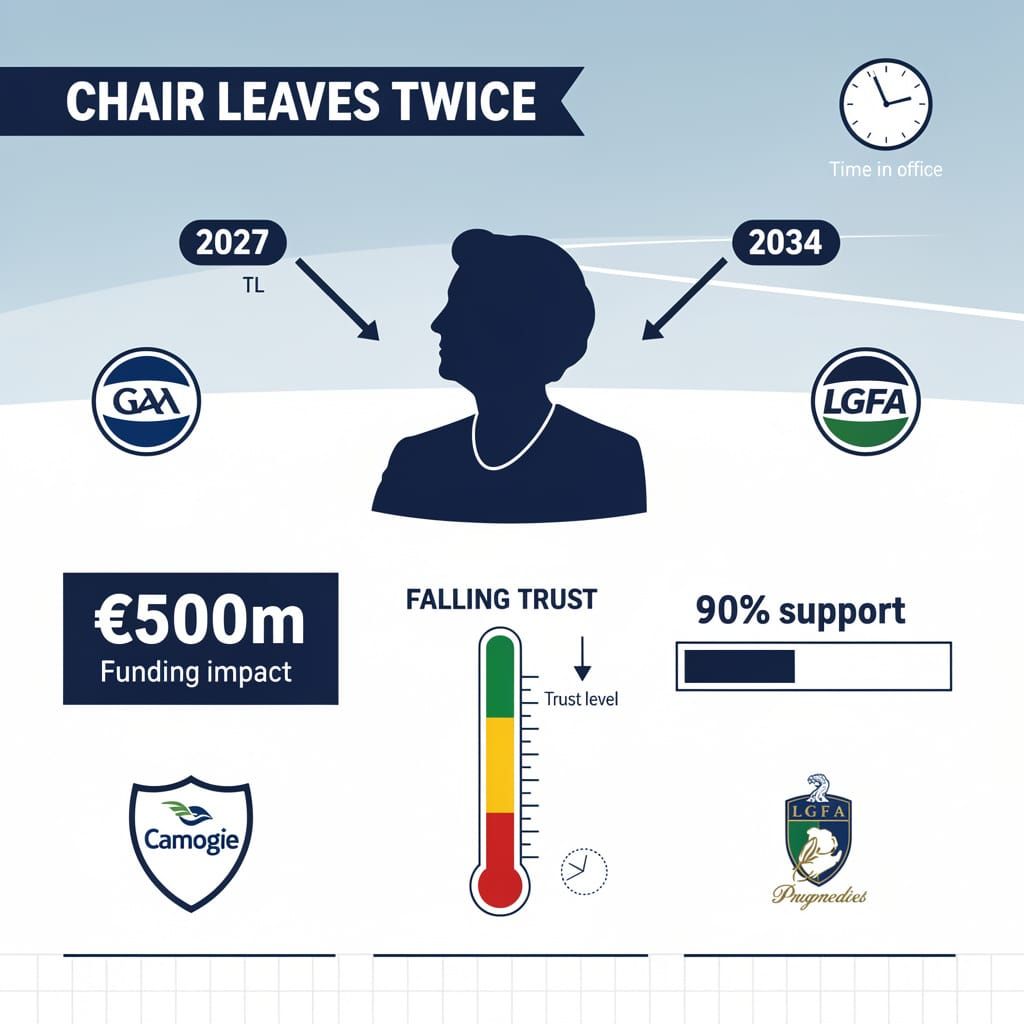
A former president resigns as integration chair. Then resigns entirely 24 hours later. When the GAA withdrew from the 2027 unification deadline and proposed extending to 2032–34, Mary McAleese departed—and the steering group lost its most visible champion. The integration project has no chairperson, no agreed timeline, and no legislative mechanism to compel three independent associations. Cost projections of €500M+ and a potential doubling of inter-county spending only surfaced after the deadline collapse. 🇮🇪 An integration timetable announced before constituent bodies cede authority becomes a trust liability—measured by the gap between what was promised externally and what could be enforced internally. Are multi-party restructurings in your sector set up to fail the same way?
In September 2026, former Irish President Mary McAleese resigned as independent chairperson of the Integration Steering Group overseeing the unification of the GAA, LGFA, and Camogie Association—then resigned from the process entirely the next day—after the GAA withdrew commitment to the 2027 integration deadline, proposed extending the timeline as far as 2034, and offered no legislative or constitutional mechanism to compel progress across the three separately constituted bodies.
The Observed Operating System
The GAA, LGFA, and Camogie Association launched "Where We All Belong" in 2022 under McAleese's independent chair, aiming to create a single governing body for Gaelic games—"One Association for Gaelic Games by 2027." The steering group operated as a public-facing integration project with a fixed deadline and a former head of state as its most visible champion. Tom Ryan, the GAA's director general, publicly backed the two-year timetable, according to his own statements. The integration was framed as a logical evolution: one club, one code, one association, with a mandate to streamline governance, funding, and competition structures across men's and women's games.
What the public announcement did not address was legislative backing. The steering group lacked the formal authority to compel change across three separately constituted organisations with separate legal structures, constitutions, funding streams, and member voting procedures. The two-year timetable became a target without a mechanism to enforce it.
On September 8, 2026, McAleese resigned as chairperson, criticising GAA management for blocking integration progress and lacking vision. The next day, she resigned independently from the process entirely. On September 9, Tom Ryan confirmed the GAA's commitment to eventual unification, stated publicly that the GAA was not ready to integrate LGFA and Camogie by 2027, and introduced proposals to extend the timeline to 2032 or 2034—citing financial constraints and projecting integration costs exceeding €500 million, with potential doubling of inter-county team expenditure from €45 million to €90 million annually.
Minister for Sport Patrick O'Donoghue publicly expressed frustration with the new five-year-plus timeline. Equality Minister Norma Foley criticised the current leadership structure. Fine Gael Senator Evanne Ní Chuilinn warned that the lack of clarity harms women's sport credibility. The Camogie Association thanked McAleese for her leadership; the LGFA reaffirmed commitment to integration but signalled continued collaboration. The GPA (Gaelic Players Association) remained publicly aligned with the integration principle, with GPA co-chair Morgan Treacy noting that 90 per cent of delegates had previously supported integration.
By September 10–12, multiple reports confirmed the same sequence: the 2027 deadline was abandoned, no replacement chair had been identified, and projected spending of over €500 million and more than €90 million in annual inter-county costs introduced uncertainty across the three associations.
Behavior and Consequence: Trust as Observed Action
Trust, in an organisational context, is not a feeling. It is a pattern of observable behaviour: people speaking up, accepting difficult change, sharing sensitive context, coordinating across silos, and judging decisions as procedurally fair. The McAleese resignations demonstrate a trust breakdown by all five measures.
First, speaking up. McAleese's public criticism of GAA management for blocking progress—on record as part of her resignation statement—was a direct statement that she no longer believed the process would deliver. Tom Parsons of the GPA raised concerns about the legitimacy of the existing integration framework. Fiona McHale and Niall Morgan, high-profile players, expressed disillusionment publicly.
Second, accepting change. The internal opposition within LGFA and Camogie constituencies hardened around concerns that integration would subordinate women's association identities into a GAA-dominant structure. The original 2027 target was set without buy-in from the member bases of all three associations—members had not yet voted on a concrete integration proposal—so when the deadline slipped, the resistance that had been latent became overt.
Third, sharing context. The constitutional and legislative hurdles were known to the steering group but not resolved or communicated as binding constraints. Financial forecasts of over €500 million total integration cost and a potential doubling of inter-county expenditure were not widely shared with players or the public until the deadline collapse. Information arrived unevenly across the three associations, each of which holds its own financial and membership data.
Fourth, coordinating across silos. The GAA, LGFA, and Camogie continued operating as separate legal entities. Every coordination required separate votes, separate approval cycles, and separate governance processes. The GAA proposed phasing implementation over nearly a decade—some reports indicated a timeline as far as 2034—rather than delivering on the "One Association by 2027" framework.
Fifth, judging decisions as fair. The erosion of distinct women's association identities was perceived as a zero-sum tradeoff. Minister for Sport O'Donoghue, Equality Minister Foley, and Senator Ní Chuilinn all publicly questioned whether the proposed structure protected women's inclusion and democratic process. Reasonable compromises—like phased integration—looked like concessions when no binding governance agreement existed.
The consequence: a three-year integration project that began with a former president, a public campaign, and unified backing now has no chairperson, no agreed timeline, a legislative pathway that does not exist, and an increasingly public dispute among the three associations over what "integration" even means. The trust that enabled the 2022 launch has not been replenished.
Why the Incentives, Information Flow, and Authority Produced This
The root mechanism is a mismatch between authority and accountability. The steering group was asked to deliver integration by a fixed deadline, but it held no formal power over the three organisations' constitutions, funding streams, or member votes. The 2027 timetable created external pressure without internal leverage. When progress slowed, the public-facing project became a source of frustration rather than a container for constructive tradeoffs.
Information flow compounded the problem. Because the three associations operate independently, each possesses its own data on membership, finances, and legal constraints. The integrated steering group relied on voluntary sharing. When financial constraints emerged—projected integration costs of over €500 million, inter-county expenditure potentially rising from €45 million to €90 million annually—they arrived unevenly and without a shared interpretation framework. The GAA's public statements emphasised timeline commitment; the LGFA and Camogie communications emphasised identity protection and fair representation. The steering group had no mechanism to reconcile these frames.
Incentives also cut against integration. The GAA, as the largest and oldest body, had less internal urgency to cede structural control. Its management committee expressed an inability to commit to the 2027 timeline, citing financial concerns as a major barrier. The LGFA and Camogie, with stronger identity-based membership, had incentives to defend autonomy unless integration terms clearly protected them. Without a binding governance agreement, each association's leaders remained accountable to their own members first—and those members had not yet voted on a concrete integration proposal. The steering group operated in the gap between institutional self-interest and collective ambition, with no authority to close it.
Counterevidence and Limits
One could argue that the integration process was never realistically going to meet a two-year timeline, and that McAleese's resignation was an overreaction to normal political friction. The GAA remains formally committed to integration: Tom Ryan's public response on September 9–10 struck a note of patience rather than panic. The LGFA and Camogie Association have not withdrawn from the project. Both are on record reaffirming their commitment to continued collaboration.
GPA co-chair Morgan Treacy pointed out that 90 per cent of delegates previously supported integration, suggesting that player-level support for a single body had not collapsed. Grassroots support reportedly remains above 90 per cent, indicating unity amid structural setbacks. GAA official Jarlath Burns emphasised the complexity of unification, suggesting that recent disputes have been mischaracterised in media coverage.
However, these counterpoints do not address the structural problem: an integration process that cannot hold its chairperson for 24 hours after a resignation does not have the authority to hold its constituent organisations to a timeline. The 2027 ambition was a binding promise externally, but internally it was a suggestion. The GAA proposed extending the timeline to 2032 or 2034, but some reports indicate no definitive end-point for the phase-based rollout. That gap is the trust mechanism, not the personalities involved.
Three Evidence-Based Implications
First, an integration or restructuring timetable announced publicly before the constituent bodies have ceded legislative authority creates a structural trust deficit. The project becomes measured against an external clock that the project itself cannot control. When the clock runs out, the failure is attributed to the project and its leadership, even when the root cause is the absence of enabling authority. Organisations monitoring large-scale integration should track not just milestone dates but whether the steering body has independent power to compel votes, allocate funding, or override constituent-level procedural blocks. The GAA's ability to unilaterally shift the deadline from 2027 to 2032–2034 without a binding governance agreement demonstrates that the steering group had no such power.
Second, trust in multi-organisation projects is best measured by the frequency and content of cross-organisational coordination, not by public endorsements or attendance at launch events. The McAleese resignation was a lagging indicator. Leading indicators would have included whether LGFA and Camogie board members shared draft constitutions with the steering group, whether joint funding proposals were tabled, and whether each association's membership had received concrete integration terms in writing before the 2027 deadline was set. If those data points are missing, public commitments are decoupled from actual behaviour. The projected €500 million integration cost and potential €45 million-to-€90 million expense increase were not surfaced publicly until the deadline collapse.
Third, when a high-credibility external figure resigns from a restructuring project citing blocked progress and lack of vision, and a second resignation from the process follows within 24 hours, the exit is a diagnostic signal that the process lacks a pathway to resolution. Organisations should treat such an exit as a structural audit trigger, not a personnel issue. The relevant question is not "what went wrong with the chair" but "what specific authority, information, or incentive mechanism failed such that this was the rational exit." In the case of Gaelic games integration, the answer is clear: the steering group had a timeline, a vision, and a former president—but no legislative lever to pull. That mechanism is what broke. No replacement chair can fix it without the missing authority to compel votes, allocate shared funding, or enforce timelines across three independent associations.


Comments ()