⚖️📉 Glencore Cuts Ties, Takes $480M Hit on Radiant World
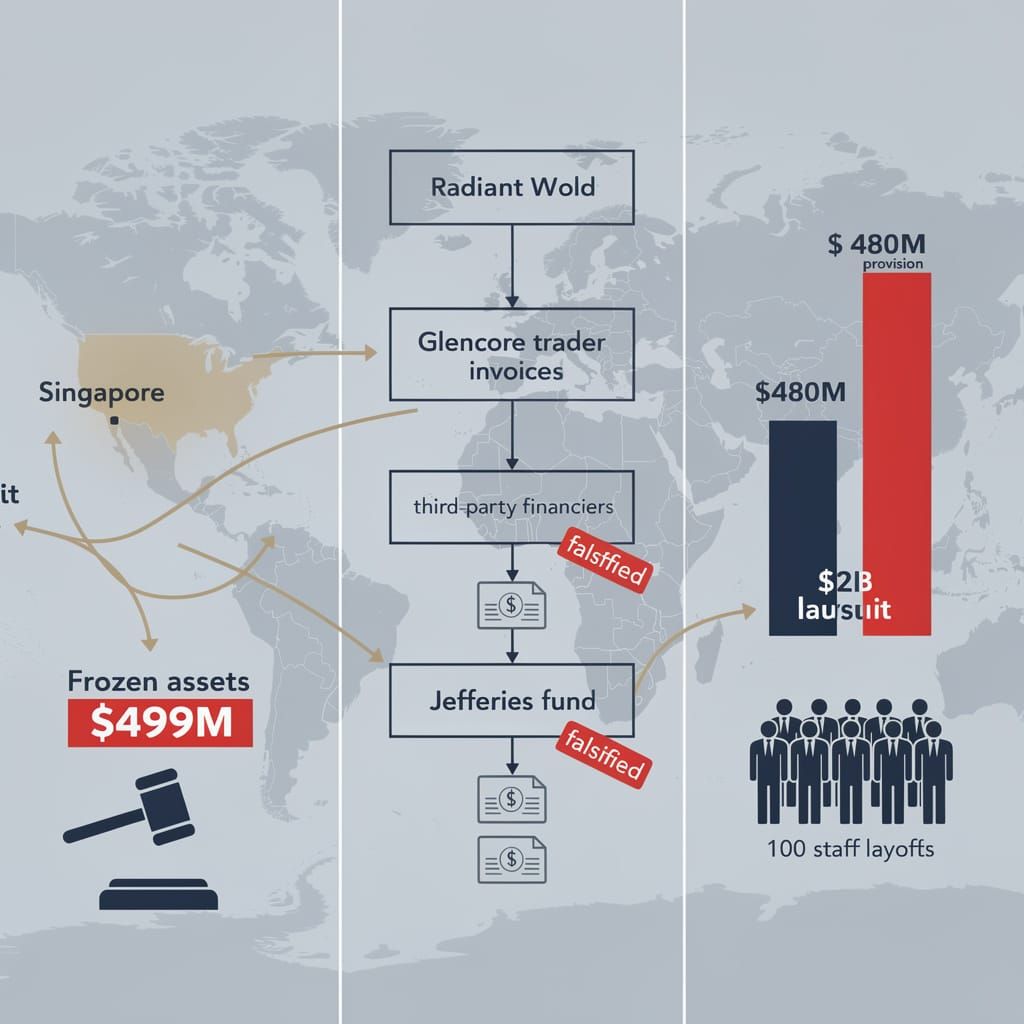
$480M provision, $2B in mutual lawsuits, and a $499M asset freeze. ⚖️ Glencore cut all ties with iron ore trader Radiant World after confirming falsified invoices and fabricated emails that broke its trade-financing model. — Now a Jefferies-managed fund and regulators are circling a market that moved 80M+ tonnes annually. More than 100 traders lose jobs as counterparty documentation scrutiny tightens. Could this freeze raise the cost of commodity trade credit beyond iron ore? 💭
Radiant World's alleged invoice fraud unravels Glencore's central trader financing line, forcing a $480 million provision and mutual $2 billion lawsuits that rewrite who underwrites commodity trade credit as US and Singapore regulators step in.
What Changed
On September 15, 2026, Radiant World and affiliate Sapphire Minmetals filed a S$2.5 billion (~$2.0 billion) fraud lawsuit against Glencore in Singapore, alleging falsified invoices and contracts. That same day, Glencore announced it had terminated all business with Radiant World, confirming it had received falsified invoices, contracts, and fabricated emails. A London court imposed a worldwide freezing order covering up to $499 million of Radiant World and Sapphire Minmetals assets, requested by a Jefferies Financial Group (JEF)-managed fund.
The collapse has been building since mid-August, when a Bloomberg report triggered scrutiny followed by simultaneous US DOJ and CFTC probes and a Singapore police investigation launched August 20. Vitol, Cargill, and Glencore all terminated relations, while Deutsche Bank and KBC froze accounts and suspended credit lines. Rio Tinto and Vale removed Radiant World from approved customer lists, and Mizuho filed for insolvency in late August.
How the Mechanism Works
Commodity traders like Radiant World—which moved 80+ million metric tons of iron ore annually on $9.6 billion FY2025 revenue—operate on a two-layer credit system. First, a major merchant (Glencore) provides trade financing and working-capital support, a relationship Glencore has called its role as Radiant World's "most important backer." Second, traders pledge receivables and invoices to third-party financiers, including Jefferies-managed funds, for further liquidity against those paper claims.
The mechanism broke when invoices carrying bank counterparty names were presented to financiers with allegedly fabricated supporting documentation—including emails seemingly from Glencore personnel. The credit stack inverted when the paper proved unenforceable: a Jefferies-managed fund sought the $499 million freeze in London, while Glencore took a $480 million provision after confirming the documentation was falsified.
Distribution of Value, Risk, and Leverage
Glencore absorbs the direct provision but converts its exposure into legal claims—its $2 billion suit against Radiant World seeks restitution. The September 16 filing escalated the dispute: Radiant World now alleges Glencore concealed trading arrangements and extracted over $800 million in payments from 2021 to 2026 before terminating the relationship. Jefferies' managed fund, holding nearly $500 million exposure via LAM Trade Finance Group II on a minority-owned basis, gains leverage through the London freezing order and a September 7 Singapore injunction.
The follow-on extends beyond the two parties. Radiant World has cut roughly half its Chinese and Singapore traders with reductions reaching London and Geneva—more than 100 staff laid off as counterparty documentation scrutiny tightens. That displaces iron ore volume Chinese steel mills must source elsewhere. The exit also removes the anchor that made Radiant World's paper tradeable; with its founder, Pinkesh Nahar, constructing annual volumes near 75 million tonnes, billions in trading value now carry uncertain recoverability.
Counter-Signal or Unresolved Uncertainty
The $480 million provision—roughly a quarter of the frozen $499 million—reflects Glencore's own uncertainty about recoverability. Incomlend's earlier accusations and Jefferies' separate exposure claims suggest multiple, possibly overlapping, claims that could expand or contract final liability. Radiant World denies wrongdoing, and Jefferies' minority stake leaves open whether its fund's loss represents actual impairment or merely contingent exposure.
Monitoring Indicators
- Singapore case conference on October 21, 2026: determines whether the $2 billion claims proceed or move toward settlement.
- Final provision vs. recovery ratio on Glencore's $480 million Radiant World exposure as restitution is awarded or denied.
- Independent-trader credit access in Asian iron ore: tracking whether counterparty documentation scrutiny raises the cost of trade credit beyond Radiant World's immediate orbit.
Comments ()