🤖 ABBYY Phoenix Plus pairs deterministic and generative AI to cut document-processing costs
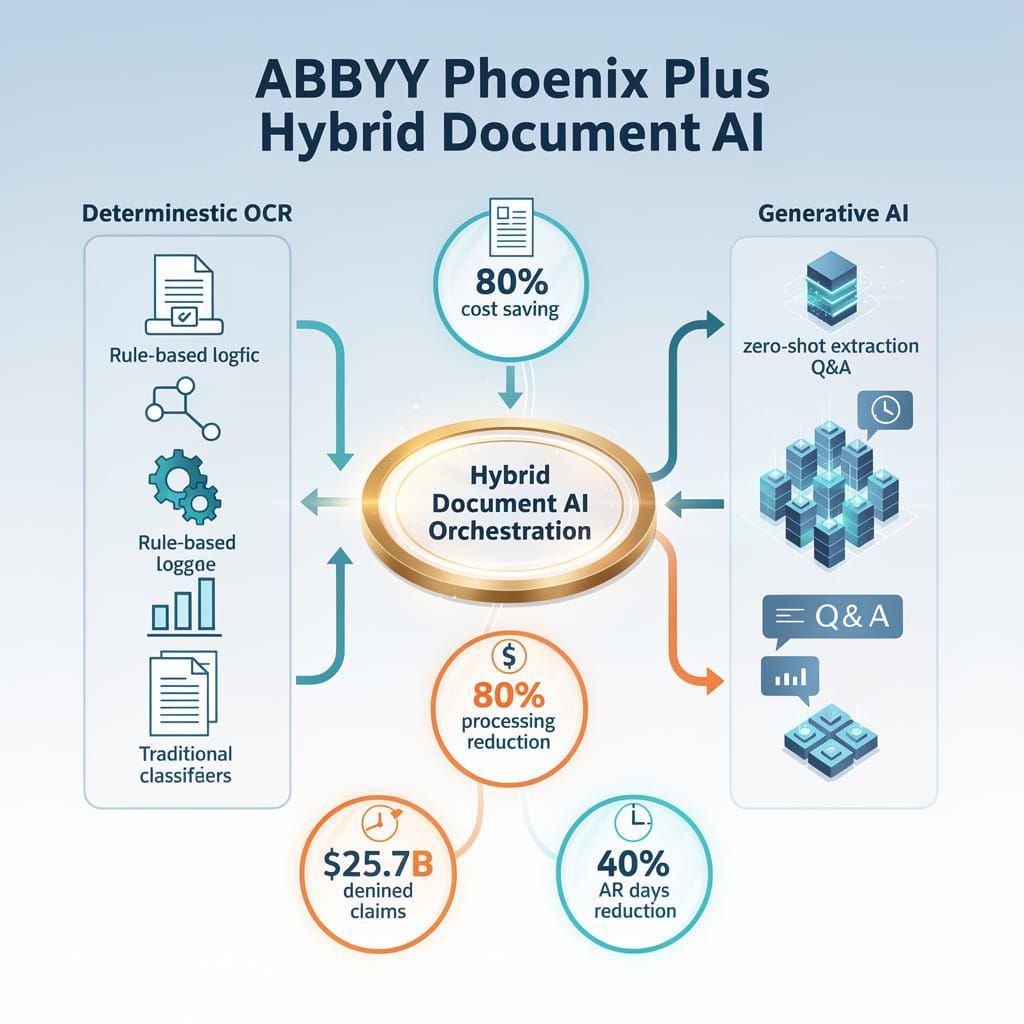
80% of enterprise document work doesn't need generative AI — and Phoenix Plus is built to know the difference 🤖 ABBYY's new Phoenix Plus routes routine pages through fast deterministic paths, reserving generative inference only for genuinely ambiguous cases. That routing is the quiet breakthrough in deployment economics. The proof: an insurer cut claim-validation cycles by more than 80%, and a global fund admin processes 1M+ financial documents a year. A governed hybrid with a defined audit trail — the model that finally earns its seat in the workflow. Is your operations team still paying generative rates for the work that doesn't need it? 🔍
For all the noise around frontier models, the messiest place in enterprise AI has always been the same: the documents. Invoices, claims forms, damaged scans, compliance filings, layouts that no two vendors seem to produce the same way. This is where generative AI famously breaks down — not for lack of intelligence, but for lack of reliability, an audit trail, and a predictable per-page cost.
On September 16, ABBYY moved to close exactly that gap. The company launched Phoenix Plus, a generative AI model suite for document processing, delivered through its Vantage platform. The release signals a quiet but sharp shift in how production AI is being built: not as a single giant model, but as a layered orchestra where deterministic and generative systems each play their lane.
A Hybrid Under the Hood
The architecture is the story. Phoenix Plus doesn't replace ABBYY's existing deterministic stack — the OCR, rule-based logic, and machine-learning classifiers that already handle the bulk of routine work. Instead, it adds a generative layer on top.
Phoenix Core handles the computer vision and document structure identification. Phoenix Plus contributes zero- and few-shot extraction, classification, question-answering, and data enrichment. An orchestration layer routes each task to the appropriate technology based on complexity. Routine, well-structured pages stay on deterministic paths — fast, cheap, auditable. Only genuinely ambiguous or novel cases escalate to generative inference, where the higher cost can be justified.
That routing logic is the quiet breakthrough in deployment economics: the design means enterprises stop paying generative-compute rates for the roughly 80% of work that doesn't need it. The economics are pre-validated across the industry — by July, OpenAI had cut roughly 60% of its own generative AI expense through task-level routing and granular cost transparency, and ASUS deployed a hybrid architecture that trims inference token costs by up to 70% for mid-to-large models by shifting work to local devices. Phoenix Plus applies the same principle to documents: cheaper paths get used first, and generative compute is reserved for the small share of genuinely ambiguous work.
Zero-Shot, Minus the Templates
The headline capability is zero-shot extraction — pulling structured data out of document types the system has never seen, with no template creation and no labeled training data. For an insurance carrier or a fund administrator, this collapses months of template-tuning into immediate deployment.
The evidence is concrete. ABBYY reports a global fund administrator now processes more than one million financial documents annually through the suite, and a recent insurance deployment cut claim-validation processing cycle times by more than 80%. This tracks a sector racing to automate exactly these workflows: in Q3 2026, US healthcare organizations lost $25.7 billion to denied claims, and early adopters of AI-driven revenue-cycle platforms cut accounts-receivable days by 40% within six months. The faster-cycle-times play is the same one — automated validation catches issues before they compound into revenue leakage.
Governed, Or It Doesn't Ship
Two things separate Phoenix Plus from a demo-grade model. First, the orchestration and model-routing layer gives the auditability regulators in banking, insurance, and finance actually require — every decision has a traceable path through a defined system, not a probabilistic black box. Second, ABBYY has packaged this into more than 150 specialized models covering distinct document types, an approach that trades a fraction of generality for markedly better consistency.
That governed posture matters as scrutiny mounts: US regulators have issued stricter guidelines on AI in claims processing, NAIC launched an AI system evaluation tool, 59 federal AI-related regulations landed in 2025, and new transparency and bias-mitigation rules for workers' comp claims took effect — raising compliance costs for any insurer running a black-box model. A hybrid with a defined audit trail is precisely what that compliance environment rewards.
The near-term roadmap is straightforward:
- Deeper integration of Phoenix Plus across the Vantage platform
- Expansion of domain-specific models for verticals like insurance and finance
- Continued cost-controlled deployment, restricting generative inference to high-value stages
The Bigger Read
Phoenix Plus is a rebuke to the assumption that "AI in production" means one model doing everything. By splitting the work between deterministic reliability and generative flexibility — and routing each task to the right engine — ABBYY demonstrates that governance, cost, and capability aren't a trade-off. They're an architectural choice.
For regulated industries still haunted by hallucination risk and unmetered inference bills, that hybrid is the model that finally earns its seat in the workflow.



Comments ()