💼🇺🇸 The $9.5 Billion Buyout That Strained Federal Capacity
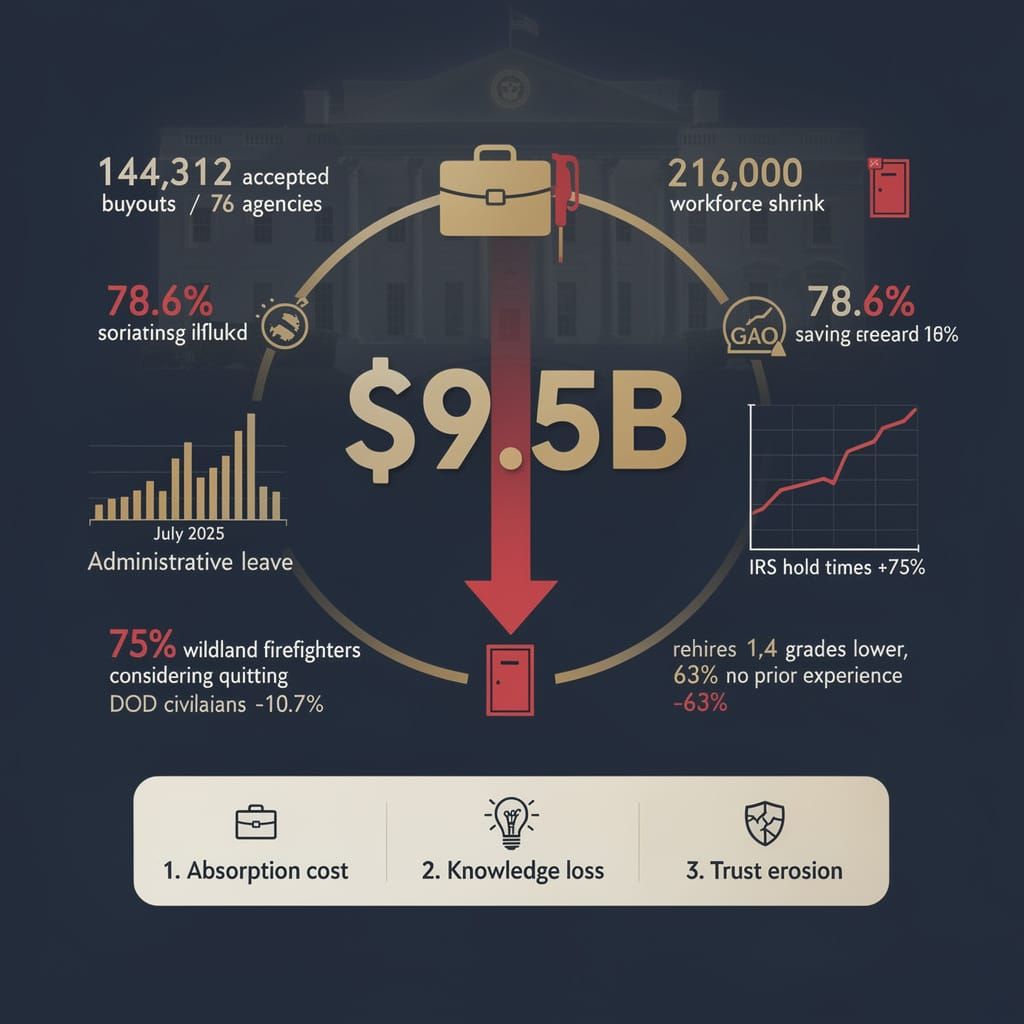
The federal government spent $9.5 billion in 2025 to pay employees to leave 💼 That's the tab for 144,312 resignations across 76 agencies — with $6.7B traced to one voluntary-exit program. Payroll savings were meant to outpace the payout. Instead: wildfire units hit 75% quitting rates, DOD's civilian force fell 10.7% (82,940 people) in the fastest contraction of modern military history, and agencies rehired 20,000+ workers at 1.4 grades below those they replaced. The tradeoff: short-term cash for long-term capacity. Replacing knowledge is now the real cost. How should agencies measure the true price of a buyout? 🧠
In 2025, the federal government spent billions to pay workers to leave — a spike in administrative-leave spending driven by a voluntary-exit program that traded short-term cash for a bet on long-term savings, then largely failed to backfill the absorbed work, straining capacity and trust in the process.
The incident
On May 30, 2025, Elon Musk and President Trump stood in the White House Oval Office. Days earlier, the Department of Government Efficiency had sent federal employees a cryptic "Fork in the Road" email offering a one-time payout to resign — with pay until September 2025. By year's end, 144,312 employees across 76 agencies accepted. The GAO eventually put the tab at roughly $9.5 billion, of which about $6.7 billion traces to that program alone. Paid administrative leave peaked in July 2025, when 2.5 million of 3 million leave workdays traced to the buyout. Separations proved more voluntary than claimed: GAO found 78.6% of 2025 probationary separations were voluntary, totaling 41,500.
The observed operating system
The program ran on the assumption that a large, staggered cohort could be removed quickly and that payroll savings would outpace the payouts. The workforce shrank by about 216,000 in 2025, with roughly 140,000 taking buyouts. The logic: sever a fixed number of roles, realize annual savings, and the GAO-flagged immediate cost becomes an investment. The GAO later found DOGE inflated its projected savings claims by roughly 96%, and OPM could not determine exact costs due to shared payroll systems. Under the Deferred Resignation Program, agencies removed 46,285 DOD staff on leaves averaging five to nine months before the broader drawdown commenced.
Behavior and consequence
Paying people to remain through September while reducing their duties created an unusual information signal: staying arguably became more costly than leaving for some, but leaving surrendered job security. Staffing gaps emerged where roles were cut without replacement — and the consequences became measurable. Wildfire capacity broke first: 75% of surveyed federal wildland firefighters considered quitting within 12 months, less than 25% reported fully staffed units, and prescribed burning projects were cancelled. The Defense Department's civilian workforce fell 10.7% — 82,940 people — to 695,248 by June 2026, the most rapid contraction in modern military history. The rebound confirmed misalignment: agencies hired over 20,000 employees to replace DRP departures by June 2026, though replacements averaged 1.4 grades below those they replaced and 63% had no prior federal experience.
Why the incentives and workflow produce it
The design optimizes for a single metric — headcount reduction — while treating absorbed work as free. When cost is measured at the ledgerline but performance at the agency line, incentives decouple. Buying departures rewards the act of leaving, not continuity; those who stay inherit both the function and the informational vacuum. No handover system is specified in the buyout terms. The State Department's July 2026 reversal illustrates the same pattern: officials announced renewed hiring for similar positions a year after large departures, only to find former employees reluctant to return over organizational culture changes. The IRS saw taxpayer hold times rise 75% and missed hiring targets as specialized capacity dissolved.
Counterevidence and limits
The administration claims hundreds of billions in potential savings, yet the GAO found the program spent more than promised while still inflating the tax burden. The $9.5B figure counts all paid administrative leave, not just DRP buyouts, so net effect is partly obscured. OPM itself could not track cost precisely. Agencies attempted offsets — a 104,000-position surge in early 2026 and an OPM push for 33% early-career hires in FY2027 — signaling headcount reduction was not aligned with mission demand in those places.
Three design implications and monitoring questions
- Absorption cost is a first-order metric, not a footnote. Track residual workload per retained employee across exit cohorts; the fact that agencies rehired 20,000+ workers at lower grades shows the program outsourced work rather than removed it.
- Exit targeting versus exit timing determines knowledge loss. If exits skew toward experienced or sole-source roles — as DOD's deep civilian cuts and the 1.4-grade replacement gap suggest — replacement cost exceeds annual payroll saved.
- Trust is observable in continued coordination. Follow whether remaining staff speak up about capacity, share context, and accept new assignments — the State Department's difficulty rehiring over culture concerns signals the exit program's information vacuum has become the operating norm.



Comments ()