⚖️ Court Rewires Google's Ad Tech: Six-Year Conduct Remedy Instead of a Breakup
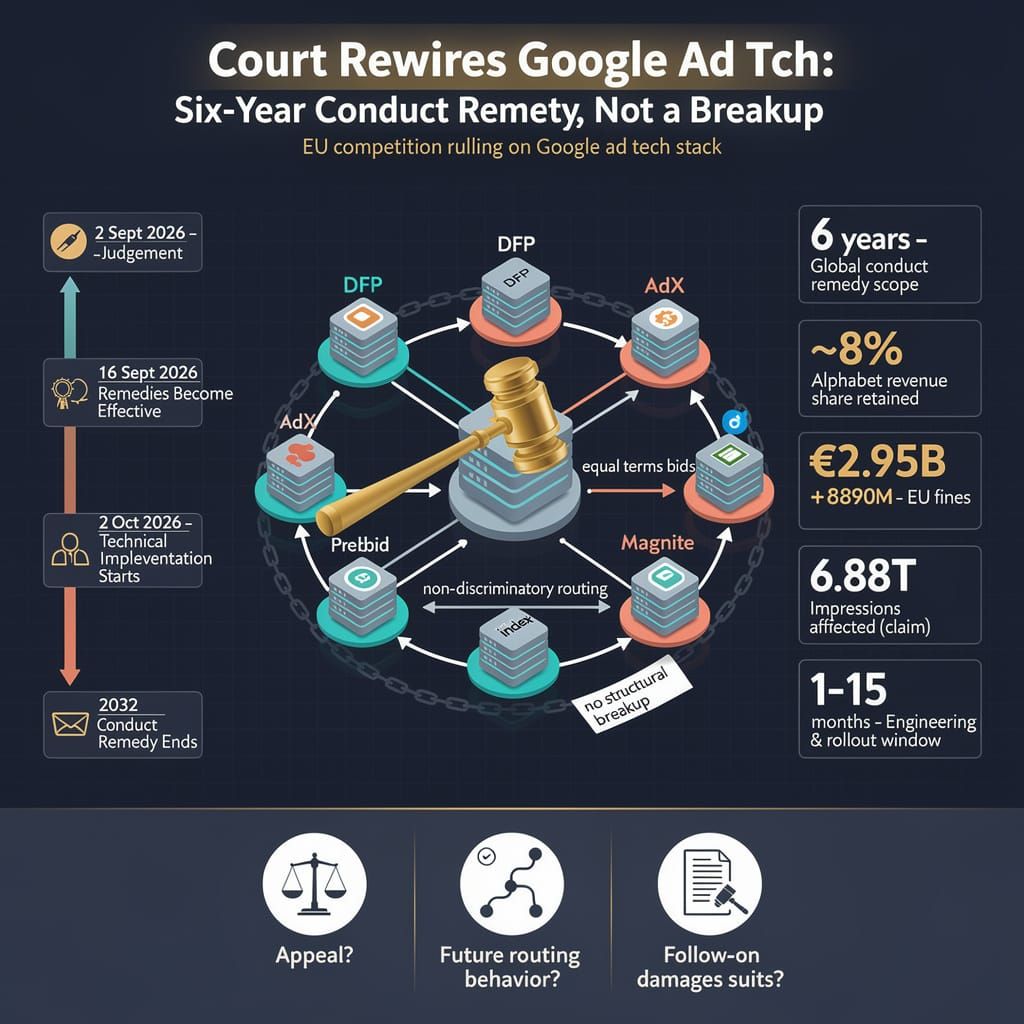
Six years of conduct rules, not a breakup: a US court declined to force Google to sell its ad-tech business, instead requiring interoperability, data-sharing and non-discriminatory bidding. ⚖️ The remedies take effect September 16 and open publisher ad-server and ad-exchange markets to rivals like Prebid, Magnite and Index Exchange. Google says it disagrees and is appealing. Will the behavioral rules actually shift publisher routing—or become technical compliance without changing demand flows? 👇
A US federal court declined to break up Google's ad-tech business, instead imposing six years of interoperability and non-discrimination rules, a compliance monitor, and data-sharing obligations that open publisher ad-server and ad-exchange markets to rivals.
Authority, Action, and Status
On September 2, 2026, Judge Leonie Brinkema of the US District Court for the Eastern District of Virginia entered a final judgment in the Department of Justice's antitrust case against Alphabet/Google. The order is a final ruling, not a proposal. It follows the court's April 2025 liability finding that Google held monopolies in the publisher ad-server and ad-exchange markets. The order was unsealed on September 17, 2026. Google has stated it disagrees with part of the ruling and will appeal; the appeal is pending, and the remedies remain in effect unless stayed.
The decision is the third consecutive US ruling rejecting a structural breakup of a major tech platform, following earlier court outcomes that blocked FTC efforts to force Meta to sell Instagram and WhatsApp and rejected a bid to force Google to sell Chrome on emerging AI-competition grounds.
Scope and Timeline
The remedial order applies globally for six years, effective September 16, 2026, through 2032, with a possible extension if the court finds compliance unsatisfactory. During this period, Google must:
- Provide interoperability so its publisher ad server (DFP) and ad exchange (AdX) integrate with third-party systems, including open-source Prebid and rival publisher ad servers.
- Route AdX bids in real time to competing publisher ad servers on the same terms as DFP.
- Share bid win/loss data and historical/configuration data with publishers.
- End discriminatory bidding practices in its ad platforms.
- Appoint an internal antitrust compliance monitor, overseen by an external Monitor and Technical Committee.
The court rejected the DOJ's request for a forced sale of AdX, open-sourcing DFP, and a 15-year monitoring term, citing a lack of qualified buyers, technical impracticality of the split, and Google's compliance record. In ruling, the judge also weighed technical arguments: industry testimony and internal Google analysis indicated an AdX divestiture was technically feasible but commercially unattractive, with Google asserting divestiture would cause technical and customer disruption.
Transmission Path to Affected Operators
The order severs the prior requirement that publishers using Google's ad server also use AdX. Publishers can now route inventory to alternative exchanges without losing access to Google's demand. Concretely, AdX must submit real-time bids into rival servers on equal terms, meaning Google can no longer grant its own exchange "First Look" or "Last Look" advantages. Publishers gain the right to export DFP and AdX data and to see win/loss bid detail, reducing information asymmetry in auction mechanics. For rivals (Prebid, Magnite, Index Exchange), the API integrations lower switching costs and open routing to Google's demand pool. PubMatic CEO Rajeev Goel assessed the remedies as "real and enforceable," estimating a one-to-fifteen-month engineering timeline for interoperability, and defined four conditions for meaningful choice: comparable terms, timely bids, usable information, and provider flexibility. The compliance monitor and Technical Committee give regulators and competitors a mechanism to flag non-compliance during the six-year window.
The DOJ also separately proposed divestiture of AdX and source-code disclosures; that proposal was not adopted in the final judgment and remains a stated government position, not a mandate.
Settled Versus Open
Settled: Google retains AdX and DFP; the final judgment does not order a structural breakup. The six-year conduct regime, monitor appointment, interoperability, and data-sharing duties are in force as of September 16, 2026. Google's ~8% share of Alphabet revenue from ad tech is not being reduced by divestiture under this order.
Open: The appeal outcome, the practical effect on publisher routing, and market share shifts are unresolved. Private damages suits filed by OpenX (August 2025), Magnite, Index Exchange, The Atlantic, and Teads (August 3, 2026) remain pending. Teads separately launched an 85-page suit on August 6, 2026, alleging Google's tie-ins of Google Ads and AdX deprived rivals of roughly 6.88 trillion additional impressions since 2017.
Separately, the European Commission fined Google €2.95 billion in September 2025 for self-preferencing in ad tech, and on July 29, 2026, imposed an additional €890 million fine under the Digital Markets Act for unfair treatment of rivals via search algorithms—actions independent of the US order and representing under 0.3% of Alphabet's annual revenue.
Near-Term, Contingent, and Watch Conditions
- Near-term: Google has until October 2, 2026, to implement remedial measures via a joint final judgment process. Engineering estimates place interoperability implementation 60+ days after entry.
- Contingent: Compliance failures could prompt court action or extension of the monitoring term.
- Watch: AI-driven advertising (OpenAI's ChatGPT ad features launched September 16, 2026) and self-serve platforms are accelerating shifts that could reshape the competitive landscape independently of the court order; analysts project these changes accelerating through 2028.
Three Open Questions
- Whether the behavioral remedies materially change publisher routing decisions, or whether bidding integration becomes technical compliance without altering demand flows.
- Whether the pending appeal stays, narrows, or vacates the conduct provisions before the six-year term ends.
- Whether the unresolved private damages suits—including Teads' Aug 2026 impression-loss claim and the EU's standing fines—produce additional monetary or structural outcomes beyond this final judgment.
This article is reporting and analysis, not legal advice.

Comments ()