🏛️ State antitrust suit blocks $111B Paramount–WBD merger
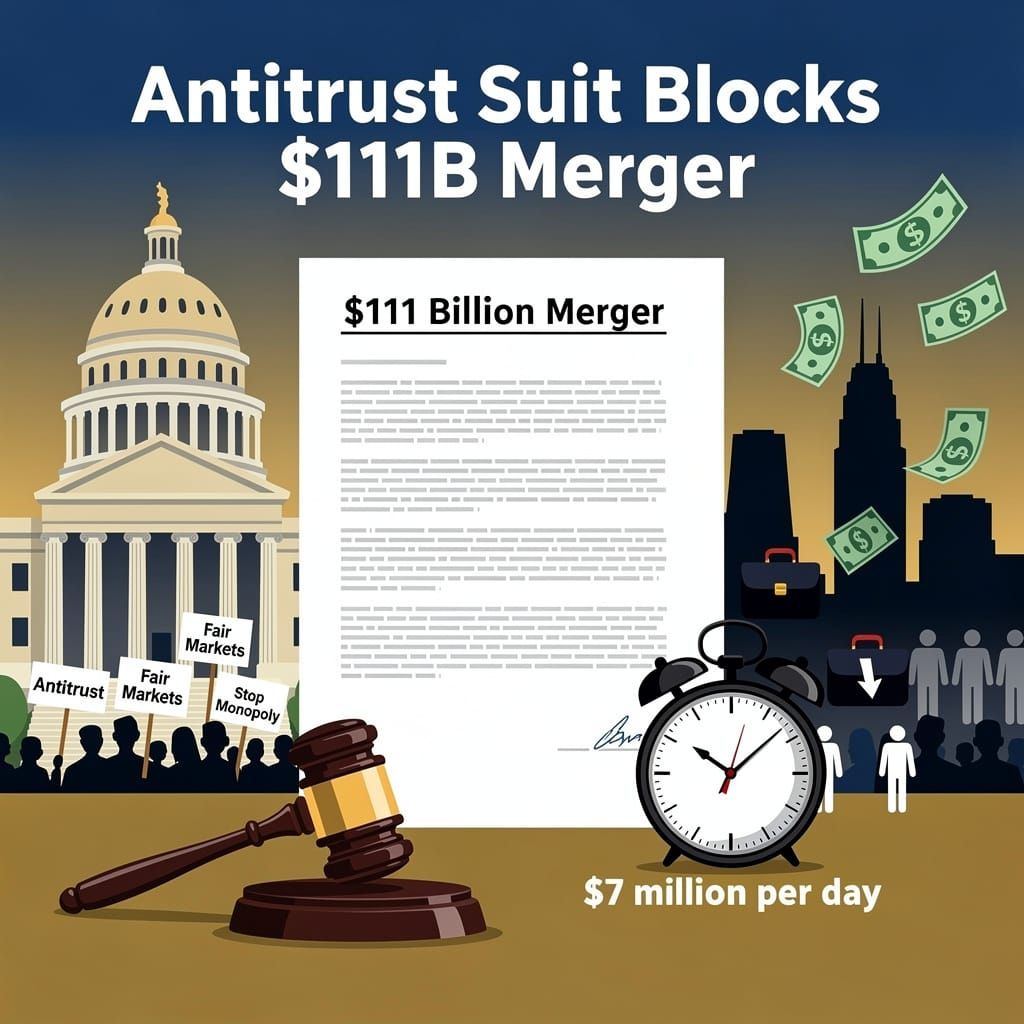
A $111B Paramount–Warner Bros. Discovery merger is held hostage by a 12-state antitrust suit — and LA feels it. 🏛️ Starting Oct 1, Paramount faces a ~$7M-per-day ticking fee while court delays stack up. Ellison threatens to relocate LA headquarters, putting up to 57,980 local jobs at risk. Can settlement talks before March's trial salvage the deal — or does California lose one of its biggest studios? 👇
A California-led coalition of 12 states and the Writers Guild is blocking Paramount's $111 billion acquisition of Warner Bros. Discovery, creating a $7-million-a-day ticking fee and threatening relocation of Paramount's Los Angeles headquarters with up to 57,980 local jobs at risk.
Authority, Action, and Status
California Attorney General Rob Bonta and 11 other state attorneys general filed an antitrust lawsuit in July 2026, arguing the merger would reduce competition in theatrical film distribution and basic cable television. The Writers Guild of America filed a parallel suit. In that same month, U.S. District Judge Araceli Martínez-Olguín issued a temporary restraining order and later accepted a stipulation permitting Paramount to delay closing until a trial verdict or June 1, 2027, whichever comes first.
The Department of Justice, which reviewed more than two million documents over eight months, concluded in June 2026 that the transaction was not likely to cause competitive harm and cleared the deal without concessions. A trial is scheduled for March 2, 2027. On a separate track, the DOJ filed a statement of interest urging the judge to require the 12-state coalition and WGA to post a bond covering potential damages, since they are proceeding as private parties rather than federal enforcers. Investment bankers have separately signaled readiness to prepare asset sales—approaching buyers for New Line Cinema and weighing bids on WBD cable networks such as Comedy Central—should structural remedies prove necessary.
Scope and Timeline
The disputed bond figure is the flashpoint. Paramount is seeking approximately $1.88 billion to cover financial losses if the merger is blocked and it wins the case, a figure its opponents call justified only if the court finds the plaintiffs' case improvidently brought. The California-led coalition is arguing for a minimal $10,000 bond. Associate Attorney General Stanley Woodward Jr. contends the bond must exceed nominal value. A hearing on this question is set for September 24.
A court-ordered, two-day settlement conference is scheduled for October 14–15 in San Francisco, with settlement statements due October 7. Notably, Bonta had previously canceled a scheduled meeting over alleged leaks and misrepresentation. Governor Gavin Newsom has called for immediate settlement talks, and Cinema United reversed an earlier anti-merger stance to urge mediation.
Transmission Path to Affected Operators
The mechanics begin with the merger agreement's ticking fee. Starting October 1, Paramount must pay roughly $6.9–$7 million per day to shareholders if the deal has not closed by June 1, 2027—a structure reporters have quantified on a $0.25-per-share-per-quarter basis equating to roughly $650 million annually and $1.3 billion in potentially unrecoverable losses if the merger fails, on top of an incremental $1.7 billion in delay-period costs. Skydance CEO David Ellison has publicly threatened to relocate Paramount's historic Los Angeles properties if the litigation drags on, with leaked reporting pointing to October 1 as a migration trigger and Georgia, Texas, and Tennessee as candidate destinations.
Two independent studies now quantify that exposure. An August 18 report by CVL Economics and the L.A. County Department of Economic Opportunity puts direct film/TV jobs at risk at roughly 4,500 over three years, with 10,360 total job-years affected, 2,661 indirect job-years at stake through small-business supply chains, $1.26 billion in lost wages, $4.06 billion in business output reduction, and $547 million in tax revenue loss. A September 15 analysis by the Los Angeles County Economic Development Corporation, commissioned in response to Ellison's relocation threat, projects a wider statewide toll: 28,990 to 57,980 full-time jobs lost and $10.6 billion to $21.2 billion in annual revenue losses if the headquarters leaves California, against a counterfactual gain of 1,020 to 2,760 jobs should the merger proceed.
For operators, the consequences cascade: delayed integration, postponed content investment, and stalled hiring across both studios. Ellison has pledged 30 films annually post-merger—commitments underpinned since August 9 by contractual guarantees with AMC and Regal guaranteeing at least 30 theatrical releases per year on 45-day theatrical windows, with digital distribution excluded for ninety days, and offered August 23 as a formal remedy alongside a 45-day theatrical window carve-out. Settlement talks reportedly contemplate structural remedies built on those same release undertakings, with Bonta signaling openness to channel carve-outs while Paramount insists on retaining its news network CNN.
Settled Versus Open
Settled: the antitrust injury theory is lodged (competition harm in theatrical distribution and basic cable); the temporary restraining order is in place; the ticking fee clock starts October 1; settlement talks are scheduled; and independent studies now corroborate the $4.06 billion output and $547 million tax figures while expanding the job-range estimate statewide. The trial date of March 2, 2027, is fixed.
Open: the bond amount; whether the 30-film structural remedies and potential divestitures (New Line, cable channel carve-outs) satisfy the plaintiffs; the fate of Warner Bros. Discovery's roughly 50% stake from Middle Eastern royal family investors under foreign-ownership scrutiny; and whether the wider LACEDC job-loss range displaces the more conservative CVL Economics figures in the public debate.
Near-Term, Contingent, and Watch Conditions
In the near term, the September 24 bond hearing and October 7 settlement filings set the frame. Contingent on those, the October 14–15 conference will determine whether the case resolves before the March trial. Watch whether state enforcers accept structural divestitures, whether Ellison acts on his relocation warning, and whether the $1.88 billion bond demand reshapes the states' calculus. Watch also whether the LACEDC report—not yet officially published—is released in full and how its 57,980-job ceiling enters settlement positioning.
Three Unresolved Questions
- Will the court require a bond for the plaintiff coalition, and at what magnitude?
- Can the parties negotiate structural remedies (the 30-film annual theater guarantee, 45-day theatrical windows, possible New Line or cable-channel divestitures) that clear the states' competition objections—and does that commitment survive scrutiny given declining theatrical demand?
- If talks fail, does Ellison's relocation threat to Georgia, Texas, or Tennessee materialize, and how do the competing job figures—28,990 to 57,980 statewide versus 4,500 direct Los Angeles jobs—factor into the outcome?
This article is reporting and analysis of public filings, statements, and commissioned economic studies; it is not legal, investment, or operational advice.
Comments ()