$332.82M Record Haul — California Cannabis Tax Revenue Masks Market Strain Before 19% Excise Hike
🚩 California’s Pot Tax Haul Hits a Record, and the State Wants More
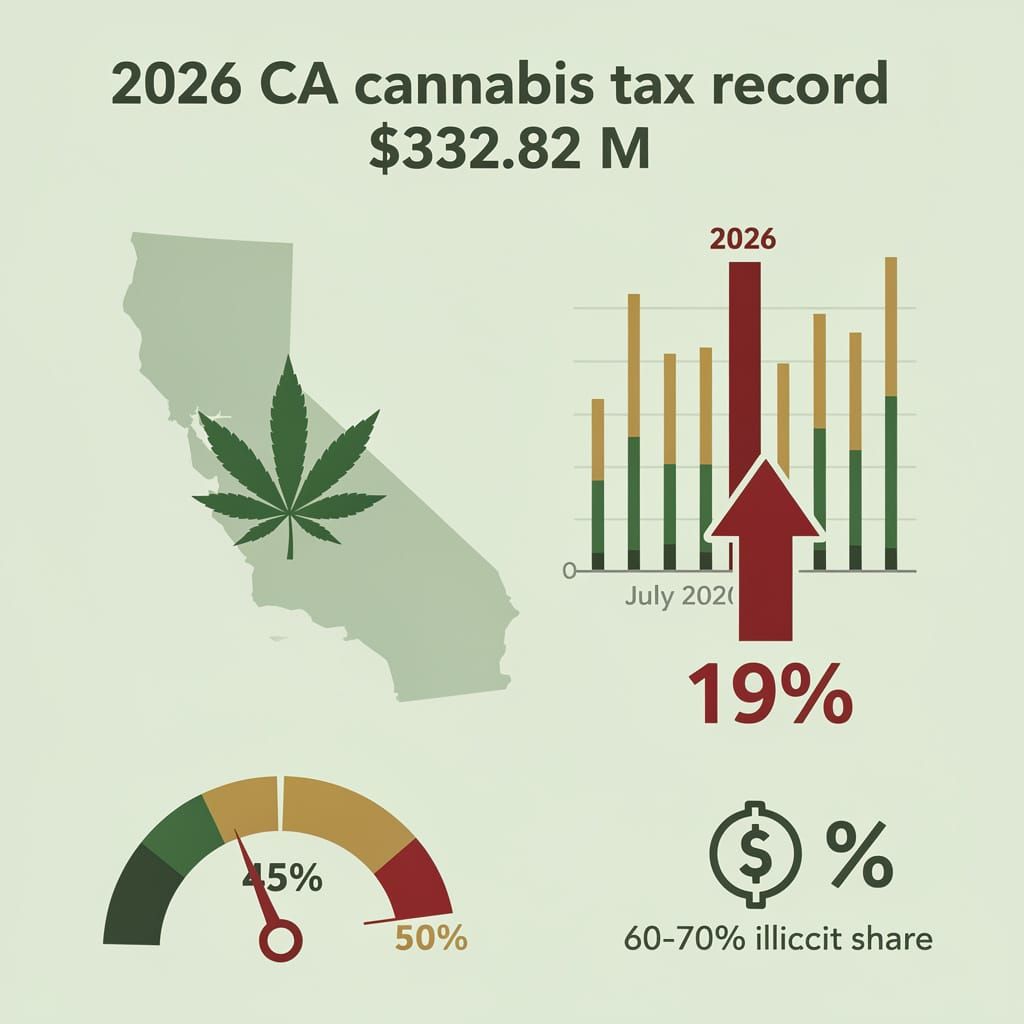
$332.82M in California cannabis tax revenue for July — a record. Sounds like a win? It's a panic buy before a 19% excise hike. 🚩 Inflation-adjusted growth is flat. Real unit demand hasn't budged. Licensed operators are absorbing costs the black market ignores. Illicit share? 60–70%. The state is squeezing a shrinking tax base and calling it growth. 6.3% is noise. 45% combined tax burden is the signal. Who actually believes taxing legal operators into extinction shrinks the black market?
The $332.82 Million Question
On July 13, 2026, California’s tax collectors tallied their biggest cannabis haul ever: $332.82 million in a single month. That’s a tidy 6.3% year-over-year gain, fueled—officials insist—by Prop 64’s steady legal framework and consumer demand that hasn’t flinched. Cue the celebration.
Except Nobody’s Celebrating
The state’s proposed 19% excise-tax hike hangs over the entire industry. So here’s the math the press release leaves out: record collections in July reflect pre-hike purchasing behavior—consumers stocking up, businesses front-loading inventory, and everyone bracing for the rougher math coming soon.
A 6.3% growth rate in nominal tax revenue, after factoring in inflation (running above 3%), suggests real unit growth barely budged. That’s not a thriving market. That’s a market holding its breath.
What Records Actually Demonstrate
- $332.82M collected in July 2026 reflects elevated compliance as much as elevated demand. The state’s home-grow permit enforcement push has squeezed smaller operators into the licensed channel.
- January–July 2026 total ran approximately $1.9 billion, tracking close to 2025’s pace. Growth has plateaued.
- The tax-hike proposal: A 19% excise increase would push California’s combined state-local cannabis tax burden past 45% in some jurisdictions—higher than any other legal market in North America.
The Causal Chain Nobody Wants to Trace
Prop 64 (2016) enabled the legal market. That market is now mature, saturated, and carrying overhead that would break any other retail sector. Record tax collections indicate one thing reliably: the state is extracting maximum revenue from a shrinking base of compliant operators.
- Legal operators absorb costs that illicit sellers bypass. Higher taxes widen that gap.
- Illicit market share is estimated at 60–70% of total consumption. Tax hikes push that number up, not down.
- Unit volume shows no acceleration. Revenue growth = price growth + enforcement drag, not consumer expansion.
What Follows, in Order
- Late 2026: Tax increase passes or fails. Either way, price volatility spikes.
- Q1 2027: Licensed operators pass costs through or exit. Expect dispensary closures in lower-margin regions.
- 2027–2028: Tax base erodes. Higher rates on fewer transactions produce diminishing returns. The state will chase the same revenue curve with higher rates, watch volume decline, and call it a compliance problem.
The Sectoral Implication
Investors tracking cannabis equities (Tilray, Curaleaf, Green Thumb) should note: California sets the tone for U.S. legal-market narratives. A 45% tax burden in the largest state market does not project sector-wide margin expansion. It projects consolidation, attrition, and a legal industry that survives on enforcement crutches rather than consumer preference. Even Canopy Growth—boasting $81.2M net revenue (+13%) and a 68% reduction in net loss—benefits from California’s tax regime only insofar as the state’s distress distorts investor expectations for every operator touching U.S. soil.
Bottom Line
Record tax receipts don’t signal a healthy industry. They signal a state maximizing extraction from a captive, shrinking tax base—and calling it growth. The 6.3% "uptick" is noise. The 19% tax hike is the signal.



Comments ()