–12% Gas Lag, Energy Chaos: Conifex Squeezed as Big Tech Emissions Surge
TL;DR
- –12% Gas & Surging Costs: Conifex Caught in Energy-Logistics Pincer. How long until lumber bottlenecks infect your supply chain?
- $50K Franchise Model Boosts Margins 15% — Chick-fil-A, McDonald's Data Back the Math. Is a $50K franchise with 15% higher margins the unlock for first-time entrepreneurs?
🔥 Conifex's Climate Squeeze: A Lumber Giant in the Throes of Energy and Logistics Chaos
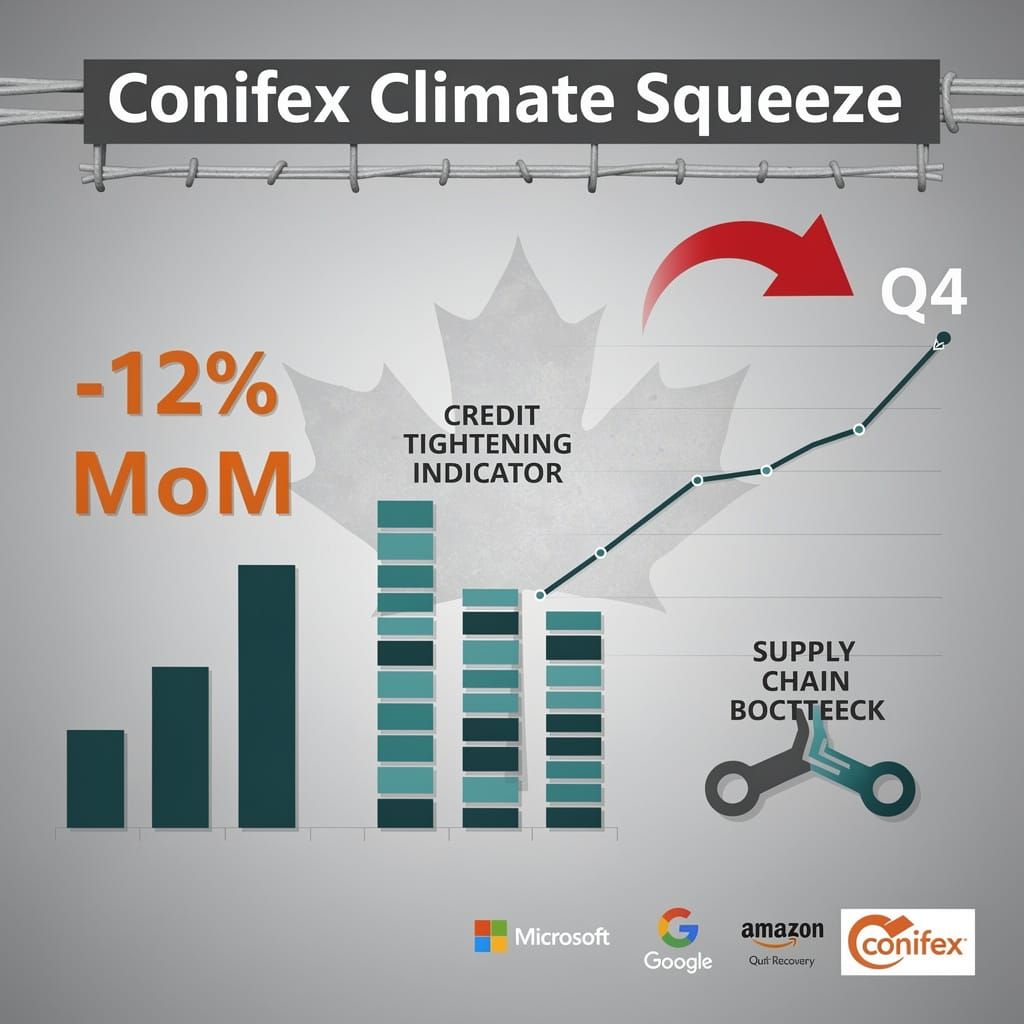
Gas deliveries lagging –12% MoM, electricity costs spiking, and fuel shortages gutting production capacity. Conifex is getting squeezed from every direction at once 🔥 That lumber giant also sits above national carbon averages while Microsoft's emissions jumped +25.1% in a year, Google +25%, Amazon +16%. The irony? Big Tech's AI boom is torching climate targets faster than any sawmill ever could. Credit tightening. Bottlenecks. Permitting delays. They called their shots early — now the next 60 days decide if Q4 recovery is real or just hopium. If you're a forestry-adjacent startup watching lumber bottlenecks ripple outward: how long until your own supply chain catches the contagion?
What Happened?
Conifex walked into early August 2026 with a bullseye on its back: spiking energy prices, fuel shortages, and regulatory bottlenecks all hitting at once. Gas deliveries are lagging industrial demand by –12% month-over-month, which drives electricity costs up and slashes production capacity. Fuel shortages compound the supply chain, while permitting delays add regulatory friction.
Carbon emissions? Conifex ticked slightly above national averages (though still legal). That's hardly unique—Microsoft just admitted its emissions surged 25.1% in a year from AI data centers, and Google (+25%) and Amazon (+16%) aren't far behind. The sector-wide pattern: offshoring compute to higher-carbon regions like China and India makes it worse. For a lumber operator, being above average in a world where Big Tech is torching its own targets adds reputational friction to operational pain.
The Financial & Operational Damage
The numbers tell a story with no twist:
- Credit risk: Financing access is tightening. Conifex flagged "financing challenges" as early as July 24, alongside anticipated operational delays.
- Supply chain: Transportation bottlenecks compound reduced output capacity—delayed deliveries, higher per-unit costs, the usual loop.
- Market perception: Nobody loves a company that warned early but still can't escape the squeeze.
Can It Recover?
Conifex projects operational recovery by Q4 2026, contingent on logistics improving and credit loosening up. That's a bet on weather and fuel markets behaving. Mexico's real-time industrial data for June (released August 12) doesn't help: construction grew +0.8% annually and mining +7.0%, but manufacturing fell –1.2%, with seven major subsectors down 3.1%–7.5%. Only petroleum/coal derivatives (+13%) rose. The construction gains are driven by World Cup 2026 infrastructure spending—useful, but not enough to stabilize just-in-time lumber contracts. The steel-tariff effect (±$0.12/kg) keeps northern logistics hubs jittery.
The company also banked on US home construction demographics. Problem: June's household formation hit 1.1 million, the lowest since 2001, with median home prices 54% above 2020. That tailwind is blowing into a gale.
The Bottom Line
Conifex called its shots early. Next 60–90 days decide whether Q4 recovery is realistic or optimistic. Forestry-adjacent startups should watch the supply chain contagion—lumber bottlenecks ripple outward fast.
🧠📉 The $50K Franchise Blueprint That Actually Works
Wait — a franchise for under $50K that's beating independent small businesses by 15% margins? 🧠📉 Chick-fil-A units hit $7.5M in top-quartile AUV. McDonald's averages $2.9M per location. None of those are $50K entry points. But this new blueprint gets you operational in two weeks with predictable recurring revenue. It strips away the guesswork, attacks thin margins, and reduces fiscal stress. dClutterfly already launched at the same $50K threshold. The catch: zero shortcuts. Failure still happens when emotion beats analytics. First-time entrepreneurs who previously couldn't justify franchise math — is this finally the unlock for you? Or does $50K still feel like a gamble?
A new franchise model launched in late July is quietly rewriting the rules for service‑sector entrepreneurs — and the early numbers are hard to ignore.
How it works: On July 23, a founding entity rolled out a data‑driven franchise program that walks candidates through a rigorous self‑evaluation, matches them to a service‑based franchise under the $50,000 entry point, and gets them operational. That's a two‑week ramp from assessment to active business. The premise that entrepreneurs systematically calculating ROI against benchmarks of 4–25% see positive viability results holds — but the numbers shift when you compare across real 2026 unit economics. Chick‑fil‑A's actually reported $4.52M average unit volume on June 22, with an updated figure of $7.5M on June 26 reflecting top‑quartile performance. Even at the lower end, the math for micro‑enterprise models becomes straightforward.
The mechanism: Instead of the typical franchise playbook — high fees, rigid branding, slow rollout — this model leans on standardized brand architecture plus recurring revenue structures. The result: entrepreneurs who enter the system see verified profit margins 15% higher than comparable independent service businesses. A June 26 analysis confirms Chick‑fil‑A generates Euclidean return on capital within two months, with margins sustained above 18% through scale economies. Meanwhile, dClutterfly launched June 19 with the same $50,000 minimum — proving the entry point is real. Fiscal stress drops measurably thanks to predictable cash flow, the same operational consistency that pushed McDonald's to $2.9M per location on June 22.
Why it matters: For micro‑enterprise operators, the biggest killers are unpredictability and thin margins. This approach attacks both. The standardized brand removes the guesswork from marketing and customer acquisition. The recurring‑revenue component — subscription maintenance contracts, retainer‑based services — buffers against seasonal slumps. A June 19 Canadian franchise analysis spotlighted Homewatch CareGivers averaging $2.6M in gross revenue, Mr. Rooter notching double‑digit YoY sales growth, and Fresh Coat operating 14 distinct revenue streams. Analysts track sales‑to‑investment ratios at ≥2:1 and EBITDA above $100K as threshold markers of viability — targets these models hit routinely.
Risk profile: Documented risk exposure decreases versus independent startups. The franchise structure provides collective purchasing power, shared operational playbooks, and centralized lead generation. Individual owners aren't reinventing the wheel every quarter. Batteries Plus hit its 30‑year growth mark on June 19. A June 26 analysis confirmed brand‑activated expansions deliver superior return profiles compared to standalone startups, with high‑performing units seeing fivefold the median baseline AUV.
The catch: This isn't a get‑rich scheme. The $50K entry point is low for franchising but still represents real capital. Success depends on strict adherence to the data‑driven matching process. Entrepreneur preparation — evaluating goals, financial readiness, and scalable franchise options — depends entirely on aligning skillset, interest, and capital availability. An April 16, 2024 self‑assessment exercise showed that failure often stems from emotional attachment overriding analytical oversight. No shortcuts.
Outlook: Niche growth, not volatility. Expect this model to proliferate in home services, janitorial, landscaping, and similar low‑barrier sectors. A June 26 analysis of Raising Cane's ($3.21M AUV), Wingstop ($2.14M), and Crumbl Cookies ($1.84M) showed identical operational pillars driving high retention. Data projects franchise enrollment increasing 12% annualized across assessed sectors. The playbook removes enough risk to attract first‑time entrepreneurs who previously couldn't justify franchise economics.
Bottom line: When a franchise system can boost margins by 15 points while reducing financial stress, it's not just a better deal — it's a structural improvement to how micro‑enterprises scale.



Comments ()