Pension Shell Game or Russian Oil Farce: Europe's Twin Accounting Tricks — €50B Deficit Deferred, $10,000/L Cap Ignored
TL;DR
- ¥€50B Widow's Pension Swap: Germany's Rent-Splitting Defers, Not Cuts, Liability. Is rent-splitting real reform or just kicking the pension can down the road?
- $10,000/L Oil Cap: 21,000x Market Price, Zero Impact — India, China Prove the Farce. Did the $10,000/L oil cap change anything for your wallet?
🤡 The Widow's Pension Swap: Fiscal Gimmick or Genuine Fix?
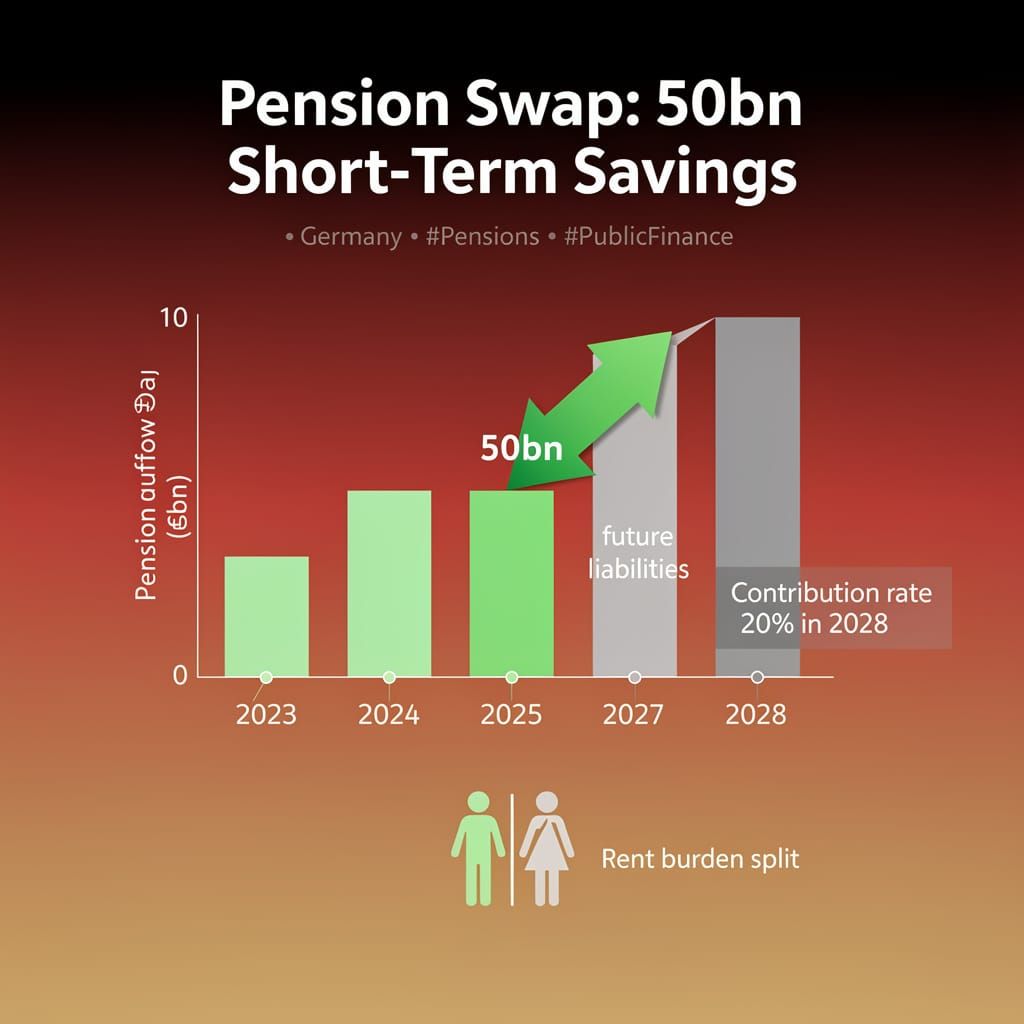
Germany "saves" ¥€50 billion/year by abolishing widow's pensions and swapping in rent-splitting. That's one-eighth of the entire state pension bill. Neat trick — except it just defers the same liability to tomorrow. Contribution rates are still heading to nearly 20% by 2028. A shell game isn't reform. 🇩🇪🤡
A ¥€50 Billion Bet on Rent‑Splitting
Economist Martin Werding's August 8 proposal to abolish Germany's widow's pension—a ¥€50 billion annual outlay, representing one‑eighth of total state pension expenditure—and replace it with a "rent‑splitting" model sounds surgical. Couples would share accrual points instead of inheriting benefits. The stated goal: immediate cost compression. The unstated risk: this is a shell game dressed as reform.
The Arithmetic That Doesn't Add Up
The math is straightforward, and troubling. Cutting ¥€50 billion from current payouts reduces today's pension expenditure, yes. But rent‑splitting defers—not eliminates—liability. Accrual redistribution pushes costs forward, compressing the present while inflating future obligations. The government's own July 4 announcement already projects pension contributions climbing by up to two percentage points annually, reaching nearly 20 % by 2028. Werding's framework does not alter that trajectory—it merely relabels the shortfall. The question is whether the current government is trading a manageable hike now for a steeper spike later.
Fiscal relief (short‑term): ¥€50 billion annual reduction in state outflows. Fiscal burden (mid‑term): Higher contribution rates as rent‑splitting accruals mature—the ZDH's July 4 demand for a second reform package underscores that the first round already fails to contain costs. Structural risk: Undermines prior reforms (e.g., raising the retirement age to 70, announced June 22) by reallocating rather than reducing systemic dependency. The same commission that raised the retirement age also abolished "Pension at 63"—yet the widow's pension swap simply pushes liabilities sideways.
Undone by Its Own Logic
The proposal's central contradiction: rapid cost‑cutting is the selling point, yet opposition delays implementation precisely because postponement pushes the scheme into later phases. If the plan were truly stable, why insist on acceleration? Conservative MPs, including Friedrich Merz's faction, remain skeptical—not because they oppose austerity, but because they recognize a gap between "savings" and "genuine solvency."
The primary concern is unaddressed: whether accelerated savings translate into long‑term stability, or whether they simply enable crisis‑induced contribution hikes in the next decade. The June 22 Merz pension package already spikes social welfare expenditure by €3.1 billion annually while dropping workforce participation 2.3 %. Adding a rent‑splitting gimmick on top does not fix the structural deficit—it just changes which year's ledger takes the hit. And the June 12 standard pension increase of 4.24 % for 21 million beneficiaries, funded through institutional compliance, further corroborates that the system's direction is toward higher payouts, not lower—making Werding's cost‑cutting premise look even more detached from reality.
The bottom line: ¥€50 billion in immediate paper savings, but zero evidence the pension system exits its structural deficit. Rent‑splitting reconfigures the burden; it does not lift it.
🎭 The $10,000-a-Liter Oil Fantasy
$10,000 per liter for Russian oil — 21,276x the spot price. That's not a policy, it's a press release with delusions of grandeur 🎭 India just imported a record 2.8M bpd of Russian crude the same week. China locked in Power of Siberia-2. Diesel prices are heading up while Moscow's revenue dips from drone strikes, not from Washington's fantasy number. The tariffs have actual teeth. The cap is theater. American consumers get the bill. India's import bill climbs 8–12%. And the Senate gets a headline. What exactly changed on the ground for you?
August 12, 2026
The U.S. Senate passed sanctions on August 8 capping Russian oil at $10,000 per liter — a figure roughly 21,000 times the current market price of $0.47. A second, broader package passed August 9 authorizes 500% tariffs on Russian oil and gas imports and 100% tariffs on top five buyers — China ($7.3 billion) and India ($5.5 billion) — while targeting Russia's shadow fleet, which now carries an estimated 54% of maritime shipments. The legislation, named after the late Sen. Lindsey Graham, awaits House approval after September 2026.
None of this matters yet.
What the Numbers Actually Say
India imported 2.8 million barrels per day of Russian crude on August 10 — a record, at 55.5% of total shipments. That's up from June's 50% share (2.7 million bpd) and far above May's 36.5%. The $5.5 billion monthly hydrocarbon tab includes coal and refined products. Alternative ports like Mundra (+58%) and Vadinar (+35%) absorbed volumes declining at Paradip. India's refiners halted discounts on Russian crude as far back as July 23, not because of sanctions, but due to unrelated Middle East supply shocks. The price mechanism already did what Washington's headline numbers pretend to accomplish.
The Real Machinery
The August 9 package includes tariff powers up to 500% on energy products, enforced through presidential decree requiring trade representative certification, with a 99-day implementation window. The July 14 Sanctioning Russia Act had already authorized 100% tariffs on China and India — Beijing's foreign ministry called it "self-defeating" on July 16. But the $10,000/L cap is pure performance. No trader pays 21,276 times the spot rate. The teeth are in the tariffs and the shadow-fleet provisions.
What Actually Happens Next
Refiners face a calculus that ignores the ceiling entirely:
| Option | Cost | Timeline |
|---|---|---|
| Switch to Iraqi/Saudi crude | $4–6/barrel premium ($2M/VLCC) | Immediate |
| Keep buying Russian | Legally risky, Western banks refuse financing | Instant |
| Build alternative infrastructure | Capital-intensive | 18–24 months |
Banks, insurers, and shipping firms enforce the real sanctions. The safest compliance answer is "refuse all Russian crude." That works — except China bought Russian crude at $68/barrel in July, finalized Power of Siberia-2 pricing in May, and absorbed a 53% surge in Russian fish and seafood exports by value. Indonesia accepted 770,000 barrels at Balikpapan on July 9 for $75 million. Every sanctions loophole closed opens a new buyer.
The Structural Erosion
Russia extended its gasoline export ban through January 2027 on July 30, with domestic prices jumping 19% to $3.69/gallon after Ukrainian drone strikes crippled refineries. The Kremlin's export capacity shrinks from within, not from Washington. Shadow-tanker activity spikes, and illicit LNG routing channels grow — the August 10 CREA briefing confirms structural revenue erosion through evasion, not enforcement.
| Metric | Pre-Sanctions | Projected Q4 2026 |
|---|---|---|
| India Russian crude imports | 1.5M bpd | 0.4–0.6M bpd (with enforcement) |
| India blended crude cost/bbl | $75 | $79–83 |
| Russia oil export revenue | ~$185B/year | $155–165B/year |
| US diesel import price | $2.85/gallon | $3.10–3.40/gallon |
The Farce in Full
The $10,000/L cap is a headline, not a lever. The tariffs create genuine supply-chain friction — American consumers will see diesel prices rise, India's import bill will climb 8–12%, and Russia's revenue will erode. But India just set a record at 55.5% Russian crude share. China locks in long-term pipeline deals. Russia's revenue declines because drone strikes crater its refinery capacity, not because a Senate bill picked an absurd number.
If the goal was to signal toughness while achieving nothing measurable, congratulations — mission accomplished. If the goal was to disrupt Russian energy revenue, the tariffs might work. The $10,000/L cap is just the world's most expensive press release.



Comments ()