50 Users, Zero Co-Founders: The Solo B2B SaaS That Proves Traction Isn't Scale
😬 The 50-User Founder: When a Side Project Becomes (Sort of) a Business
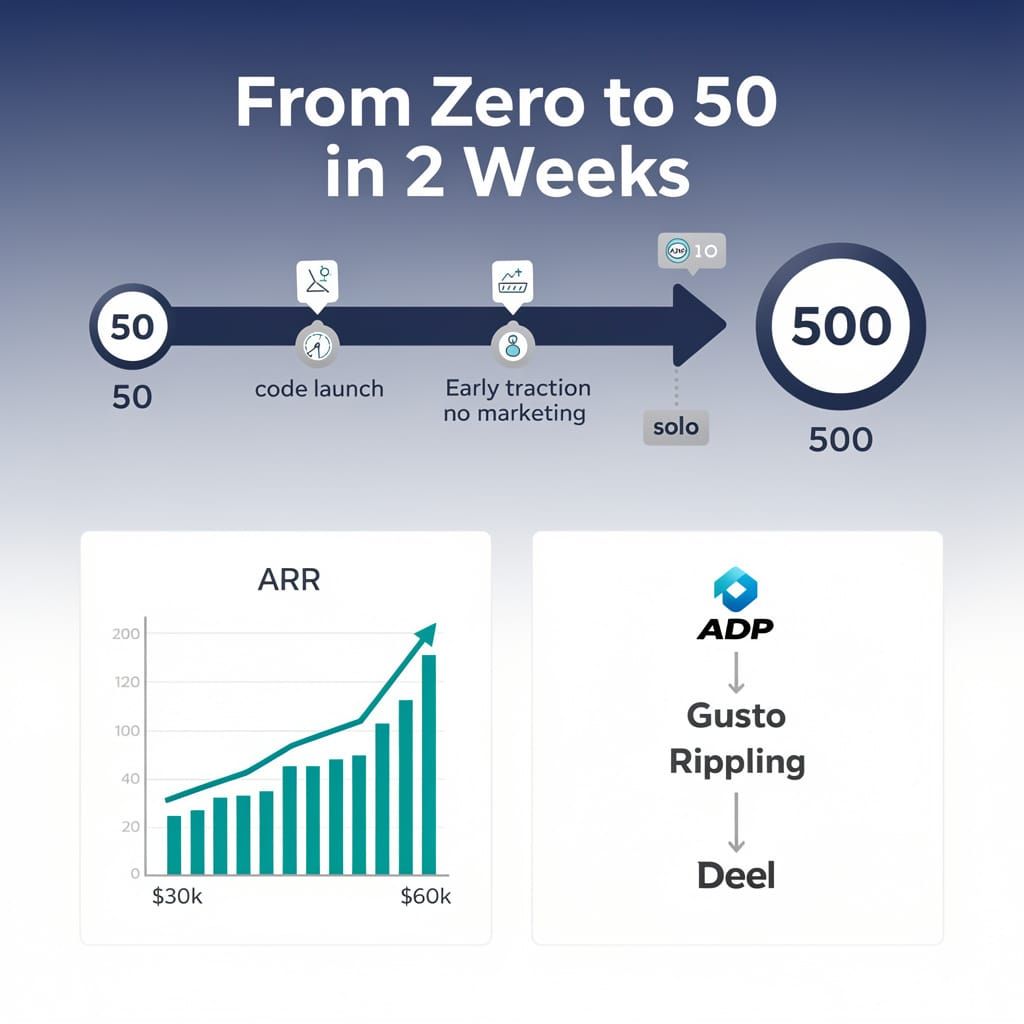
A solo dev just hit 50 paying B2B payroll compliance users in 2 weeks — zero marketing, zero co-founders, just code and a hunch. That's ~$30K–$60K ARR. Enough for rent. Not enough to survive the US market. 😬 Meanwhile, AI-native platforms that process payroll across all 50 states in seconds already exist, and the market is consolidating toward unified HCM giants. Standalone compliance tools that don't integrate? Dead on arrival. So question is: does this founder scale to 500 users — or get swallowed by a machine that never sleeps? What would you do: chase venture growth or keep the lifestyle business?
What Happened?
Late July, a lone developer quietly launched a B2B SaaS platform aimed at enterprise payroll compliance. By August 2nd, 50 active subscribers. Not a unicorn. But 50 paying customers in two weeks, with zero marketing budget and zero co-founders, is the kind of move that makes angels glance at their phones—especially when over 200 U.S. angels recently committed to AI builder ventures, and a different solo founder just landed a $30M Series B for an AI-native sales platform processing 20 million automated CRM updates monthly.
The Causal Chain
- July 15: Developer launches the platform. Solo. No team. No funding. Just code and a hunch.
- July 25: Formalizes the venture. Still solo. Posts for a co-founder to help digitize forms.
- August 2: Hits 50 active subscribers. Early validation—but scaling capacity remains zero.
The correlation is simple: a clear pain point (payroll compliance) + a lean solution = early traction. But correlation also exposes the flaw: 50 users for a payroll tool is proof of concept, not proof of scale.
The Ugly Math
50 subscribers at roughly $50–$100/month per seat yields about $30,000–$60,000 in annual revenue. That covers rent and coffee. It does not cover a sales team, North American market entry (the real growth lever), or the co-founder runway needed to stop being a one-person show.
The Real Signal
What this actually indicates: payroll compliance is a sticky, miserable problem that businesses will pay to ignore. On July 28, just days before the 50-user milestone, a different pre-revenue health tech SaaS startup hired a Chief Commercial Officer at $100k base plus performance bonuses—tasked with building a GTM engine from scratch with fewer than 5 clients averaging $3K–$30K ARR. That firm is betting on founder-led risk before chasing scale. The payroll founder is running the same play, minus the hired gun. Meanwhile, analyst briefings from June 2026 confirm the market is consolidating toward unified HCM platforms that bundle payroll, benefits, and compliance—meaning standalone tools face increasing pressure to integrate or die. Three weeks before the payroll founder's launch, Kyber's AI-native document platform reached profitability on $40x revenue growth over 18 months by automating insurance compliance workflows. The pattern is obvious: AI-native compliance automation is where the money flows.
What Happens Next
- Near-term: The founder either hires a co-founder (the July 25 post suggests awareness) or burns out trying to be CEO, CTO, and support desk. The Cost of Cancellations metric—introduced by a SaaS firm back in 2013 as p×MRR×c—shows that exponential revenue decay follows when retention isn't built in from the start. SaaS pricing is also shifting from seat-based to credit-consumption units, which decouples compute expense from headline subscriptions. If our founder doesn't anticipate that pricing shift, 50 users acquired becomes 50 users churned.
- Mid-term: North American market entry is the real test. US payroll compliance is a different beast. On June 30, an AI-native platform launched that runs payroll across all 50 US states in seconds, with compliance agents that monitor regulatory changes and resolve agency notices automatically. That's the competitive reality. If our founder's platform adapts, 50 users becomes 500. If it doesn't, it gets eaten by a machine. Meanwhile, Raise Us—a new $500 million workforce retraining initiative—is already enrolling displaced workers in Arkansas and Connecticut, signaling that AI-driven labor displacement isn't theoretical.
- Long-term: If this stays a UK-only compliance tool, it's a lifestyle business—respectable, profitable, but not venture-backable. The payroll software market is already consolidating toward integrated HCM platforms (ADP, Gusto, Rippling, Deel), and the pricing models that succeed are the ones that align with user value perception, not feature dumps.
The Takeaway
50 users in two weeks isn't a headline. It's a hint. The founder has shown they can build something people need. The next 90 days will show whether they can build something people pay to scale—and whether that thing survives the platform machines already running at full speed.

Comments ()