📉 Buffett Cedes Chair to Son, Abel Runs the Machine
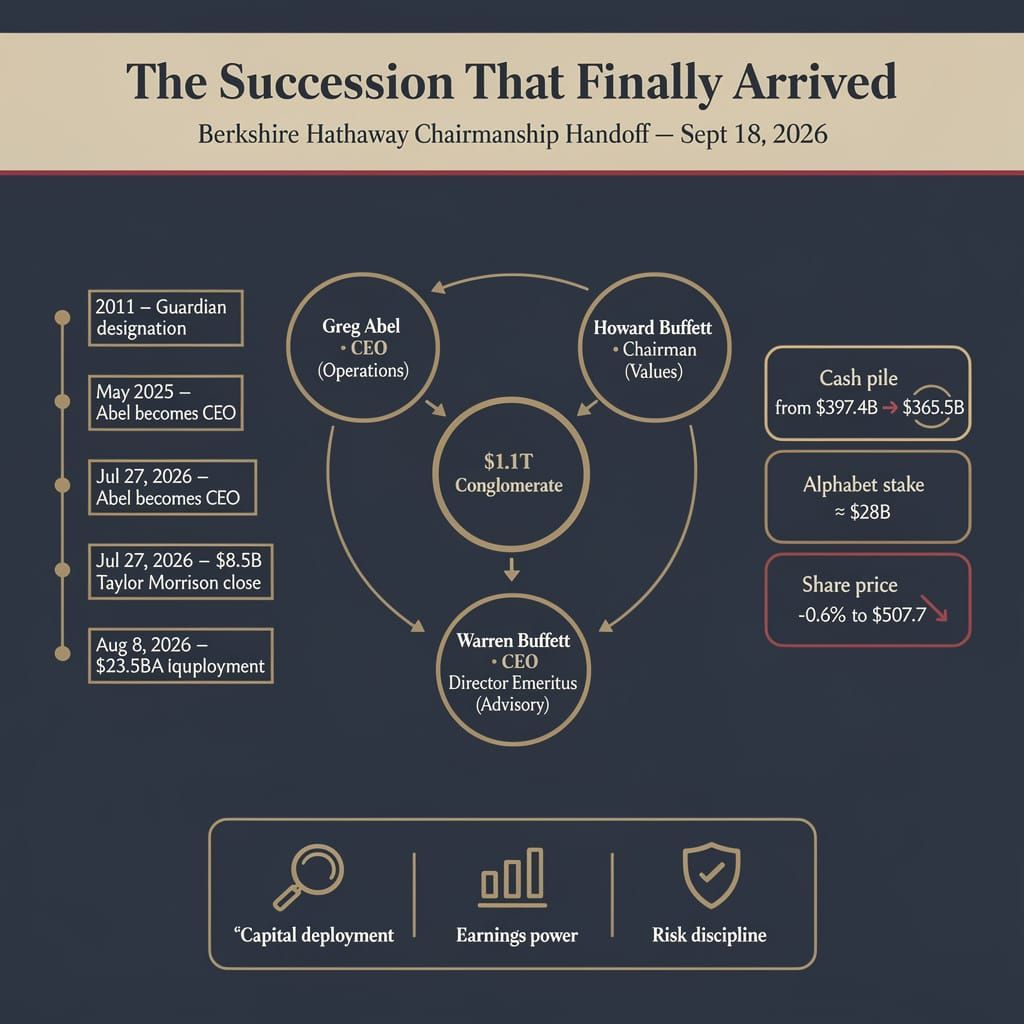
Berkshire Hathaway slips 0.6% to $507.7 as Warren Buffett hands the chairmanship to son Howard. 📉 The $1.1T conglomerate now splits control—Greg Abel drives operations and deals, Howard guards the culture. Abel's already spent $32B on tech and real estate. Berkshire's biggest test: can three leaders outlast one? Would you trust leadership continuity over fresh perspective?
Warren Buffett has ceded the Berkshire Hathaway chairmanship to his son Howard, effective Sept. 18, 2026, while remaining a director and chairman emeritus—the closing act of a transition that began with Greg Abel's CEO appointment in May 2025. Berkshire shares slipped 0.6% to $507.7 on the news.
The Succession That Was Built to Outlast One Man
Warren Buffett designated Howard, then a board member, as Berkshire's "guardian of values" back in 2011—15 years before the role actually transferred. The arrangement answered a specific operational question: how a $1.1 trillion conglomerate maintains decision authority and cultural continuity when its founder can no longer run it. Buffett's answer was structural rather than personal—splitting operational control (CEO Greg Abel) from cultural stewardship (chairman Howard), with Buffett himself retained as director-adjunct during the handoff window.
The Observed Operating System
For decades, Berkshire ran on Warren Buffett's personal capital-allocation discretion, a model that required one individual's judgment over almost everything that mattered. The observed system now distributes that authority across three distinct nodes: Abel runs operating businesses and investment management, Howard chairs the board and carries the public-facing values mandate, and Warren remains on the board to advise. What changed is the locus of final authority, not the portfolio—and the change is empirically visible.
Since taking the CEO seat, Abel has not waited for the handoff to finish. On July 27, 2026, he closed an $8.5 billion purchase of Taylor Morrison, folded into Berkshire's 15-homebuilder group via Clayton Properties, while deploying surplus toward tech stakes including a roughly $28 billion Alphabet position. Days later, on Aug. 8, he spent $23.5 billion on equities and cut Berkshire's cash pile from $397.4 billion to $365.5 billion—a velocity of deployment that never characterized Buffett's late-era caution. Abel is running the allocation machine, not merely holding it.
Behavior and Consequence
Buffett's stated reasoning for the chairmanship appointment was blunt and transparent: he took the role "because it is my son." That candor indicates an actual concession—Buffett acknowledging the chairmanship exists to preserve continuity, not to maximize fresh perspective. The behavioral consequence for employees and subsidiary leaders is a defined reporting and escalation path. For the first time in six decades, no decision at Berkshire requires routing through Buffett's personal judgment; Abel's active buying and selling confirms that authority is live, not nominal.
Why the Design Produces This
The sequence was engineered to prevent a single abrupt shock. Abel took the CEO seat 16 months before Howard took the chair, giving the market, subs, and employees an adjustment period that Abel used to establish an independent track record—the Taylor Morrison close and the cash redeployment are evidence the operating CEO was already operating. Howard's long director tenure means the board's cultural authority isn't new to him. Warren's retained directorship and chairman-emeritus status keeps an advisory channel open without operational veto.
Counterevidence and Limits
The arrangement's durability is untested. Howard's prior work—security analysis, Illinois farming, international development in El Salvador and Ukraine—does not include running a diversified operation, making his role cultural more than operational. Family succession introduces tension between kinship loyalty and shareholder return; Buffett's own admission that kinship, not merit, drove the pick is the strongest honest limit. Whether the three-node split persists after Buffett exits the board entirely is open—and whether Howard's "guardian" mandate becomes a brake on Abel's aggressive deployment remains the chief unresolved tension.
Three Design Implications and Monitoring Questions
- Authority handoff pacing matters more than the headline event. Watch how long Warren's advisory role persists and whether Abel's sustained buying sprees continue—each confirms whether operational control is genuinely transferred.
- Cultural stewardship and operational control are separable, but their tension is measurable. Abel's diversion of nearly $32 billion into tech and real estate against a chairman whose stated role is preservation flags a live divergence worth tracking in board disclosures.
- Kinship-based appointments carry trackable risk. Watch Berkshire's governance disclosures and director departures over the next 24 months as indicators of whether independent oversight holds alongside family authority—while monitoring whether Abel's aggressive cash burn trails the 5%-plus daily drawdown reported in August.

Comments ()