$1.269B for 0.03 CPI: The Philippines' Reserve-Burning Math Doesn't Add Up
TL;DR
- Peso Rescue: $1.27B for 0.03 Inflation Point — BSP's Expensive Arithmetic. Is the BSP defending the peso or just defending its own credibility?
- ¥164 to ¥156.9: U.S.-Japan Yen Intervention Masks a Rate Chasm That Won't Close. Can FX intervention fix a 250bps rate gap, or is this just kicking the carry trade can down the road?
🇵🇭 The Peso's Little Dance: A 0.03-Point Inflation Story
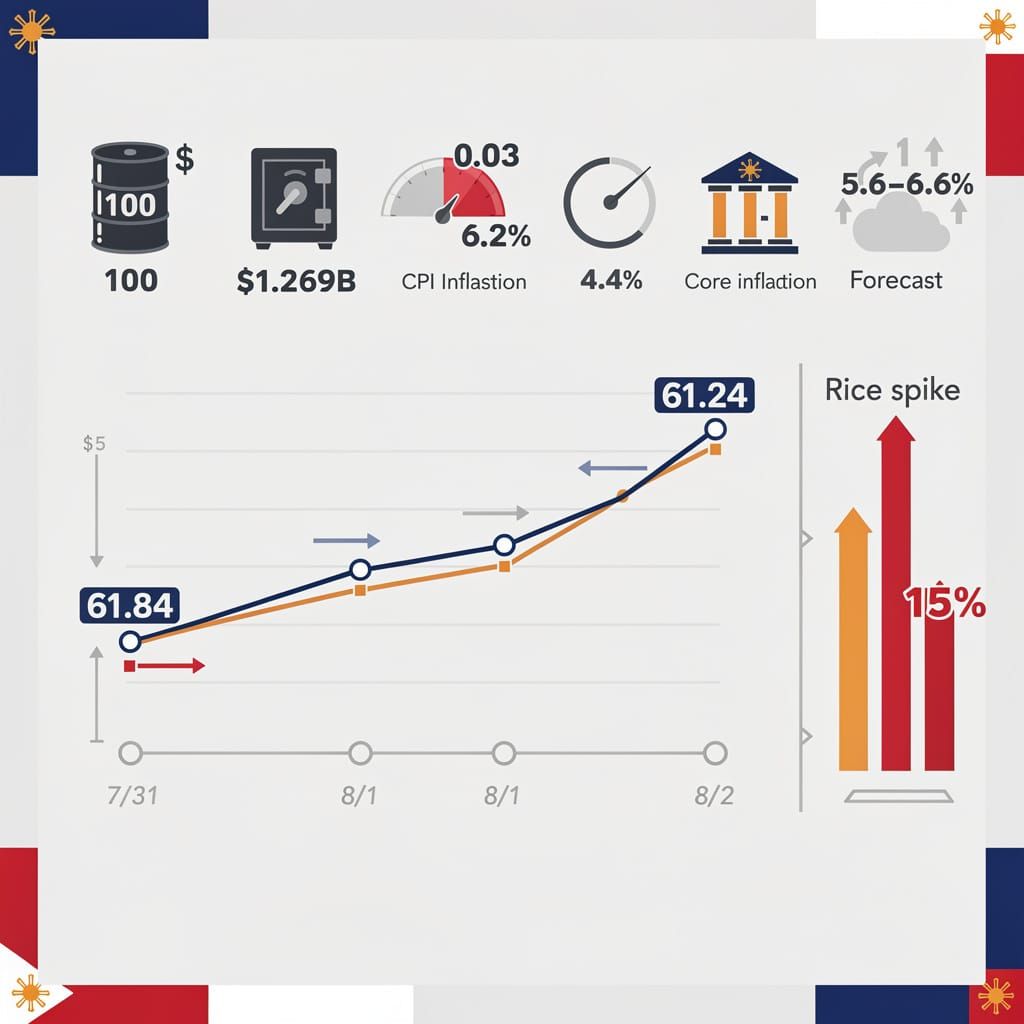
P61.84—peso's weakest in 2 months. BSP burned $1.269B in reserves for a 0.03-point CPI nudge 🇵🇭 That's $9 billion per peso point defended, so your gas costs P11.70 less than it otherwise would. A neat narrative: oil spike, rate hike, peso saved. Except the peso was down 4.79% YTD before Iran. Rice up 15%. Core inflation stuck at 4.4%. "Resilience" is not health. Policy rate at 4.50%, inflation nearly double the target, and impeachment proceedings the same week—who's still buying the credibility story?
Markets love a good drama, and the Philippine peso obligingly gave one in late July—dipping to P61.84, its weakest in over two months, before staging a heroic recovery to P61.24. A 0.60-peso bounce on weak US GDP. Call the history books.
Let's trace the causal chain the analysts want you to believe: US-Iran tensions escalate, oil breaches $100 a barrel, the peso flinches, the central bank sells $1.269 billion in reserves to halt the slide. Import bills rise, annual CPI climbs by approximately 0.03 points, household budgets take a hit. A neat narrative. Too neat.
The arithmetic nobody wants to do: $1.269 billion is roughly 2% of the Philippines' gross international reserves. Deployed to defend a currency that hit a yearly low—P61.84 on July 31. The central bank intervened "minimally" this time, fearing reserve loss. That works out to roughly $9 billion in intervention per peso point defended. For an inflation impact of 0.03 points. The BSP's balance sheet took a beating so that your gasoline might cost P11.70 less per liter than it would otherwise.
What the narrative conveniently ignores: the peso was already down 4.79% year‑to‑date before any Iranian saber‑rattling. Jakarta's PSEi closed below prior levels on August 2 precisely because investors were awaiting GDP data, not geopolitical shocks. The "Middle Eastern tensions" explanation masks a structural erosion—a current account deficit, slowing remittance growth, and an import dependency that makes every oil spike a tax on the poor. Never mind that headline inflation actually cooled to 6.2% in July—still nearly double the 2–4% target band, and the lowest in four months precisely because rice and meat prices cheapened 15% and 2% respectively, not because the peso suddenly found religion.
The institutional response worked in the narrowest sense: no crash. But resilience is not the same as health. The BSP raised its policy rate to 4.50% in June after forecasting inflation would exceed targets consecutively—Metrobank projected May inflation at 7.3%—while core inflation tracked an uncomfortable 4.4% in July, excluding those volatile items the government would rather not talk about. Former Deputy Governor Diwa C. Guinigundo warned that political instability, not oil, poses the greater risk to the Philippine economy. That impeachment proceedings and an imminent senator arrest occurred the same week as the rate hike tells you everything about the credibility gap.
The forecast: 5.6–6.6% through year-end, per the BSP's own range. P61.60–P61.80 through October, assuming OPEC+ behaves. That is not a prediction; it is a hope dressed up as modeling. By August 2, the peso had already strengthened to P61.24 on weak US GDP data, making that narrow band look suspiciously like wishful thinking. If Russia's war reignites supply chains or the Middle East talks stall, that $1.269 billion buys less time than it did in July. Diesel hit P26.19/L on August 3; kerosene P23.89/L. Traders are pricing volatility, not stability.
The peso story is micro-scale stability paid for with macro-scale exposure. A 0.03-point CPI nudge is technically manageable. For families watching rice prices climb 15% and core inflation stay above 4.4%, "technically manageable" is a luxury statisticians afford themselves.
The currency held. The vulnerability did not.
🎪 The Great Yen Charade
¥164 → ¥156.9 in hours — but that 7-yen "rescue" already fading. The Fed holds at 3.5–3.75%, BOJ at 1%. A 250bps gap no intervention can close. Bessent's $5–$10B program is just taxpayer-funded triage on a sinking carry trade. Japan spent ¥11.73T in one day and got weeks of stability. Who's left holding the bag when Washington's patience runs out? 🎪
Buying Time, Not Changing Reality
The United States Treasury, under Scott Bessent's watch, joined the Bank of Japan in aggressive yen-buying operations on August 1 and 3—two coordinated sessions that lifted Japan's currency toward its strongest level in weeks. On August 3, the NY Fed purchased JPY using euro reserves while the BOJ increased its own buying, pushing the yen to ¥156.9 from below ¥164. Bessent later announced a $5–$10 billion program on August 4. The official rationale: "strong finances" and "geopolitical coordination." The subtext reads differently.
The mechanics: The Fed holds rates at 3.5–3.75%. The BOJ persists at 1% after its June 16 hike—its highest since 1995, the Nikkei 225 closing near 70,000 that same day. That 250-basis-point gap makes the yen a carry-trade piñata—borrow cheap in Tokyo, lend dear in New York. Treasury's intervention doesn't close that gap; it just subsidizes the other side of the trade temporarily. The BOJ spent ¥11.73 trillion (~$73.7B) on July 13 alone, selling $75.6B in U.S. Treasuries to fund it—and another $73.5B on June 6. The results speak for themselves: the yen still traded near ¥160 within weeks.
The results: The yen stabilized—barely. Export sectors got a brief reprieve on carrying-cost risk. But structural deficits continue widening. Japan's current-account fundamentals haven't improved; the currency just got a steroid shot from Washington's balance sheet.
What the Data Actually Says
- August 1–3, 2026: Coordinated USD/JPY intervention across multiple sessions, the first time the U.S. has openly participated in yen-buying since the Plaza Accord era.
- August 3 intervention specifics: NY Fed bought yen using euro reserves, BOJ joined. Yen rose from sub-¥164 to ¥156.9, stabilizing above 150.
- August 4 announcement: Bessent confirms $5–$10 billion joint program; Finance Minister Satoshi Katayama calls it Japan's first joint rate move with the U.S. in 15 years.
- Outcome: Yen lifted to its strongest level in weeks—a recovery measured in days, not quarters.
- Forecast window: 155–160 yen per dollar through September, assuming intervention patterns hold. Goldman Sachs raised its USD/JPY target to 165 on July 6. Analysts project ¥180 within twelve months as carry trades persist.
The Uncomfortable Questions
Is this sustainable? No. The Fed shows no inclination to cut. The BOJ shows no capacity to hike meaningfully without cratering its sovereign debt market (Japan's government debt exceeds 250% of GDP). The rate differential remains structural, not cyclical. One analyst noted the intervention's "failure to sustain momentum" highlights the fragility of FX moves lacking structural policy alignment.
Who actually benefits? Japanese exporters and U.S. importers get short-term relief. The broader narrative—that coordinated intervention signals confidence—looks more like a rear-guard action masking unresolved monetary divergence.
What's missing? Washington and Tokyo haven't addressed the core mechanism: capital flows chase yield differentials. Buying yen doesn't change the Fed's rate stance. It doesn't change Japan's demography-driven deflationary gravity—an aging workforce has accelerated real wage erosion, and nominal wage growth above 3% monthly hasn't translated into sustainable demand. It just adds taxpayer money to the losing side of a trade the market keeps winning. The BOJ's own governor warned on May 29 that oil-driven inflation could become permanent—yet rate normalization stalls at 1%.
The Outlook
| Timeline | Projection | Caveat |
|---|---|---|
| Through September 2026 | Yen holds 155–160 | Requires continued intervention at current pace |
| Q4 2026–Q1 2027 | Renewed downside pressure toward 165 | Goldman target; no Fed pivot priced in; BOJ remains dovish |
| 12-month horizon | ¥180 per dollar possible | Carry-trade dynamics persist; structural issues unresolved |
Treasury's involvement signals one thing clearly: the U.S. fears a disorderly yen collapse more than it fears the market's judgment on its intervention policy. That's not conviction. That's triage.
Comments ()