⚖️ Tesla's Self-Driving Rollout: Mutual Recognition, Regulatory Backlash
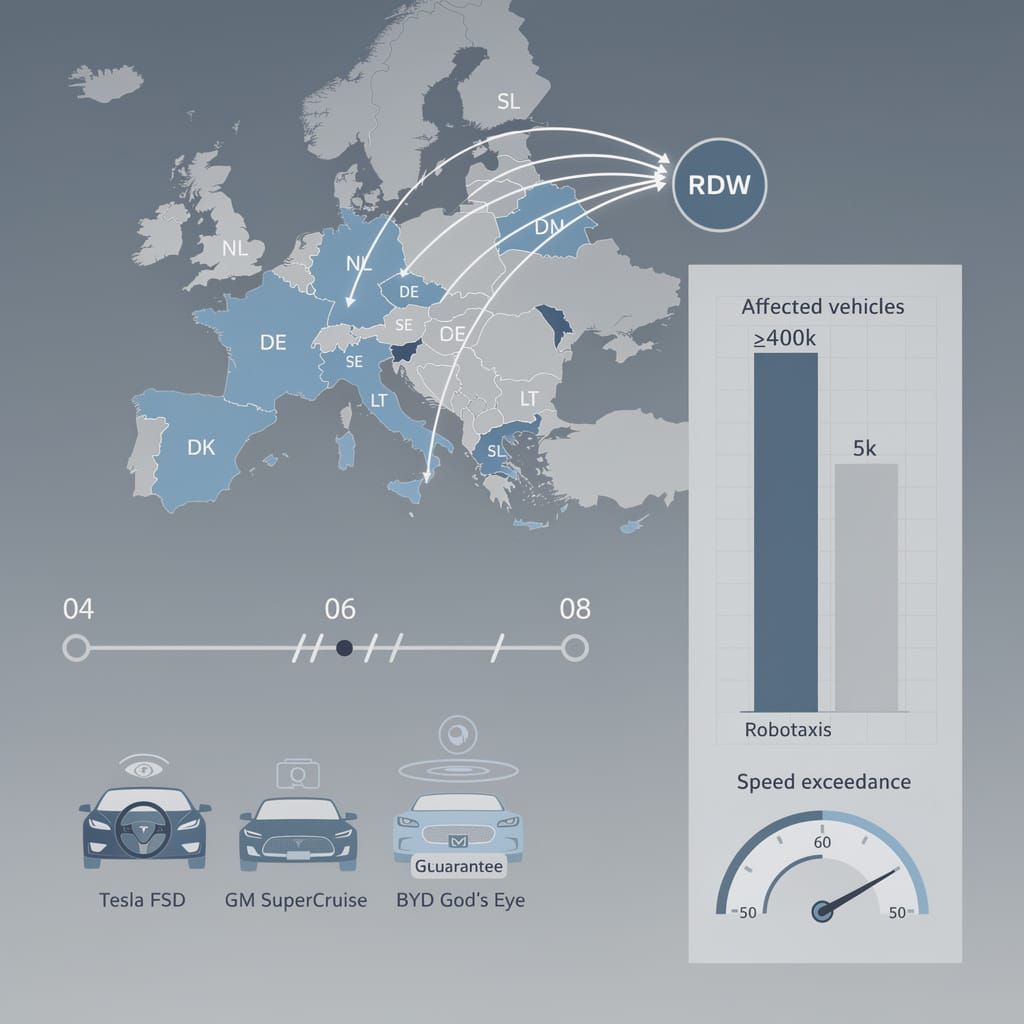
FSD was approved across 7 EU states via mutual recognition — yet each later launched enforcement actions on attention-monitoring gaps. GM's SuperCruise, by contrast, was built around driver attention from the start. A system that reduces disengagement rates by narrowing its operational envelope does not improve safety. If the metric is ambiguous, what is the actual safety baseline for vehicles on your roads? 🚗⚖️
On September 12, 2026, Representative Raja Krishnamoorthi's office released a summary of escalating enforcement measures against Tesla's Full Self-Driving (FSD) system. The interventions span Denmark, Illinois, Lithuania, Belgium, California, Estonia, and Slovenia—seven distinct regulatory bodies acting on a technology that, by market capitalization, is valued as though it has already solved autonomy.
The Mechanics of Distrust
The enforcement sequence is instructive. Between April and September 2026, the Netherlands' RDW approved FSD, triggering a mutual-recognition cascade across EU member states—Lithuania (May 20), Estonia (May 29), Denmark (June 9), Belgium (June 10), and Slovenia (September 7). Yet two months after Slovenia's approval, Krishnamoorthi's investigation documented enforcement actions, not endorsements. On August 7, 2026, the Dutch RDW publicly rebuffed requests for detailed safety documentation supporting its Green Light decision, citing proprietary concerns. Regulators in Estonia and Slovenia—nations without domestic automotive lobbies to protect—granted market access while their enforcement arms simultaneously pursued corrective measures. The pattern indicates independent safety assessments converged on the same conclusion: the system required post-hoc corrections after deployment, not preemptive validation. Sweden's Transport Administration voted against EU-wide rollout on June 19, 2026, explicitly citing speed offset removal as an unresolved risk.
Who Is Watching the Driver
Cabin-camera gaze detection exists today in Toyota's Driver Monitoring System and GM's SuperCruise. GM reported 70% SuperCruise subscriber revenue growth in Q2 2026, adding 70,000 subscribers and reaching approximately 160,000 active users, with 30–40% of owners retaining payment after the trial period. The system was designed from the start with driver attention as a core requirement, not a regulatory retrofit. Tesla's implementation, by contrast, was compelled by external pressure. The FSD v14.3.3 release on May 17, 2026, added enhanced eye-tracking and driver-monitoring profiles—a recognition that the system could not reliably enforce attention without software-level intervention. By July 21, 2026, a driver operating FSD in Standard mode near Montreal exceeded a 50 km/h speed limit to 78 km/h; manual throttle input was logged, yet FSD remained engaged. The difference between GM and Tesla is not philosophical. It is the difference between engineering for a problem and engineering around a regulator.
What the Numbers Do Not Show
Tesla's fleet reports declining intervention rates per mile. On June 4, 2026, Tesla integrated driver-performance incentives and anonymized intervention data into its training pipelines, creating a feedback loop where the system learns to avoid edge cases by refusing to engage them. That metric is ambiguous. A system that reduces disengagements by narrowing its operational envelope does not improve safety; it reduces opportunity for mishap. Reuters reported on May 29, 2026, that internal witnesses described frequent near-misses, and investigators challenged the company's safety metrics. An independent study published May 28, 2026, adjusted Tesla's claimed safety advantage down to approximately 3× after correcting for data-labeling flaws. BYD, by contrast, announced on June 1, 2026, a one-year, no-cap liability guarantee for its 'God's Eye' system in China, setting a precedent for accident coverage that Tesla has not matched.
Fleet-Level Calculus
- May–August 2026: Seven EU member states approved FSD Supervised via mutual recognition; Denmark, Belgium, and Slovenia joined Estonia, Lithuania, and the Netherlands in approving the system. Simultaneously, regulators in each jurisdiction initiated enforcement measures targeting cabin-camera and attention-monitoring gaps.
- June 2026: Tesla filed a permit to deploy up to 5,000 robotaxis in Clark County, Nevada, while simultaneously reducing unsupervised robotaxi availability in Texas and the Bay Area due to regulatory and technical concerns.
- July 2026: A Quebec driver received a speeding citation during FSD operation, demonstrating that the v14 software's replacement of configurable speed offsets with five rigid presets could not prevent a 56% urban speed exceedance.
- August 2026: Multi-jurisdiction enforcement orders required retrofits or software overrides, affecting an estimated 400,000+ vehicles across the named regions.
Why This Matters Beyond Tesla
The FSD case establishes a precedent: a manufacturer can deploy a system at scale, gather real-world validation data, and still be overtaken by regulatory findings that reveal design decisions the company chose not to disclose. The Dutch RDW's refusal to publish safety documentation on August 7, 2026, confirms that proprietary claims can shield the very evidence regulators need. For the broader autonomous-vehicle industry—Waymo, Cruise, Zoox, Baidu—the lesson is that any safety margin left implicit will eventually be made explicit by enforcement. The next standard will be not what a system can do, but what it was designed to prevent itself from needing to do.
Comments ()