🇪🇺 UniCredit Sidesteps Takeover Rules to Grab 48% of Commerzbank
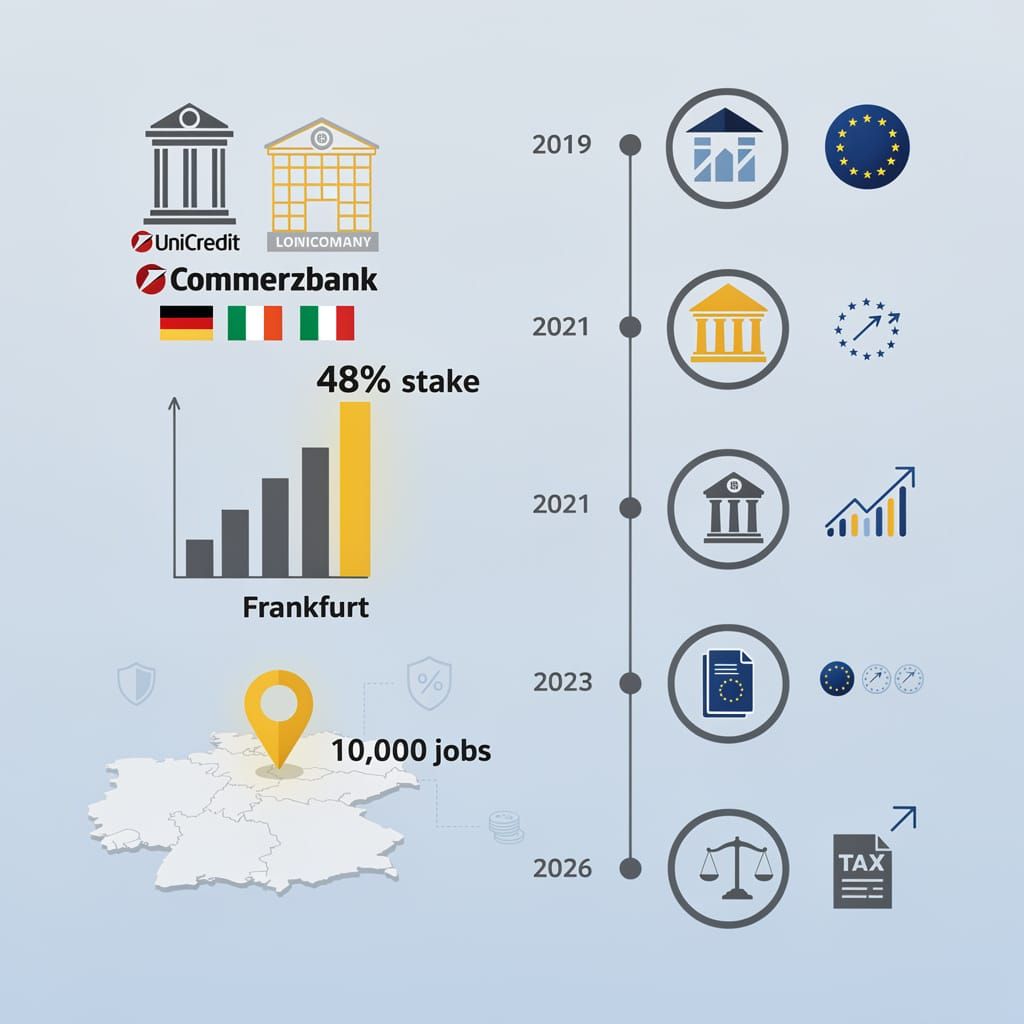
UniCredit held 48% of Commerzbank by July — just below the control threshold — after a takeover bid the German government rejected. 🇪🇺 That's not a minority stake. It's a foreign bank owning half a systemic lender while Berlin negotiates terms of a merger it claimed to oppose. Commerzbank posted a record €2.7B H1 profit in August, making the deal look rational. 10,000 Frankfurt jobs have no protection. Shareholders voted against. Regulators flagged antitrust. None of it stopped the stake from climbing. Who exactly is running Commerzbank now — and who foots the bailout bill when things turn?
September 14, 2026
The German government sold its full Commerzbank stake to Unicredit on September 11, 2024, at €13.2 per share—below prevailing market value. Two years later, Vice Chancellor Lars Klingbeil sits down with Andrea Orcel to discuss a complete takeover. According to the official line, this was never the plan.
Let's trace the math. And the timeline. And the gap between what was said and what happened.
The 48% That Isn't "Minority"
Unicredit has been remarkably precise about its public posture. From early 2026 onward, the bank positioned itself as a passive stakeholder while methodically acquiring control. The problem: the narrative collapsed in June, when the bank's takeover bid triggered an oversubscribed exchange offer at 0.485 shares per Commerzbank share. The German government rejected the proposal due to nationalized interests, citing threats to approximately 10,000 Frankfurt-based jobs. Unicredit's response was to extend the investor exchange deadline to July 3.
By July 8, Unicredit reached 47.65% ownership via OPA closing at an exchange rate of 0.485 UniCredit shares per Commerzbank share—valuing the target at roughly €35 billion. By July 23, the stake hit 48%. The mechanism matters: a voluntary public exchange offer structured to exceed the 30% mandatory takeover threshold without triggering a formal buyout requirement. Commerzbank Chairman Jens Weidmann called for regulator review, citing the loophole. BaFin dismissed financial risk concerns—because no premium was paid.
The market reaction: Commerzbank stock dropped 0.7%. Not a rout. But not enthusiasm either. Regulators noted antitrust concerns while Germany's finance minister shifted from blocking the merger to "possible acceptance."
Commerzbank then reported a record H1 profit surge to €2.7 billion in August (+14% YoY), with operating margins at 17%. Higher valuation made the target more attractive. The bank that was supposed to fend off a takeover suddenly became the evidence for why the takeover should proceed.
The "Accidental" Control Structure
Unicredit currently holds 48% direct ownership—just shy of the 50% threshold that would trigger mandatory disclosure requirements. The mechanism involves gradual accumulation executed between January and July 2026, structured to avoid triggering regulatory reviews that a formal buyout would require. The Q4 completion target depends on regulatory clearance that European authorities intensified scrutiny of in June 2025 and again in June 2026, citing market concentration concerns.
The official narrative: these are minority positions. The operational reality: when the bank that lost its takeover bid in June ends up at 48% by July, with more to follow, the distinction between minority stake and control collapses.
What This Enables
- Concentration risk: 48% ownership concentrated in one cross-border institution with no German governance accountability. A market correction will test whether those votes translate into capital calls the state will have to cover.
- Tax cascade exposure: If the merged entity requires rescue, deposit insurance and state aid flow to a bank whose strategic decisions originate in Milan. German taxpayers underwrite an Italian acquisition strategy.
- Regulatory gap: EU non-discrimination rules were designed to prevent a member state from selling its strategic banking asset to a foreign competitor at a discount, then pretending no transfer of control occurred while a hostile takeover bid fails and a backdoor accumulation succeeds. The voluntary exchange mechanism that pushed UniCredit past 30%—the legal trigger for mandatory takeover rules—without a corresponding obligation is precisely the loophole Weidmann flagged.
- Regional economic drag: Mittelstand companies relying on Commerzbank's Frankfurt-based lending now face a management structure that reports to a cross-border parent. The 10,000 jobs threatened in June have no contractual protection.
- Shareholder opposition: Commerzbank shareholders voted against the takeover in May 2026 meetings in Frankfurt and Wiesbaden. Employee protests followed. European regulators stalled the deal. None of this prevented the stake from reaching 48%.
The Timeline That Speaks for Itself
- September 11, 2024: German government sells full Commerzbank stake to Unicredit at €13.2 per share—below prevailing market value.
- March 2026: Unicredit launches voluntary public exchange offer. Stake grows from 9% to ~48% over four months.
- June 2, 2026: Unicredit increases stake to over 30% via voluntary buy-out offer. European regulators intensify scrutiny of merger.
- June 16, 2026: Commerzbank stock falls below Unicredit takeover bid threshold. German government rejects bid.
- June 19, 2026: Germany confirms withdrawal of Unicredit takeover bid. State declares victory.
- July 8, 2026: Unicredit achieves 47.65% ownership via OPA closing at 0.485 exchange ratio. BaFin finds no grounds to block.
- July 23, 2026: Unicredit raises shareholding to 48%. Aims at full control by Q4.
- August 6, 2026: Commerzbank reports record H1 profit of €2.7 billion. Unicredit initiates takeover discussions.
- August 11, 2026: UniCredit secures 48% ownership at €43.6b valuation. Stock drops 4.6%. Buybacks suspended.
- August 28, 2026: German government shifts stance from rejection to possible acceptance.
- September 11, 2026: Klingbeil meets Orcel. Agenda: "bridging policy stances." Result: undetermined.
The Sarcasm Gap
The official narrative asks markets to believe that a foreign bank whose takeover bid was rejected, whose shareholder base voted against it, and whose regulators flagged antitrust concerns, can simply purchase 48% of a domestic systemic lender through a voluntary exchange mechanism—exceeding the 30% mandatory threshold without triggering a mandatory offer—while the seller government negotiates the terms of a full merger it previously opposed, and call it normal M&A activity.
The gap between that framing and the operational reality is where the actual risk lives. Commerzbank is no longer a German bank under German control. It is a German bank with a notional Italian parent, a €2.7 billion profit that makes the acquisition look reasonable, 10,000 Frankfurt jobs without protection, and a German government that no longer has a seat at the table but still holds the bailout check.
Comments ()