🧪 DEA Approves Three Cannabis Research Licenses in Two Months
DEA just approved three new cannabis research licenses in ~2 months — down from over a year as recently as spring 2026 🧪 More manufacturers and importers mean shorter wait times, replicable studies, and lower costs for university budgets. No dispensaries. No retail. Just more supply for legitimate clinical trials. If you're building in cannabinoid biotech, is the window opening for real this time?
On September 11, Irvine Labs quietly secured three new federal licenses to import and manufacture Schedule-I substances. That sounds like bureaucratic jargon, but the numbers tell a concrete story: the DEA processed these applications in roughly two months — a pace that stands out for an agency that, as recently as spring 2026, still had researchers waiting over a year for equivalent authorizations.
What Actually Happened
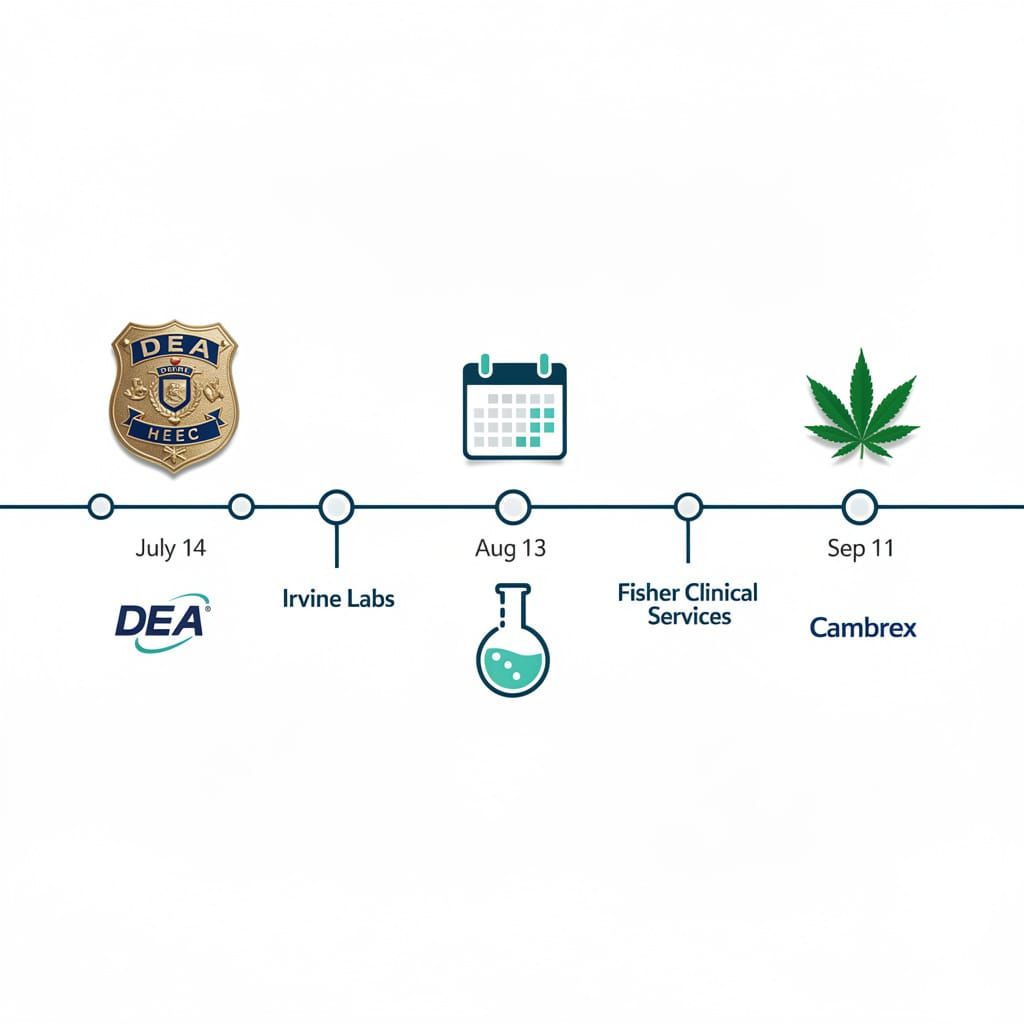
The chronology:
- July 14: Biopharma Res Corp files a dual-authorization application with the DEA for import and bulk manufacturing of pharmaceutical-grade cannabis.
- August 13: Irvine Labs, Inc. files to register as a bulk importer of Schedule I substances including marijuana, THC, LSD, and multiple psychedelics.
- August 26: DEA publishes notices for Experic LLC (research-focused THC import), Chemtos LLC (bulk marijuana manufacturing), and Cambrex (synthetic THC production).
- September 8: DEA publishes additional notices for Fisher Clinical Services, Irvine Labs, and AndersonBrecon.
- September 11: Three licenses approved — at least two of which (Irvine Labs and Fisher Clinical Services) had applications filed only weeks earlier.
Three new entrants cleared within a roughly two-month window. For context, on June 29 the DEA itself convened a hearing in Arlington evaluating whether to move marijuana from Schedule I to Schedule III — the first such review in nearly five decades. The processing speed isn't an accident; the agency appears to be building the research pipeline ahead of the policy decision.
Why This Matters Beyond Policy Nerds
The federal licensing pipeline for Schedule-I substances has been a notorious bottleneck — universities and pharma companies couldn't get materials to run controlled studies. Each new license opens a supply channel:
- More manufacturers means standardized, quality-controlled cannabinoids for clinical trials. Chemtos LLC, for example, specifically applied to produce bulk marijuana and THC as reference standards — material any lab can replicate against.
- More import authorizations let U.S. researchers access compounds already studied abroad. Irvine Labs' application explicitly cites plans to import bulk substances for internal research, clinical trials, and customer distribution — meaning they'll serve as a conduit for compounds already validated overseas instead of forcing domestic reinvention.
- More entrants in the supply chain breaks the monopoly-like grip a few licensed producers held. With Cambrex manufacturing synthetic THC for conversion into dosage forms and Chemtos producing bulk reference standards, the sourcing bottleneck is fragmenting.
The Real-World Effects So Far
The immediate impact isn't dramatic. No dispensaries opening in Iowa. But the operational mechanics shift:
On supply: Researchers can now source directly through authorized intermediaries like Irvine Labs or Biopharma Res Corp, not just the handful of DEA-registered growers. Shorter wait times, less administrative friction.
On research quality: When multiple manufacturers can produce synthetic THC or CBD isolates, studies become replicable. One lab's results aren't tied to one supplier's extraction batch.
On pricing: More entrants → more competition → lower per-gram costs. A Minnesota cultivation project recently projected dropping from $1,750/lb to $1,000/lb by Year 5 as capacity scales — and that's in the recreational market. Similar dynamics apply to research-grade cannabis as the licensing pool widens. University budgets breathe a little easier.
The Players and Their Positions
Irvine Labs and Fisher Clinical Services operate in the pharmaceutical-services space, not the recreational market. Their interest signals where commercial gravity is pulling: clinical-grade cannabinoid research.
Cambrex filing for synthetic THC manufacturing is particularly telling. Synthetic production sidesteps agricultural variability — no sunlight hours, no soil pH, no harvest timing. That's appealing for pharmaceutical companies needing consistent dosage forms.
Biopharma Res Corp's dual application — import of flowering marijuana and bulk manufacturing — suggests they're building an end-to-end research supply pipeline. Their import permit explicitly allows use for analytical chemistry and preclinical/clinical trial manufacturing.
What This Doesn't Mean
- No federal legalization: Schedule-I status remains. Though the DEA held that June 28 hearing in Arlington pushing toward Schedule III — and the USDOJ already rescheduled medical marijuana to Schedule III on June 1 — these remain research licenses, not commercialization permits.
- No retail access: Patients can't walk into a pharmacy based on these approvals.
- No sudden DEA pivot: The agency processed applications. The same week these went through, Connecticut reinstated a 35% THC cap on flower — regulators are still hedging.
The Outlook
Short-term: Expect more applications. The bottleneck just widened. At least seven distinct applications landed between July and August 2026 — expect that pipeline to grow as comment periods close.
Mid-term: Clinical trials using Schedule-I cannabinoids will find it easier to enroll and source materials. The global cannabis testing market hit $2.4B in 2025 and projects $7.2B by 2033 — the research infrastructure is scaling alongside the regulatory access.
Long-term: If positive trial data emerges, the regulatory argument for rescheduling strengthens — you can't claim a substance has "no accepted medical use" while granting licenses specifically to study its medical use, especially after the June 1 DOJ rescheduling to Schedule III already cracked that logic.
The DEA is building the infrastructure for cannabis research without fully changing the regulatory framework. Enable the science, let the outcomes drive the policy conversation.
For startups in the biotech and pharmaceutical space: the supply constraints that have historically throttled cannabinoid research are easing. If you've got a trial design, a molecule, or a delivery mechanism worth testing, the window is opening.
Comments ()