🇪🇺 ECB Raises Rates Again as Consumer Costs Surge
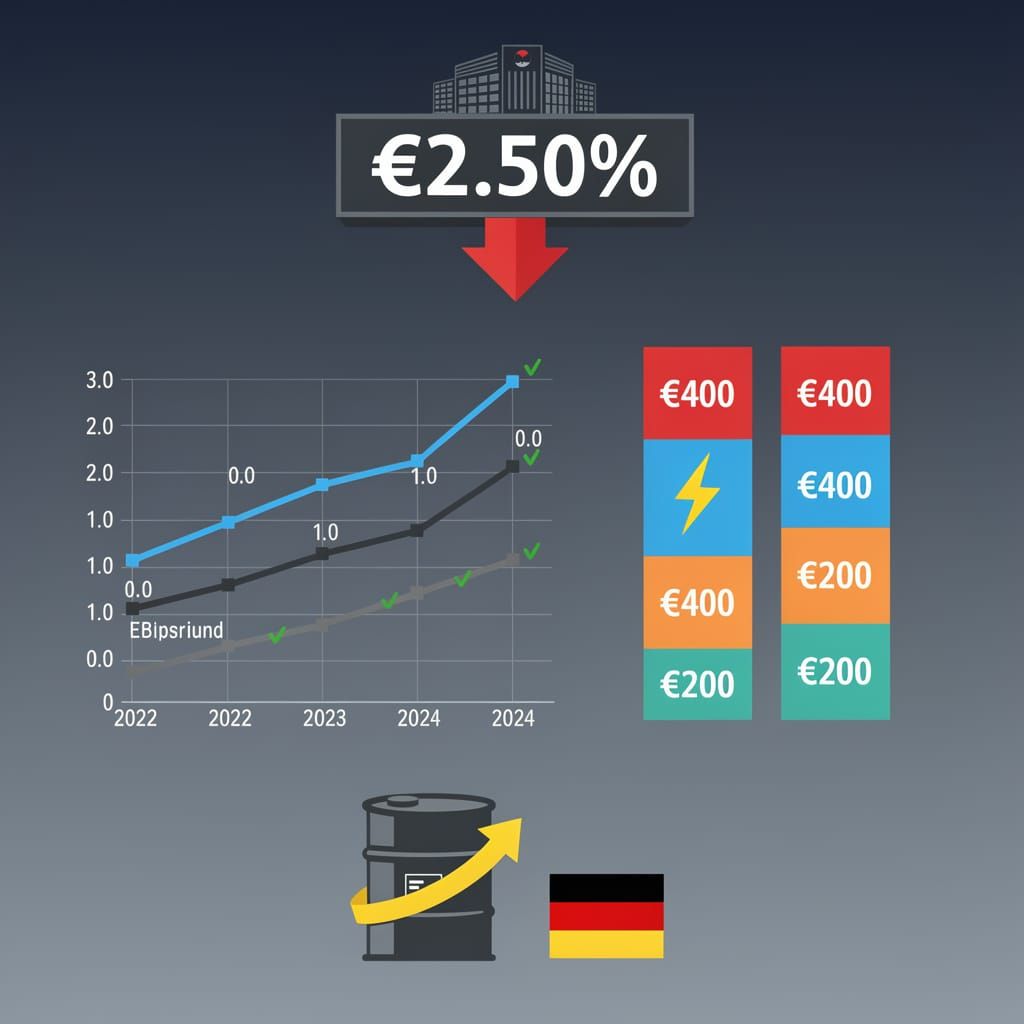
ECB hikes deposit rate to 2.50% — second hike of 2026. 🇪🇺 Danish borrowers now pay 160 krone more per month per million borrowed. German heating costs projected to rise €400/year. Bond markets aren't buying it: 10-year bund yields above 3.2%, a record. Household energy costs up 14% YoY. ECB growth forecast for 2026: 0.6%. Inflation target: 2.1% in 2027. That math works only if no more shocks, no policy errors, and no consumer revolt materialise. What exactly is the plan when rate hikes compound an oil-shock cost structure?
The Great "We Must Do Something" Charade
On September 10, 2026, the European Central Bank raised its deposit facility rate by 25 basis points — to 2.50%. At least, that's what the press release says. The problem is the press release also claims this is the second hike of 2026, following a June 11 move that lifted the same rate from 2.00% to 2.25%. The narrative being sold is coherent: measured tightening against persistent inflation driven by Middle East conflict. The reality, as Danish borrowers just discovered, is a 160-krone monthly increase per million borrowed on variable-rate loans. That's not measured. That's mechanical.
Three Crises, One Target
What's driving the current price mess is not a single pipeline. It's a convergence of unforced errors and geopolitical spillover:
- Iran-conflict oil supply shock: Direct rail-war disruptions pushed crude costs upward. Verivox-indexed German household heating costs are now projected to rise €400 per year following a 20% wholesale gas surge since early August. The transmission chain is clear, mechanical, and utterly outside ECB control.
- ECB's own rate passthrough: The deposit rate now exceeds what most small-to-mid European banks priced into their 2025 stress tests. Lending margins compressed. Households saw higher loan costs almost immediately — short-term spending restrictions, by design.
- Structural electricity burden: German households already pay €0.356/kWh (Q2 2026), nearly triple the global average, with taxes and levies accounting for more than 60% of the bill. Raising rates into that cost structure doesn't fight inflation — it compounds hardship.
The central bank's own medicine is now a contributing cause of the very stagnation it claims to fight.
Bond Markets Aren't Buying It
German ten-year bund yields pushed above 3.2% on September 11 — the highest on record. That's higher than the ECB's own deposit rate implies for a stabilized economy. The curve steepened not on growth optimism, but on term premium repricing: bond investors demanding more compensation for inflation uncertainty that the central bank has not anchored.
Marcel Fratzscher, DIW president, offered the kind of polite academic framing that translates to this isn't working. "Monetary policy is encountering diminishing returns," he said on September 12. That's economist-speak for pushing on a string while hoping the oil shocks and supply-chain reordering from the Hormuz closure magically resolve themselves before the next projection round.
Consumer Reality vs. Frankfurt Theory
The gap between ECB projections and household experience is now a chasm. Verivox data shows German household energy costs rose 14% year-on-year through August. Retail gasoline prices at Berlin stations tracked the oil-index jump within 48 hours of the September 2 Iran escalation spike. Meanwhile, even the modest good news — German Q2 GDP grew 0.3%, beating expectations — is a fragile artifact of the Strait of Hormuz closure redirecting industrial orders to Europe, not a sign of organic demand recovery. Factory orders jumped 2.5% in July, but machine-tool production fell 11% in the same period. That's not a boom. That's a reshuffle.
The ECB's own September 10 macroeconomic projections revised 2026 euro-area growth down to 0.6%, while maintaining a 2027 inflation forecast of 2.1%. That math works only if you assume the next 16 months contain no further shocks, no policy errors, and no consumer revolt.
What the Rate Path Actually Signals
| Timeline | ECB Projection | More Likely Outcome |
|---|---|---|
| Q4 2026 | Rates stable at 4.75%, inflation drifting toward 2.5% | Rates unchanged, inflation stuck at 2.8–3.0%, growth below 0.5% |
| H1 2027 | First cut to 4.50%, inflation at 2.3% | Delayed cut to Q3, core inflation still above 2.5%, bund yields above 3.5% |
| 2028 | Normalization to 3.50% | Structural plateau at 3.75–4.00%, unless anchoring methodology changes |
The "straightforward anchoring methodology" mentioned in policy briefs is the polite fiction that supply shocks will conveniently fade on schedule. They haven't. The June peace deal between Washington and Tehran lowered oil prices temporarily, but wholesale European gas prices still surged more than 20% since early August — and basic supply tariffs in Germany are set to rise another 6% in October. The supply shocks keep arriving. The methodology does not adjust.
The Unasked Question
If the ECB's own rate hikes are now compressing household spending and bond yields are signaling disbelief, what exactly is the plan? German electricity costs are the highest in the G20 at €0.356/kWh. Gas heating costs are about to jump €400 per household per year. Manufacturing orders are up, but production is down. Auto insurance premiums are still 52.8% above 2022 levels despite a recent plateau.
The ECB is raising rates into an oil shock, treating an inflation symptom while ignoring the underlying fragility that Verivox data, wholesale gas indexes, and consumer spending patterns all confirm. The result: higher consumer costs, slower growth, and a central bank that looks increasingly like it's following a script written before the real world intervened.
Maybe that's the point. The ECB's mandate is price stability. What it's delivering is a stable story — told with conviction, repeated at every press conference — while the actual numbers keep writing a different ending.
Comments ()