Shein's $99M Quarterly Loss: Fast Fashion Meets Regulatory Reckoning as U.S., Europe Close Loopholes
TL;DR
- Shein Posts $99M Loss as Tariff Loopholes Vanish — Fast-Fashion Model Cracks. Can Shein survive without the duty-free loopholes it was built on?
- BoE Holds at 3.75% as Oil Surges Past $100 — The 'Transitory' Trap, Again. How much more inflation data does the BoE need before it admits this isn't transitory?
💸 Shein's "Fast Fashion" Meets Fast Collapse
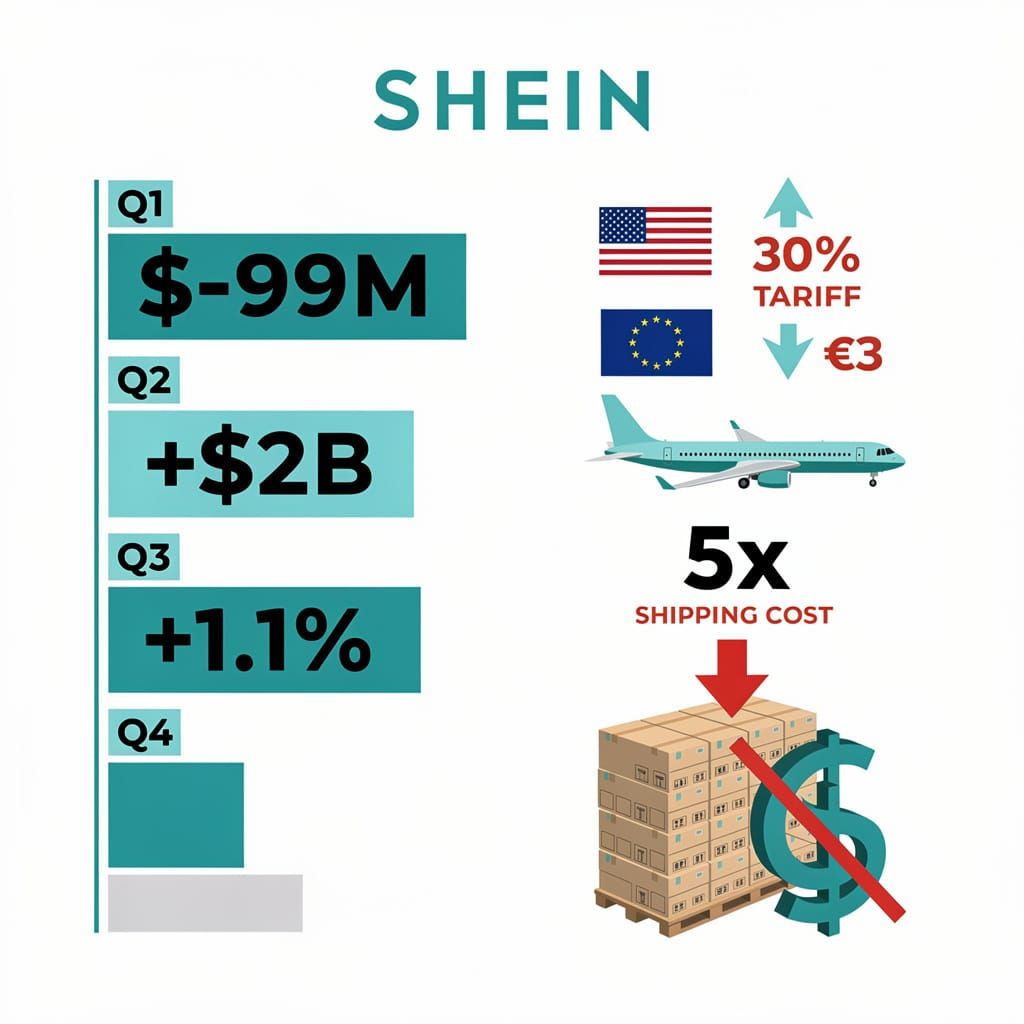
Shein just posted a $99 million Q1 loss after raking in $2 billion profit last year. That's a 105% profit swing in twelve months. 💸 U.S. killed the duty-free loophole for China parcels. Europe slapped a €3 fee on every cheap import. Shipping costs went up 5x. Gross margins collapsed. Shein built its whole model on regulatory favors, not actual efficiency. Now 281 million users don't matter if each unit loses money. Inventory is piling up. The IPO is in doubt. Who still believes this is just an "external shock" — and how long before the next shoe drops?
Shein Inc. posted a $99 million Q1 2026 loss (confirmed July 27, 2026), flipping from a 2025 net profit of $2 billion that had already slumped 38.7%. The company blames "global cost shocks," but the mechanisms are traceable and entirely self-inflicted.
What changed: The U.S. eliminated de minimis duty exemptions for China-origin goods on April 16, 2025 (effective May 1, 2025), imposing up to 30% tariffs on all parcels under $800—ending duty-free entry that had covered roughly 98% of small-package shipments. Freightos forecast a 50% rise in air cargo rates within weeks. Europe followed on July 1, 2026 with a €3 per-item levy on all cross-border shipments below €150, directly targeting the 6 billion low-value parcels that had overwhelmed EU customs since 2022. Shipping costs rose fivefold. Gross margins collapsed.
- U.S. tariff removal raised landed costs by 25–40%. Shein's ultra-low-price model absorbs zero slack.
- €3 EU unit fee adds $3.42 per imported item, directly cutting margins. Europe accounts for ~33% of sales. EU customs inspections found >60% of imported toys, cosmetics, and electronics contained banned substances.
- Inventory write-downs accelerated as demand adjusted faster than Shein could reprice its backlog.
- Iran war-driven demand collapse in the Middle East further cut regional revenue.
The Causal Chain Is Brutal
- U.S. eliminated duty-free loophole → Shein's per-unit costs surged.
- Europe matched with per-item levies → margins compressed on both primary markets.
- No pricing power → losses materialized; inventory aged; write-offs followed.
The result: a quarterly loss that erased two years of accumulated gains, even as revenue rose a meager 1.1% to $9.05 billion.
Where the Narrative Breaks Down
Shein's management frames this as an external tariff shock. It is not. The company built a logistics model entirely dependent on regulatory exceptions—China's export subsidies, U.S. de minimis rules, EU low-value thresholds. Each exception was politically fragile. All three were revoked within twelve months. The EU also fined competitor Temu €200 million on May 28, 2026 for failing to prevent illegal and unsafe product listings under the Digital Services Act—the largest DSA penalty to date—signaling systematic enforcement, not a temporary crackdown. Temu must submit a remedial action plan by August 28, 2026 or face additional sanctions.
Investor takeaway: The promised IPO is now unlikely before September 2026—at best. Private market valuations predicated on 2024–2025 margins have no basis in current unit economics.
Broader Sector Contamination
- EU-China trade deficit reached €360.6 billion (June 2026). Macron proposed protective tariffs; Germany and Poland backed enforcement.
- Fast-fashion competitors with diversified sourcing (Zara, H&M) show no comparable margin shock. Shein's problem is structural, not sectoral.
Outlook
| Horizon | Signal |
|---|---|
| Q3 2026 | Inventory liquidation pressures → further write-downs likely. |
| Sept 2026 | IPO possible if Q2 books stabilize; current trend suggests delay. |
| 2027+ | Business model requires full price restructuring or geographic pivot. Neither is quick. |
Shein maintains 281 million active users and >$1 billion monthly volume. None of that matters if each unit loses money. The loss is not a blip. It is the bill coming due for a supply chain built on regulatory arbitrage, not operational efficiency. Markets are correct to remain pessimistic.
🇬🇧🔥 The Central Bank That Learned Nothing
BoE held rates at 3.75% while Brent crude is above $100 and CPI is heading toward 4% That's 24 military jets worth of household purchasing power incinerated per month 🇬🇧🔥 The "transitory" playbook from 2021 is being recycled word-for-word. Colombia just hiked to 13% and understood the math. The Bank of England is pretending a geopolitical oil shock is a seasonal fluctuation. UK households are seeing real incomes shrink for the fifth consecutive quarter while the MPC votes to wait for "more data." More data on what exactly—whether stagflation tastes different the second time around?
Another oil shock, another round of stubborn denial.
On July 23, 2026, Brent crude surged past $100 a barrel—levels not sustained since the Iran–Iraq war. The Strait of Hormuz, conduit for a fifth of global oil and gas, remained blocked. Shipping lanes collapsed under regional escalation. Fuel and food costs slammed U.K. households. Staple goods shifted from expensive to unaffordable for millions.
The Bank of England's response? Holding rates at 3.75% until December. Governor Pill's committee split, some arguing for an immediate hike, but inertia won. The rationale—that this is a "transitory" supply shock—echoes 2021 almost word for word. It was wrong then. The arithmetic suggests it is wrong now.
On July 22, the ONS reported CPI at 2.6%. One month earlier, it was 2.8%. Analysts forecast 2.7%. The number is drifting in the wrong direction. The energy price cap reset in July will push it further. Economists now project CPI breaching 3.5%—possibly 4%—by autumn. The Bank's own analysts warn that wage-bargaining power is declining, which should cool services inflation, but energy costs are overwhelming that channel.
The mechanics of self-delusion
- July 2026: Oil above $100, Strait of Hormuz severed, CPI at 2.6% but heading toward 4%. BoE holds at 3.75%. Markets price a 60% probability of an emergency inter-meeting hike before October. The Bank refuses to acknowledge the scenario.
- October 2026: CPI projected above 4%, household purchasing power eroding, retail sales contracting. BoE: waiting for more data.
- September 2026: Analysts expect a hike if inflation persists above 3.5%. Ruth Gregory notes oil above $90 triggers "significant inflation pressure." If CPI hits 7%, rates could climb to 4.75%. But by then, the damage compounds.
The playbook is familiar. Tightening is painful. Inflation is political. So central banks delay, hope the crisis self-resolves, and intervene only when the numbers become undeniable. Colombia's central bank just raised rates to 13%—it understood the math. The BoE does not.
Real consequences, abstract thinking
Unlike pandemic-era supply snarls, this shock has a geopolitical off-switch no central bank controls. Iran's escalation shows no de-escalation timeline. The OECD projects UK GDP growth slowing to 0.9% by 2027. The CBI warns of a 1.8% contraction if conflict persists. The BoE's "wait and see" posture treats a structural rupture as a seasonal fluctuation.
For households: food inflation running above wage growth, real incomes shrinking for the fifth consecutive quarter, savings buffers exhausted. Andy Burnham's proposal to remove VAT from electricity bills—starting October 2026—is unfunded and faces scrutiny over solvency.
For markets: gilt yields compressing, sterling weakening, import costs climbing—a feedback loop that tightens conditions more harshly than any rate hike would have.
For the BoE: a credibility gap widening by the week. Markets now price two future rate rises. The Bank's own vote is split. The MPC refuses to move until the numbers break decisively. By then, they already have.
Low confidence, high impact
The official forecast carries a "low confidence" label—an admission that the model fails under the current conditions. Yet policy continues as if the model were reliable. That is not caution. It is negligence dressed as prudence.
History's lesson from 1973, 1979, and 2022: central banks that hesitate during supply-driven inflation do not preserve stability. They import crisis. The OECD, the CBI, the IMF, and the ONS all agree: the trajectory points to stagflation. The BoE alone pretends otherwise. The U.K. is about to prove that pattern still holds.

Comments ()