One Developer vs. The ERP Empire: 3 Versions Dropped in 24 Hours
TL;DR
- One Developer Drops Three ERP Versions in a Single Day — Free and MIT-Licensed. Can one open-source developer deliver what Oracle spent billions building? ERP Kit says yes.
- Qualcomm Bids Up to $10 Billion to Crack CUDA Empire With On-Device AI. Could Qualcomm's edge AI bet make traditional GPU-dependent AI development a thing of the past?
- $1 Trillion Man: How One Person Accumulated More Wealth Than 174 Countries—And Why It Keeps Dropping. Should anyone really hold more wealth than 174 countries while swinging $350 billion in two weeks — and calling it "normal"?
💸🚀 Who Needs Oracle When You Have GitHub?
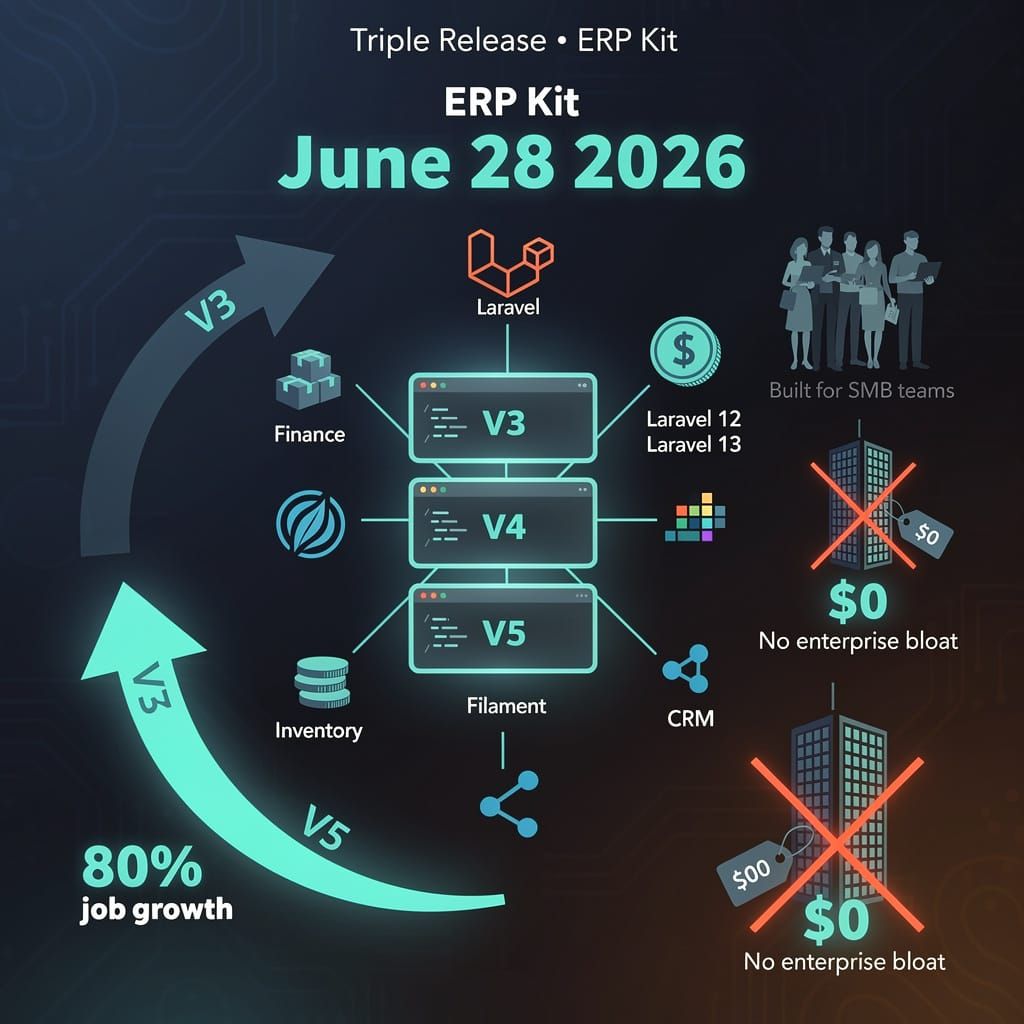
One dev dropped 3 ERP versions in ONE day — 13 modules, MIT-licensed, free. 💸 SMBs generating 80% of new U.S. jobs can finally get enterprise-grade tools without the enterprise costs. The democratization bet is on. 🚀
Most enterprise resource planning software comes wrapped in enough price tags, licensing fees, and dependency chains to make a CFO break into a cold sweat. But on June 28, 2026, one developer decided to flip that script — twice in a single day.
Jefferson Goncalves dropped three versions of his open-source ERP Kit project. V3 hit first, built on Laravel 12 and Filament, packing 13 integrated modules ready for corporate deployment with minimal infrastructure overhead. Hours later, V4 arrived, running on Laravel 13 with stronger data flow capabilities and enhanced automation aimed squarely at mid-tier providers hungry for something leaner than what the enterprise giants sell. A fifth release that same day — according to signals from the Jefferson Goncals repository — layered in CRM and supply chain modules on top of that core stack.
"I'm trying to give smaller teams the same Software that big corporations use without the sticker shock and complexity. That's the whole point." — Jefferson Goncalves, via GitHub changelog
The "sticker shock and complexity" line cuts to the core of what makes these releases interesting. ERP adoption among SMBs has historically lagged because traditional platforms demand expensive licensing, dedicated IT staff, and consulting armies just to get invoices talking to inventory. Goncalves is betting that stripping ERP down to its Laravel-and-Filament bones — and releasing it for free on GitHub — collapses that barrier entirely.
The triple-release cadence itself signals something worth watching. Dropping V3, V4, and V5 on the same calendar date reads like a deliberate statement: the pipeline is moving fast, and developers who get involved now are jumping onto a project in active acceleration rather than a dormant repo. That breadth across versions tells contributors the maintainer is all-in, which tends to pull in pull requests, bug reports, and ultimately a more robust ecosystem around the tool.
This accelerated cadence matters not just for adopters but for the Laravel developer community. With GitLab pivoting to AI agents in software development, Python's feature freeze for version 3.15 quietly underway at the Foundation, and Anthropic releasing autonomous sub-agents with elevated unauthorized modification risk, developers need real-world enterprise patterns to study. ERP Kit's modular architecture — where finance talks to inventory, CRM intersects with supply chain — provides exactly that kind of production-adjacent reference material. That educational utility is underrated and rarely discussed when projects like this land.
There's a broader displacement context here worth acknowledging. Oracle announced 21,000 workforce cuts this June as AI adoption accelerates inside the company. Cisco, Intuit, LinkedIn, and GitLab have combined for tens of thousands more in reductions among their ranks. Meanwhile, small firms now account for roughly 80% of recent U.S. hiring — and per NFIB data, 29% of those owners still can't fill open roles despite the broader pullback. MIT-licensed ERP Kit slots directly into that paradox: it lowers the infrastructure cost equation for exactly the businesses taking on workers and building operational capacity without enterprise-grade IT budgets.
The supply-chain logic reinforces this. Across April and May, geopo litical disruptions — from the Druzhba pipeline halt sending German refineries scrambling, to Ukrainian grain export protests near Berdyansk — coincided with a measurable spike in AI-driven ERP adoption as businesses sought operational resilience. That urgency for adaptable, independent tooling hasn't gone away; if anything, it's sharpened appetite for anything that doesn't lock vendors into a single proprietary stack.
Open-source package integrity did take a hit in mid-June, when Arch Linux users faced a security incident involving over 1,500 compromised packages due to AUR malware outbreaks. That's a reminder that community-maintained software carries audit responsibilities Goncalves will need to stay on top of as adoption grows. The same week as ERP Kit's releases, a wave of Java ecosystem patches — including Quarkus emergency releases mitigating CVE-2026-50559 and CVE-2026-39852, alongside Hibernate ORM adding row-level security enforcement — illustrated how active stewardship catches problems before they cascade. The Commonhaus Foundation's independence move that same day, led by Jesse Wilson and Jake Wharton, signals a broader shift toward transparent, sustainable governance for open-source tooling. Goncalves will need to build that kind of long-term structure into ERP Kit as it matures.
The ERP Kit releases slot directly into that momentum, offering a community-driven counterweight to licensed incumbents. Whether the project scales into mid-tier provider territory as intended depends partly on community adoption velocity, partly on whether the Laravel 13 base holds up under heavier production loads, and partly on whether Goncalves can keep security surface area manageable as the codebase expands.
What seems more certain is this: the democratization bet is on, and it's playing out right now in GitHub repos, Discord servers, and the Stack Overflow threads that will inevitably follow. Enterprise software doesn't have to mean enterprise price tags — at least not if Goncalves and his growing contributor base have anything to say about it.
Jefferson Goncalves' ERP Kit V3, V4, and V5 are available on GitHub. Versions are MIT-licensed and open to community contribution.
🚀💪🔥🤯 Why Qualcomm Just Bet Billions on AI — and What It Means for Everyone Else
Qualcomm just dropped up to $10B on AI chip moves — without opening its wallet. 🚀 While AI stocks panicked 9.3% after RTX Spark, Qualcomm sidestepped the CUDA empire by buying Modular's IP outright and bidding on Tenstorrent's RISC-V architecture. That's not hedging. That's a hostile takeover of the inference layer. The Massive Move: No cash. No burn. Just 19.2M shares swapping hands — and suddenly Qualcomm has on-device AI compute that phones AND cars desperately need. Why it stings for everyone else: If Qualcomm locks Stellantis and automotive partners into its pipeline, rivals don't just lose a supplier — they lose the entire inference stack baked into next-gen vehicles. That's structural, not temporary. Bottom line? The AI silicon game just got a lot more crowded — and Qualcomm's playing for keeps. 💪🔥
Qualcomm has a reputation for playing the long game in mobile silicon. But on June 28, 2026, it stopped playing coy. The company announced plans to acquire AI startup Modular in an all-stock deal valued at $3.9 billion — and quietly confirmed it's eyeing a far bigger prize: a potential purchase of Tenstorrent valued somewhere between $8 billion and $10 billion. That's a lot of silicon ambition wrapped in one weekend.
Here's the thing that makes this interesting beyond the headline number. Qualcomm isn't reaching for its checkbook. It's reaching for its stock ledger, issuing up to 19.2 million shares directly to Modular's backers as part of a swap structure. That matters enormously for early investors in Modular — they get exposure to a financially healthy, diversified semiconductor giant instead of riding out the volatility that typically comes with a startup staying independent. No cash burn anxiety. No uncertain Series D. Just liquidity and alignment with a company that has real distribution.
The CUDA Challenger Energy
The broader picture is where things get genuinely spicy. Qualcomm's acquisitions aren't experiments — they're declarations. By bringing Modular's AI compute IP in-house and potentially layering in Tenstorrent's RISC-V architecture, Qualcomm moves aggressively to reduce dependence on external GPU architectures, specifically Nvidia's CUDA ecosystem, which has become something close to an operating system for AI development.
The CUDA moat has been durable — and it's now a bullseye. When Nvidia unveiled RTX Spark at GTC Taipei on June 1, 2026 — integrating Blackwell GPU and Grace CPU with Microsoft Windows security primitives — AI stocks dropped 9.3% in a single day. That kind of market reaction tells you how existential the inference competition has become. Qualcomm's mobile-first architecture may win the latency argument in ways that data-center-centric rivals can't easily copy, but the competitive bar is rising fast.
Mobile and automotive are the obvious leverage points. Phones need efficient on-device inference. Cars — particularly those supplied by Stellantis, among others — increasingly demand on-board AI pipelines for safety, autonomy, and real-time sensor processing. These aren't workloads that are well-served by pulling inference from a data center. The latency kills you. Qualcomm's mobile SoC heritage gives it a structural advantage here that pure GPU competitors simply don't have.
The Dilution Question, Answered
Investors' immediate worry with large stock-based M&A is dilution — existing shareholders waking up to a suddenly larger share count and diluted earnings per share. Qualcomm's approach sidesteps that narrative cleanly. By structuring the Modular deal as a stock swap, early backers receive equity in a company with existing revenue, global supply chain relationships, and an established investor base. It's equity sweetener without immediate cash outlay.
But not everyone was reassured. The June 24 investor day saw Qualcomm shares drop 8.01% amid rising skepticism about AI data center expansion risks — even as the company reported Q2 FY26 revenue of $10.60 billion and record automotive sales hitting $1.33 billion, up 38% year-over-year. The dip reflects investor anxiety around the overlapping Modular and Tenstorrent deals, not underlying business weakness. The bull case still points toward potential upside via ADAS and AI revenue streams.
| Factor | Impact |
|---|---|
| Deal structure | All-stock swap preserves cash; 19.2M shares avoids cash drain |
| CUDA competition | On-device AI reduces reliance on GPU vendors, targeting Nvidia's inference stack |
| Automotive urgency | Stellantis and others now mandate on-board inference pipelines — a hard market deadline |
| Competitor pressure | RTX Spark integration deadline forces accelerated timelines for AI silicon partnerships |
Tenstorrent: The Real Prize
The Modular acquisition is the clean transaction — a done deal closing in weeks. Tenstorrent is the wildcard, and the valuation math tells you everything about why it's attracting premium interest.
Tenstorrent's RISC-V core designs offer something Nvidia doesn't: an alternative to proprietary instruction set architectures. The company also brought in Jim Keller — the legendary chip architect behind Apple's A4/A5, Tesla's Autopilot silicon, and AMD's Zen architecture — as chief technology officer back in 2020. That's not a coincidence. That's a talent moat.
Yet TechStarts previously valued Tenstorrent at just $3.2 billion. Qualcomm's $8–10 billion outbound? That's a 2.5x to 3x premium asking price. Some of that is acquisition fever. Some of it is genuine scarcity — Tenstorrent represents one of the most credible CUDA alternatives in existence, and Qualcomm knows it.
Nvidia isn't standing still either. The June 20 unveiling of the RTX Spark platform — integrated with Microsoft Surface hardware for professional creators, delivering ultra-low-latency AI processing — demonstrates that Nvidia knows the on-device inference war is heating up. With DLSS 4.5 for real-time upscaling and a $2,500 price point aimed at enterprise and flagship consumer lines, Nvidia is betting big that AI-native hardware becomes standard in premium laptops by late 2027. The forecast suggests RTX Spark will drive a 15–20% shift in AI chip revenue within 12 months.
The US-China tech competition adds another dimension. Geopolitical tensions are accelerating demand for localized AI computation — which redounds to the benefit of Qualcomm's independence narrative. If external GPU supply chains become strategically risky, Qualcomm's vertical story looks a lot more attractive.
Why This Matters for Everyone Else
Let's anchor this with some hard context. The first half of 2026 saw Qualcomm move from cautious to aggressive in AI hardware, and that shift wasn't arbitrary. AI infrastructure demand — particularly inference at the edge — has outpaced what traditional silicon suppliers can deliver through off-the-shelf parts. Modular solves a specific architectural problem. Tenstorrent solves a broader compute efficiency problem. Together, they give Qualcomm a vertical story that previously required third-party IP licensing.
The forecast for Modular's acquisition closing is weeks away, not months. The Tenstorrent bid is messier — contingent discussions don't close deals — and most analysts expect a formal review process that stretches into Q4 2026. But the signal is clear. Qualcomm wants to own the AI compute layer in devices you hold in your hand and drive under your feet.
The knock-on effects are immediate. Competitors now face a deadline of their own — if Qualcomm locks in automotive platform partnerships through these acquisitions, rivals lose not just a supplier relationship but the entire inference pipeline that gets baked into next-generation vehicle architectures. That's a structural disadvantage, not a product feature gap.
This is consolidation behaving exactly the way consolidation should — fast, motivated, and a little bit unsettling to everyone standing still.
💸 The Trillionaire's Club Just Got One More Chair—And It's a Really, Really Expensive Chair
SpaceX loses $4.3B in one quarter yet raised $75B in the largest IPO in history. Musk crosses $1T net worth. Then loses $350B in two weeks. Still calls it "fluctuation." 😬 With $41B in cumulative losses, this valuation isn't a metric—it's a referendum on how far we've strayed from every economic principle that used to matter.
So here we are. June 2026. Elon Musk crossed the $1 trillion net-worth mark, and the internet did what the internet does: lost its collective mind. The timing feels almost theatrical—by mid-June, SpaceX had staged its IPO, and suddenly the world's wealthiest person wasn't just wealthy. He was trillionaire wealthy.
$1 trillion. Nine zeros. Your brain probably just glazed over at "nine," didn't it?
Here's the part nobody's really talking about: SpaceX reported a $4.3 billion loss in Q1 2026 despite $18.7 billion in revenue. That same company posted a staggering $14 billion in negative cash flow during 2025, with cumulative losses reaching $41 billion across its operational history. The kind of losses that would put most companies in 求生 mode (that's "survival mode" for those of you who skipped the Google Translate phase). Yet the IPO happened—$75 billion raised at a $1.78 trillion valuation, the largest in history, surpassing even Saudi Aramco. The stock performed well enough—or at least attracted enough capital—to tip Musk past a threshold that makes even "billionaire" sound quaint by comparison. It's a bit like watching someone bet their entire life savings on red, win, and then accidentally purchase the casino.
But the real stomach-churning part isn't the number itself. It's what comes after—and just how precarious that threshold actually is.
Wild Swings on the Way to Trillionaire Status
Here's what just a few weeks of June 2026 taught us about what "trillionaire" actually means in practice:
The Ascent (June 12, 2026): SpaceX debuted on Nasdaq at $135 per share, initially valuing the company around $1.78 trillion. By June 15, shares climbed to roughly $178, pushing the market cap to approximately $2.33 trillion. Musk's 42% stake (with 82% voting control) combined with his Tesla holdings pushed his Bloomberg-indexed net worth to approximately $1.1 trillion—then higher in follow-up trading. The world's first trillionaire.
The Correction (June 22–24, 2026): SpaceX shares dropped 5% and 3.6% intraday as IPO euphoria cooled. Then things got worse. On June 23, SPCX plunged 16.43%, reaching $148—below its June 12 launch price of $135. The company's market cap fell to $2.04 trillion, marking its lowest since IPO. On June 24, Musk's net worth suffered a $350 billion decline due to a sharp SpaceX stock drop (−31%) and the Forbes exclusion of $116 billion in locked Tesla options. His total wealth dipped below $1 trillion for the first time since the milestone.
The Recovery (June 27, 2026): Bloomberg re-estimated his net worth at $1.2 trillion.
So there it is: a billionaire status that takes a $350 billion hit in two weeks and still calls it "fluctuation." The catch? That headline number hides a cavernous gap between net worth on paper and actual liquidity. Analysts estimate Musk's realizable wealth at $230–270 billion—roughly one-fifth of the Bloomberg figure—constrained by lock-up provisions lasting until December 2026, a low public float, and dual-class share structures that make rapid liquidation a nonstarter. To regenerate trillionaire status, SpaceX only needed to recover about 6%—roughly $1.22 billion. Alternatively, merging Tesla with xAI and triggering full option vesting could resurrect the wealth surplus entirely. These aren't hypotheticals. They're the options sitting in front of one man.
The Democracy Problem Nobody Wants to Name Out Loud
When one human being controls resources that rival small nations, the democratic conversation shifts from theoretical to deeply uncomfortable. Musk's net worth now exceeds the nominal GDP of 174 countries, including Taiwan ($977 billion)—meaning his paper wealth surpasses the entire annual economic output of nations housing hundreds of millions of people.
We've watched tech billionaires quietly reshape political discourse for over a decade through platform ownership, strategic philanthropy, and strategic... everything else. Now stack a cool trillion on top of that reality. Nine American tech founders—Larry Page, Sergey Brin, Jeff Bezos, Larry Ellison, Michael Dell, Mark Zuckerberg, Jensen Huang, Bernard Arnault, and Warren Buffett—now hold combined fortunes concentrated with an intensity not seen since America's original Gilded Age. The most recent data shows billionaire wealth rose 81% since the pandemic began in 2020.
Public polling data from the Australian National University, analyzed by Professor Nicholas Biddle, indicates a majority now view excessive billionaire wealth concentration as damaging to society—not as a sign of contribution, but of extraction.
The debates lighting up think tanks and timeline arguments right now aren't really about Musk specifically. They're about structural excess—what happens to governance when individual wealth bypasses every historical checkpoint? When regulatory frameworks assume a certain power distribution that simply doesn't exist anymore?
And here's the uncomfortable truth: there's no clear playbook for this. Governments tax, regulate, occasionally prosecute. But the tools for managing 万亿-level concentration of personal power? Those are still being invented in real-time.
What's Actually Changed
The SpaceX IPO on June 12, 2026, wasn't just a market event. It was a threshold crossing. The milestone—Musk's net worth officially crossing $1 trillion—was a lagging indicator of a structural shift already in motion.
What the signals tell us: SpaceX holds $100.8 billion in cash (including $85 billion from the IPO) but is already funneling capital into xAI via a $20 billion bridge loan, plus a cascading $10 billion acquisition of Cursor. The strategic logic degrades quickly from there. xAI reported a $6.4 billion operational loss, sparking investor confidence concerns and forcing a pivot toward Grok to prop up the AI pipeline. The IPO prospectus itself—which projected valuation above $1.75 trillion while citing Starlink expansion, Starship development, and AI integration—reads like a bet on everything converging at once. Throw in $6 billion in government contracts, and the geopolitical dimensions become unavoidable: this is U.S. leadership in space and AI,筹码 up on one person's balance sheet.
The forecast reads "ongoing," which is analyst-speak for "nobody actually knows how this ends." What we do know: more IPOs, more speculation, more regulatory scramble, and more uncomfortable questions about what democracy even looks like when the room has one guest who can personally finance a small country's annual budget—with change to spare for a Mars colony and still come out smelling like roses.
Welcome to the new normal. Try not to think about it too hard—or too little.



Comments ()