$900M Investment: Meta Acquires 20% of CRED India to Pivot Toward Fintech
TL;DR
- $900M Investment: Meta Takes Stake in India's CRED to Diversify Revenue. Will Meta's $900 million bet on CRED successfully turn WhatsApp into India's primary financial hub?
- 400% Robotaxi Revenue Spike: Pony AI Launches Luxembourg Pilot with Stellantis and Bolt. Can Pony AI's 400% revenue growth and Luxembourg pilot overcome EU regulatory hurdles to scale to 3,500 units?
- 35% SaaS Growth: Guidewire's AI Pivot Dominates P&C Insurance Markets. Can Guidewire's AI-driven SaaS growth offset broader US market volatility for insurance tech investors?
💸 Move Over, Ads: Meta’s $900 Million Bet on India
$900 Million! Meta just dropped a massive bag for 20% of CRED 💸 That's like buying a luxury skyscraper just to get a better view of the neighborhood. Meta is ditching ad-reliance to turn WhatsApp into a financial hub. Big risk or big brain move? India's fintech scene — is your chat app becoming your bank?
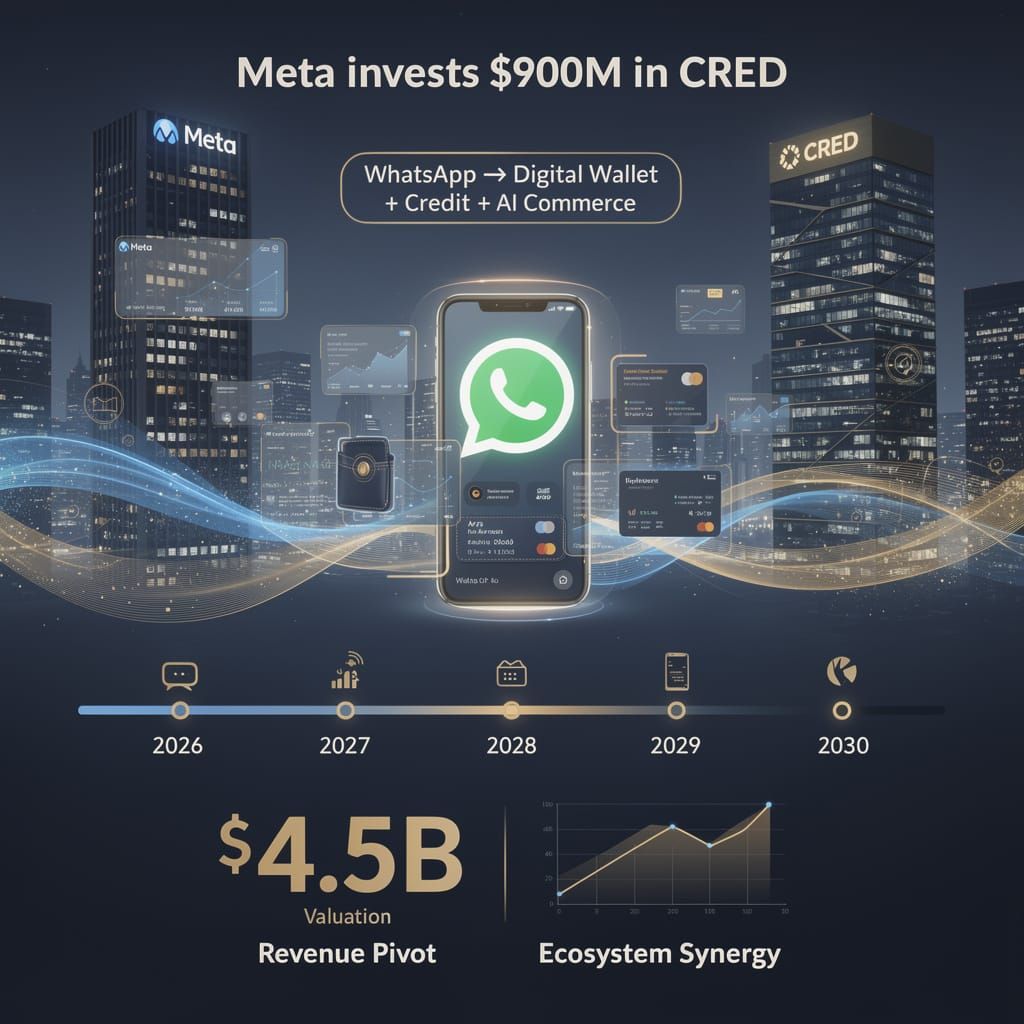
Meta just decided that relying on ad clicks isn't a complete strategy. On June 22, 2026, the tech giant pumped $900 million into CRED via an equity purchase, securing a 20% minority stake and valuing the Indian fintech darling at $4.5 billion. While that sounds like a win, it’s a recovery play; CRED's valuation has slid from its $6.4 billion peak in 2022.
This isn't just a check for the books; it's a total executive musical chairs event. Kunal Shah, the visionary founder, stepped down as CRED CEO to take the helm as the global head of WhatsApp. To keep the lights on at CRED, Miten Sampat has stepped in as interim CEO, while former WhatsApp leader Will Cathcart shifted within Meta to focus on product development.
Why the sudden switch?
Meta is hunting for revenue streams that don't involve selling eyeballs. With Q1 revenue hitting $56.31 billion (up 33% YoY), Meta is doubling down on diversification. By snagging a piece of CRED, they aren't just buying a company—they're buying a blueprint for reward-based financial ecosystems to transform WhatsApp from a chat app into a financial hub. Crucially, Meta confirmed it will have no access to CRED user data, attempting to dodge the regulatory headaches that usually follow such mergers.
The Strategic Play:
- Revenue Pivot: Shifting from ad-dependency to recurring income via "Plus" subscription tiers (starting at $2.99/month) across Instagram, Facebook, and WhatsApp.
- Ecosystem Synergy: Embedding native credit management and bill-tracking tools directly into WhatsApp to accelerate digital payments in India.
- Financial Stability: The $900M infusion stabilizes CRED’s balance sheet as it navigates ongoing regulatory scrutiny and targets a future public listing.
The Transition Timeline:
- June 2026: Series H/Equity investment finalized; Kunal Shah assumes WhatsApp leadership.
- H2 2026: Integration of AI-driven commerce and expanded rollout of tiered "Meta One" AI plans.
- 2030: Analysts project a potential valuation stabilization near $1,500 per share if AI monetization succeeds.
The Ripple Effect: Market Position: Meta enters Indian fintech with an established player $\rightarrow$ bypasses the "build from scratch" phase. Financials: Capex guidance raised to $125–$145B $\rightarrow$ reflects aggressive AI infrastructure and cloud ambitions. Risk Profile: European DMA enforcement and AI-driven cybersecurity threats $\rightarrow$ heighten regulatory and data exposure.
With Shah at the helm, WhatsApp is evolving into a digital wallet that knows if you've paid your bills. Expect your chat list to look more like a financial portfolio by this time next year.
🚀 Pony AI: The Three-Way Handshake in Luxembourg
400% revenue surge! 🚀 That's like going from a side hustle to a powerhouse overnight 🤯. Pony AI is now hitting Luxembourg streets with Stellantis & Bolt. Can a 3,500-unit fleet survive EU red tape? Tech fans in Europe — would you trust a robotaxi with your commute?
Pony AI is done playing in the sandbox. On June 24, 2026, the company launched a high-stakes mobility pilot in Luxembourg, plugging its autonomous driving brains into Stellantis’ commercial hardware and Bolt’s ride-hailing API. This strategic trifecta—the AI, the car, and the app—aims to conquer European corridors while dodging the EU's rigid regulatory hurdles.
Why Now?
For a while, the street was lukewarm. Analysts like Eugene Hsiao and Macquarie sliced price targets to $24 as Pony burned cash. But the fundamentals just shifted. A Q1 revenue beat, fueled by a massive 400% surge in robotaxi revenue, silenced the skeptics. While net losses widened to $53.5 million, the big money is still interested. Cathie Wood doubled down on June 8, snapping up 45,949 shares during a broader ARK Invest rotation into high-beta growth themes.
The Causal Chain: 400% Revenue Growth $\rightarrow$ Institutional Confidence (ARK Investment) $\rightarrow$ Global Pilot Expansion $\rightarrow$ >3,500 Unit Deployment Target.
- May 18, 2026: Secured on-road testing permits for the bZ4X Robotaxi.
- June 9, 2026: Expanded the Stellantis partnership to scale AV offerings.
- June 24, 2026: Launched Luxembourg pilot, deploying 7th-gen hardware in urban zones.
- 2026 (Ongoing): Targeting a global fleet of >3,500 Robotaxi units.
The Trade-Offs
Pony is regaining its footing, but the road is bumpy. The company is fighting a war on two fronts: balancing aggressive R&D against EU compliance and navigating a volatile AI stock market. June 2 saw U.S. markets drop 9.3% from all-time highs, driven by Fed interest-rate warnings and geopolitical friction—factors that put immediate pressure on AI valuations.
Strengths:
- Resilience: Maintained momentum by avoiding the safety reviews that plagued Baidu Apollo Go.
- Tech: 7th-gen hardware and bZ4X integration prove safety in dense urban corridors.
- Growth: 400% robotaxi revenue surge creates a buffer against macro swings.
Weaknesses:
- Margins: Widening net losses ($53.5M) keep valuation pressure high.
- Regulatory: High dependency on EU approval for wider scale-out.
- Exposure: Vulnerable to AI-sector sell-offs and global supply-chain bottlenecks.
The Bottom Line: By linking with Bolt and Stellantis, Pony AI isn't just building a car; it's building a network. If the Luxembourg pilot proves that autonomous fleets can handle European bureaucracy and traffic together, the jump to 3,500 units is a matter of when, not if.
🚀 The Cloud Silver Lining: Guidewire’s AI Payoff
35% surge in SaaS revenue! 🚀 That's a massive jump for the usually glacier-slow insurance world. Guidewire is turning legacy tech into an AI goldmine. But can a $1.1B cash pile shield them from a moody stock market? P&C insurers — is your tech actually keeping up?
Insurance tech usually moves at the speed of a glacier, but Guidewire Software Inc. just hit a sprint. On June 4, 2026, the company dropped its Q3 numbers, proving that when you mix legacy insurance with a heavy dose of cloud migration and AI, the math works out in your favor.
Why the Jump?
The numbers indicate a massive appetite for digital transformation among Property and Casualty (P&C) insurers. Guidewire reported total revenue of $372.5 million, a 27% year-on-year increase. The real engine here is the shift to SaaS; subscription and support revenue surged by 35%, demonstrating that insurers are ditching old on-premise servers for flexible, AI-driven cloud platforms.
This migration results in a more predictable revenue stream, enabling Guidewire to bump its full-year 2026 revenue guidance to a range between $1.46 billion and $1.47 billion. However, the broader market is moody. US markets recently dropped 9.3% from all-time highs, triggering a risk-off sentiment that led some investors to cut Guidewire's price target to $222. Despite the noise, the company is sitting on a comfortable $1.145 billion cash reserve.
The Financial Breakdown
- Revenue Growth: 27% YoY $\rightarrow$ $372.5M quarterly total.
- SaaS Momentum: 35% increase in subscription fees $\rightarrow$ higher Annual Recurring Revenue (ARR).
- Liquidity: $1.145B cash on hand $\rightarrow$ enables aggressive R&D despite semiconductor supply chain pressures.
What's Next?
The transition from legacy software to cloud-native AI is no longer a "pilot project"—it's the standard. While semiconductor availability remains a bottleneck for the hardware sector, Guidewire’s ability to convert its Q4 backlog into active ARR shows that enterprise AI demand is durable. This resilience mirrors a trend seen with Microsoft's cloud and AI revenue surges, which are reinforcing tech-sector stability amid geopolitical volatility.
- Q4 2026: Continued premium cloud adoption $\rightarrow$ projected earnings momentum preservation.
- FY 2026 End: Revenue target of $1.46B–$1.47B $\rightarrow$ validates AI-driven growth strategy.
Market Dynamics Strengths: High switching costs for insurers and a dominant position in P&C tech. Weaknesses: Vulnerability to macro sell-offs and short-term investor volatility. Competitive Edge: Rapid AI integration reduces claims processing time, aligning with a global shift toward automated workflows and agentic AI.



Comments ()