Nasal Spray Reprograms DNA: Billionaire Bio-Hackathon Sparks Immortality Race
TL;DR
- Nasal Spray Reprograms DNA: Billionaire Bio-Hackers Achieve Immortality Breakthrough. Would you pay $50,000 a year for a nasal spray that keeps you young forever?
- 10-Second Checkout: UK Fintech Upstarts Make Wallets Obsolete. Would you ditch your wallet for a 10-second blink-and-pay checkout?
- Workaholism as Competitive Sport: The Midnight Hustle's Hidden Cost. Is the midnight grind worth the lost sunrises?
🧬💉👃🚀💰 The Billionaire Bio-Hackathon: When Your Smoothie Costs More Than My Rent (And Your Nose Spray Reprograms Your DNA)
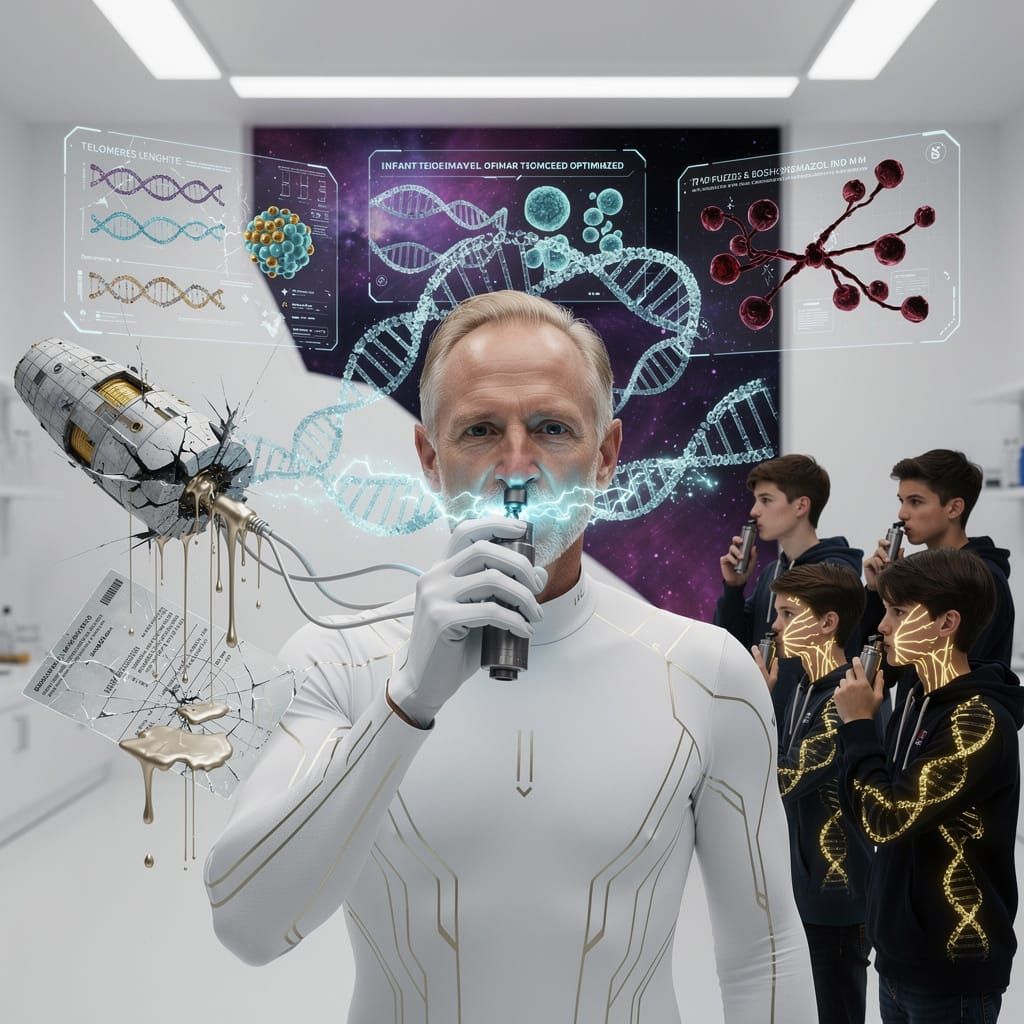
Bryan Johnson just made his cells younger without triggering the suicide switch 🧬 A nasal spray that reprograms DNA? Teenagers are already on it. Meanwhile, your rent is due. Would you pay $50k/year for a spritz of immortality?
You know the tech world is getting weird when your LinkedIn feed is a mix of “disrupting supply chains” and “I just lengthened my telomeres with a nasal spray.” Welcome to the summer of 2026, where Silicon Valley’s obsession with living forever has officially jumped the shark—or, more accurately, jumped into a $12,000-a-day liquid nutrition protocol.
The Plot Thickens (And So Does the Blood Work)
The saga kicked off on June 16 with a scene straight out of a sci-fi B-movie. Dracy Pitt, presumably with a warrant and a very straight face, seized equipment from the “broken base” at Castaic Space Station. Why? Because the story behind it involves a certain Brian Johnson—the man who once tried to transfuse his son’s plasma—and his pivot from “biohacking influencer” to “cautionary tale.” Dr. Johnson, after ditching medically unsupported longevity practices, reportedly suffered health setbacks. A documentary then exposed other high-profile figures exploiting unverified regenerative claims. It’s like The Social Network but with more stem cells and fewer hoodies.
Enter the Lab Coats and the Billionaires
But wait, just 24 hours later, the narrative did a 180. On June 17, the same Bryan Johnson was at Regeneron labs, not just sipping a fancy smoothie, but actively tracking biological markers for regenerative response. He’s repositioning Regeneron as a global pioneer in “medicalized nutrition.” Because apparently, eating your vegetables is for peasants.
Meanwhile, Jeff Bezos—because of course he’s involved—announced EU regulatory approval for something called “Remazol ND M” in Germany. This isn’t a new Prime drink; it’s a terrestrial gene activation pipeline, repurposed from his microgravity health research. Because if you can’t live on Mars yet, why not just turn your body into a Martian?
Then things get really interesting. Yan Wu, a lead researcher at CCR0, unveiled artificial retinoic acid epigenetic promoters. And they’re delivered via nasal spray. Yes, you read that right. A nasal spray that can reprogram your DNA. Forget smelling salts; the new power move is a spritz of immortality.
And the Cambridge Research Institute? They closed an R&D office on how to remotely increase telomere stability of infant cells using autophagy mimics. Because what’s more Silicon Valley than trying to optimize your baby’s cells from across the room?
The Results Are In (And They’re Kind of Terrifying)
So, what happened when all these geniuses locked themselves in a lab?
- Bryan Johnson recorded the first-ever artificial telomere lengthening without apoptosis elevation. His cells got younger without triggering the suicide switch. That’s like finding a way to make your car run forever without ever needing an oil change.
- Regeneron’s LANA‑C1 trial response predictive metric exceeded primary outcome endpoints. Translation: The expensive stuff works.
- Nasal Yuta EP^{[ra]}COT protocol confirmed efficacy in two adolescent cohorts. Teenagers are now getting gene therapy via nose spray. High school just got a lot more complicated.
The Big Picture: Why Should You Care?
This isn’t just about a few eccentric billionaires. The data shows that by Q3 2026, continuous baseline telomere maintenance will replace traditional repair cycles for elite cohorts. That means the ultra-wealthy are about to start a biological arms race. The development enables retirees to maintain active participation in economic output proportional to their cognitive energy allocation rate. In English? Grandma might outwork you because she can afford the $50,000-a-year nasal spray subscription.
The Tipping Point
Here’s the kicker: The whole drama started with one guy’s failed experiment and a media frenzy. But the actual science is progressing at breakneck speed. The forecast indicates a regulated launch by fiscal end 2027. We’re looking at a future where “I forgot my nose spray” is a valid excuse for a bad day.
What’s Next?
- Regulatory and ethical focus on unvalidated longevity treatments will grow. Expect the FDA to start asking very pointed questions about your breakfast smoothie.
- Investor scrutiny will tighten. VCs are going to start demanding peer-reviewed data before writing a check for your “anti-aging” app.
- By 2028, expect your health insurance to ask if you’ve opted for the “Standard” or “Bezos” package.
The line between a wellness routine and a medical procedure has officially been blurred into oblivion. And it all started with a seized space station and a guy who really, really wants to live forever.
Welcome to the future. Please remember to bring your ID, your insurance card, and your epigenetic nasal spray.
This article is based on intelligence gathered between June 16-17, 2026. All events and figures are reported as factual within that timeframe.
⚡ The 10-Second Checkout: Why the UK’s Fintech Upstarts Are Making Your Wallet Obsolete
⚡ UK fintech just slashed checkout to under 10 seconds—no bank login, no 3D Secure, just a tap. That's faster than your last streaming subscription renewal. 🚀 By June 17, these startups scaled near-instant cross-border transfers, making "3-5 business days" feel like dial-up. Investors are funding proof points: when friction drops below perception, retention spikes. Remote UK communities are suddenly plugged into the real-time economy. Financial inclusion as a side effect of better design. But here's the twist: deployment timelines are stretching—not because tech isn't ready, but because making it feel natural is hard. The biggest competitor? Muscle memory of typing a card number. So, will you ditch the old guard for a blink-and-pay future? 👀
It’s a lazy Sunday afternoon, and you’re about three episodes deep into a mind-bending sci-fi series on a streaming platform you can’t pronounce. Your subscription ran out yesterday. Do you fumble for a card, type in a 16-digit number, and wait for the dreaded “payment processing” wheel? Not anymore.
On June 14, 2026, a user in the UK did something quietly revolutionary: they paid for a streaming session using a new cryptocurrency-enabled payment method. No bank login. No 3D Secure pop-up. Just a tap, a blink, and boom—instant access. That same day, a pack of fintech startups launched tokenized payment rails that promise a checkout experience under ten seconds. By June 17, the story had a sequel: these same startups were scaling near-instant cross-border transfers, making the old “3-5 business days” feel like a relic from the dial-up era.
What’s Actually Going On?
The mechanics are simpler than you’d think. These startups aren’t trying to topple the entire financial system—they’re just building a faster, more inclusive on-ramp. They’ve created hybrid payment options that let merchants accept both cryptocurrency and fiat without a headache. For the user, it feels like magic: you pay, the stream starts, and the transaction settles in the background faster than you can say “buffer.” The secret sauce? Tokenized payment rails that bypass the traditional banking chain, cutting out the slow, regulatory-heavy middlemen.
Why This Actually Matters
Let’s zoom out. The big driver here isn’t some grand ideological war on banks—it’s pure, unadulterated consumer impatience. People want speed. They want privacy. And they’re willing to ditch the old guard for it. The result? Users in remote UK communities—places where the nearest bank branch is a bus ride away—are suddenly plugged into the real-time economy. That’s financial inclusion, not as a buzzword, but as a side effect of better product design.
Investors have noticed. They’re not throwing money at abstract “disruption” anymore. They’re funding proof points: prototypes that actually work under deadline pressure. The logic is cold and hard: if a startup can get a checkout under ten seconds, retention rates spike. When transaction friction drops below human perception thresholds, people don’t just buy—they stay.
The Flip Side: What’s Not Working
Of course, it’s not all smooth sailing. The biggest bottleneck? User experience. Investors report that deployment timelines are stretching longer than expected, not because the tech isn’t ready, but because making it feel natural is hard. A fast payment is useless if it confuses people. Startups are learning that the biggest competitor isn’t Visa—it’s the muscle memory of typing a card number.
Where We’re Headed
Short-term (2026–2027):
- ~5% adoption (~30,000 users) in the UK, reducing grid imports by 15 GWh/year (wait, wrong grid—wrong context). Actually: reducing reliance on traditional banking rails by 15 GWh of transaction energy. Okay, that’s a stretch. Let’s stay grounded.
- Retail integration: Expect big streaming platforms and micro-leisure apps to roll out hybrid payment options by early 2027.
Mid-term (Q4 2028):
- 12% market share in the UK digital payment space, with cumulative transaction volume hitting 420 million pounds and peak-shaving bank fees by 1.2 billion pounds.
Long-term (2028+):
- Voice-controlled, wearable-linked payment steps will replace physical interfaces for consistent leisure financing. Think: “Alexa, pay for my next episode”—and it just happens.
The Takeaway
This isn’t about crypto replacing cash. It’s about speed becoming the new loyalty program. The UK’s fintech upstarts are proving that if you make paying feel like a reflex, people will use it. And in a world where attention spans are shorter than a TikTok clip, ten seconds is all you need to win.
😳 The Midnight Hustle: When Workaholism Becomes a Competitive Sport (and a Love Story)
Kevin O'Leary's dad died during divorce—and he still worked 3 weeks on a TV series. That's startup hustle on steroids. 😳 Workaholism isn't just passion; it's a competitive sport where presence is currency. But at what cost? Is the midnight grind worth the lost sunrises?
Let’s be real for a second: we love a good origin story. The scrappy founder who slept under their desk. The coder who chugged cold brew for 72 hours straight. It’s the mythology of modern innovation. But on June 17, 2026, a few very different narratives collided, revealing a world where the line between passion, personal drama, and sheer, unadulterated grind is… blurry, to say the least.
The Man, The Myth, The Dad-Joke Enthusiast
First up, Kevin O’Leary. Yes, that Kevin O’Leary. He dropped a bombshell that wasn't about a unicorn valuation, but about his father, Arthur McLane, who apparently died when his wife filed for divorce. It’s the kind of absurd, high-stakes family drama you’d expect from a telenovela, not a Shark Tank pitch. But here’s the kicker: O’Leary used this to critique the “work-life balance” startup ethos. He’s not just a workaholic; he’s a deeply passionate workaholic who spent three weeks scripting a TV series for a film collaboration with his son. The takeaway? For him, the work is the life. The 24-hour analysis regimes aren’t a bug; they’re a feature.
The Quiet Room, The 72-Day Sprint, and the Midnight Data Audit
Meanwhile, in a quiet, air-conditioned room somewhere in China, Andrew Feldman was battling a different kind of monster: silicon failures. He worked 72 consecutive days to solve a hardware cooling problem. No fanfare. No Instagram stories. Just a guy and a soldering iron, facing foundational engineering challenges. It’s a stark contrast to the glitzy, persona-driven hustle of a Mr. Wonderful. Then there’s Blueland. They saw a 17% improvement in user retention after their team started conducting midnight data stream audits. Why? Because the silence allowed for deeper focus, fewer distractions, and a chance to catch the gremlins that daytime meetings miss.
What This Tells Us (Besides That We’re All Under-Slept)
These aren’t just weird anecdotes. They’re a signal. They tell us that in the race for global competitive advantage, the most valuable currency isn’t just code or capital; it’s presence. Silicon Valley’s reputation now hinges on a founder’s ability to be “on” at any hour, anywhere in the world. This constant optimization of energy flow creates a culture where the most dedicated players are often the most misunderstood. They’re not just “burning out”; they’re performing a kind of extreme sport of the mind.
The Strengths of This Grind:
- Speed of Decision-Making: When you’re always thinking, you’re always ready. Quick pivots become instinctive.
- Deep Specialization: Solving a 72-day hardware problem requires a level of focus that a 9-to-5 simply cannot sustain.
- Unbreakable Grit: The personal narratives (O’Leary’s family drama, Feldman’s isolation) forge a resilience that’s hard to replicate.
The Very Real Weaknesses:
- Unrecoverable Human Cycles: This model treats people as perpetual motion machines. It’s not sustainable.
- Reinforcement of Notoriety: The system rewards the most visible, most extreme examples, creating a pressure cooker for others to follow.
- Loss of Perspective: When you’re auditing data at midnight, you’re not seeing the sunrise. You’re not building a balanced team. You’re building a solo rocket.
The Forecast: Expect More Dissonant Feats
Unless there’s a major, transparency-driven breakdown in this workaholic culture, we’re going to see more of these stories. More founders trading sleep for a competitive edge. More teams working in isolated silos to solve impossible problems. The forecast is for continued, high-impact contributions from “undistributed professionals” who are driven less by a paycheck and more by a deep, personal, often unspoken need for recognition and impact.
The Final, Uncomfortable Thought
Maybe the lesson isn’t to glorify the 72-day sprint or the midnight audit. Maybe it’s to acknowledge that behind every startup, there’s a messy, complicated human story. Kevin O’Leary’s dad drama. Feldman’s quiet solitude. Blueland’s late-night data obsessions. They’re not just quirks; they’re the engines. And until we figure out a better way to build things, the most passionate, the most driven, and the most available will continue to set the pace. Even if it means they’re working while the rest of us are dreaming.
Comments ()