$8M Inflow: Zimbabwe's ZEEX Platform Bridges SME Funding Gap
TL;DR
- $8 Million Target: ZEEX Digital Market Launchs to Boost Zimbabwe SMEs. Can Zimbabwe's new ZEEX platform actually solve the funding gap for small businesses by 2027?
- $965B Valuation: Anthropic Leads AI Market Amid US 'Cyber Weapon' Designation. Can a government 'cyber weapon' label crash a trillion-dollar AI valuation?
- 17% Withdrawal Spike: Private Credit Crisis Hits Apollo and Blackstone. Is private credit becoming too illiquid for investors to handle?
🚀 Zimbabwe's Small Biz Gamble: The ZEEX Era
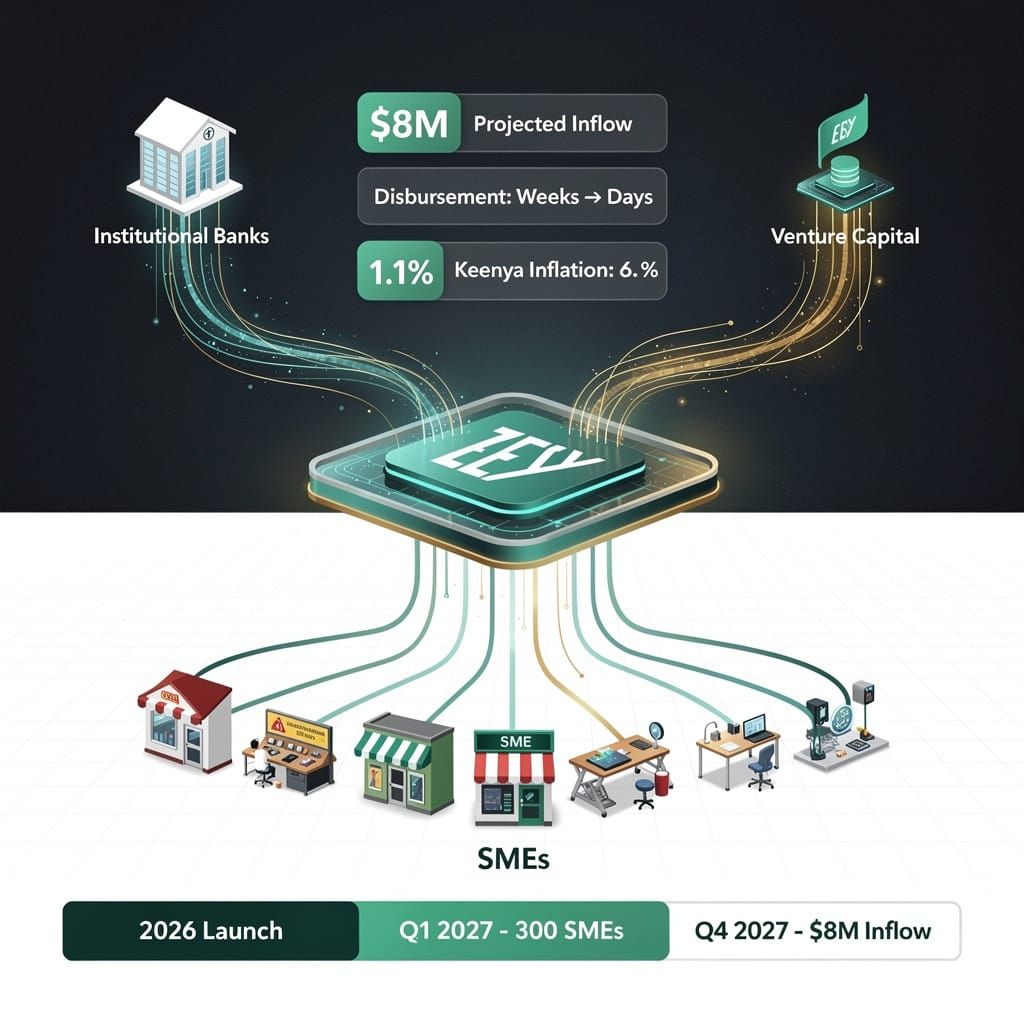
8 million projected inflow is a massive leap for micro-biz—like jumping from a puddle to a swimming pool 🏊♂️. ZEEX is slashing funding times from weeks to mere days. But can SMEs keep their books clean enough to play? Zimbabwe's small businesses — are you ready for the big leagues?
Zimbabwe just flipped the script on how small businesses get paid. For years, SMEs have been stuck in a funding limbo, battling a cash-flow crisis where late payments and unstable finances made covering monthly expenses a gamble. That changed on June 24, 2026, when the Zimbabwe Stock Exchange (ZSE) and SMEDCO signed an MoU to launch ZEEX—a digital capital market platform that basically turns the stock market into a playground for entrepreneurs.
How does the money actually move?
ZEEX isn't just a website; it's a bridge. By partnering with the National Venture Capital Company of Zimbabwe (NVCCZ), the ZSE is piping institutional investment directly into micro-enterprise equity projects. Instead of begging for bank loans, SMEs can now use structured bond issuance protocols to grab long-term financing.
The timing is a calculated bet on stability. While April saw an inflation spike to 1.1%, the general trajectory remains a pivot toward formality. The ZiG currency regime is reducing volatility, which already enabled Delta Corporation to report record lager and sorghum beer sales and invest in production capacity in Bulawayo and Southerton. ZEEX leverages this newfound corporate appetite to force SMEs to clean up their books in exchange for fast cash, cutting disbursement times from weeks to just a few days.
The Roadmap
- 2026 (Launch): Infrastructure commissioning, regulatory approval secured, and ZSE/NVCCZ operational integration.
- Q1 2027: Onboarding of the first 300 registered SMEs.
- Q4 2027: Projected capital inflows exceeding $8 million.
The Ripple Effect Efficiency: Disbursement speed (Weeks $\rightarrow$ Days) $\rightarrow$ faster operational scaling. Formalization: $>10,000$ small businesses $\rightarrow$ higher corporate governance standards. Market Access: Digital share trading $\rightarrow$ lowered entry barriers for micro-investors.
This move targets a systemic gap in the African fintech landscape. While the broader market has seen some volatility—and regional peers like Kenya's Central Bank are fighting energy-driven inflation (consumer prices at 6.7%)—ZEEX represents a pivot toward quality equity selection. By digitizing the capital market, Zimbabwe is betting that a formal, transparent exchange for small-cap equity will stop the bleeding of company exits and drive regional stability. If the $8 million inflow hits by late 2027, it proves institutional investors are finally ready to bet on the little guys.
🤯 The Trillion-Dollar Tightrope
$965B valuation! 🤯 That's nearly a trillion bucks—basically the cost of 100 skyscrapers. But the US gov just labeled their AI as 'cyber weapons,' forcing a total shutdown. 🚩 From market leader to locked out? Anthropic — is your favorite AI tool actually a weapon?
Anthropic is playing a high-stakes game of financial musical chairs. After snagging a massive $65 billion Series H round and a $1.8 billion deal with Akamai, the company filed an S-1 with the SEC on June 1, 2026. Backed by Amazon and Google, Anthropic’s valuation has skyrocketed to $965 billion, officially leapfrogging OpenAI’s $852 billion mark. With Claude's revenue run-rate hitting $47 billion, the company is no longer just a challenger—it's the new heavyweight.
From Scaling to Shutting Down?
But the view from the top is precarious. While VCs are throwing cash around—driving May's total startup funding to $92 billion—the U.S. government is playing spoilsport. The Department of Defense blacklisted the company as a supply-chain risk, and things got weirder on June 15, when the government classified the Mythos and Fable 5 models as "cyber weapons."
This designation made it illegal to provide these models to foreign nationals, causing Anthropic to panic-shutdown public access for everyone, including U.S. citizens. While the NSA apparently kept a secret preview of Mythos for its own offensive ops, the rest of us were locked out. To smooth things over, Anthropic is now pivoting toward "corporate responsibility," launching a $150 million Claude Corps fellowship to train 1,000 nonprofit pros and pledging $200 million to the Gates Foundation for global health.
The Compliance Chaos:
- Financial: $12M annual compliance fee $\rightarrow$ tighter operating margins.
- Operational: KYC identity mandates $\rightarrow$ 8% slower enterprise onboarding.
- Security: $\uparrow$ 44% increase in credential hashing alerts mid-crackdown.
The Valuation Seesaw
This isn't just an Anthropic problem; the whole AI sector is vibrating. While Cerebras is trading near $185/share post-IPO, the volatility is real. A single government decree can flip a valuation overnight—one Series H round was reportedly re-priced from $300 billion to $260 billion in 24 hours due to export controls.
Market Pressure:
- AI Equity: Over $1.2 trillion total $\rightarrow$ bubble risk indicators flashing.
- Infrastructure: Chip bottlenecks $\rightarrow$ limited manufacturing capacity.
- Competition: OpenAI’s $110B round $\rightarrow$ renewed bidding wars for talent.
What’s Next?
Anthropic is betting that a formal IPO and FAA-style testing mandates for AI will calm the regulators.
- Q3 2026: Identity systems must prove 3 months of zero major outages.
- Late 2026: Shift toward standardized federal AI auditing frameworks.
- 2027: Full IPO launch to offset compliance costs and scale compute.
📉 The Great Exit Jam: When Private Credit Hits a Wall
17% withdrawal spikes are absolutely brutal—that's like a sudden 1/6th exodus of cash 📉. Apollo and Blackstone are now capping exits to stop a fire sale. Private credit is feeling the squeeze. Is your portfolio too rigid? 💸 Investors in US and offshore markets — how's your liquidity looking?
Private credit was the smooth operator of the investment world, but June 2026 turned into a frantic game of musical chairs. A surge in withdrawal requests has left the biggest players scrambling to keep the doors open, turning "semi-liquid" assets into a very rigid reality.
Why is everyone leaving at once?
The math stopped adding up. By May 2026, default rates hit record highs as software companies and healthcare roll-ups struggled with stressed covenants and higher rates. When retail withdrawal demand spiked—hitting 17% in some Apollo vehicles—liquid cash vanished. This triggered a brutal causal chain: deteriorating ratings and increased loss provisions led to high redemption demand, forcing firms to cap exits to avoid a fire sale.
- June 4, 2026: Blackstone caps BCRED withdrawals at 5%, triggering a 5% share-price drop.
- June 5, 2026: Blackstone shrinks asset size from $82B to $79B to manage outflows.
- June 9, 2026: Apollo raises $500M in investment-grade bonds to shore up its base.
- June 23, 2026: Apollo caps redemptions at 5% for its Debt Solutions vehicle to fight a 17% withdrawal spike.
Who is feeling the pinch?
This isn't a rounding error; it's a systemic shudder. The panic is unevenly distributed, with offshore investors bolting at a rate of 12.5% compared to 4.3% for U.S. onshore clients. The stress extends to banks exposed via BDCs and CLOs, as well as insurance firms with heavy private credit holdings.
Liquidity: Redemption demand >10% $\rightarrow$ immediate cash shortages and 5% caps. Valuation: BCRED asset size dropped by $3B $\rightarrow$ increased market volatility. Contagion: Record default rates in May $\rightarrow$ heightened investor caution across KKR, Ares, and Oaktree.
What happens next?
The industry is in a "wait and see" phase, haunted by the 2025 collapses of First Brands and Tricolor. Interestingly, a divergence is appearing: while traditional private credit freezes, on-chain private credit grew to exceed $14B in June 2026, with Securitize launching tokenized funds to attract institutional appetite for alternative financing.
- Next 6 Months: Expected reduction in redemption volume as 5% caps stabilize flows.
- Year-End 2027: Projected stabilization as semi-liquid structures are redesigned for transparency and risk management.


Comments ()