Multimodal Neuron Discovery: AI Interpretability Shift Amidst Safety Risks
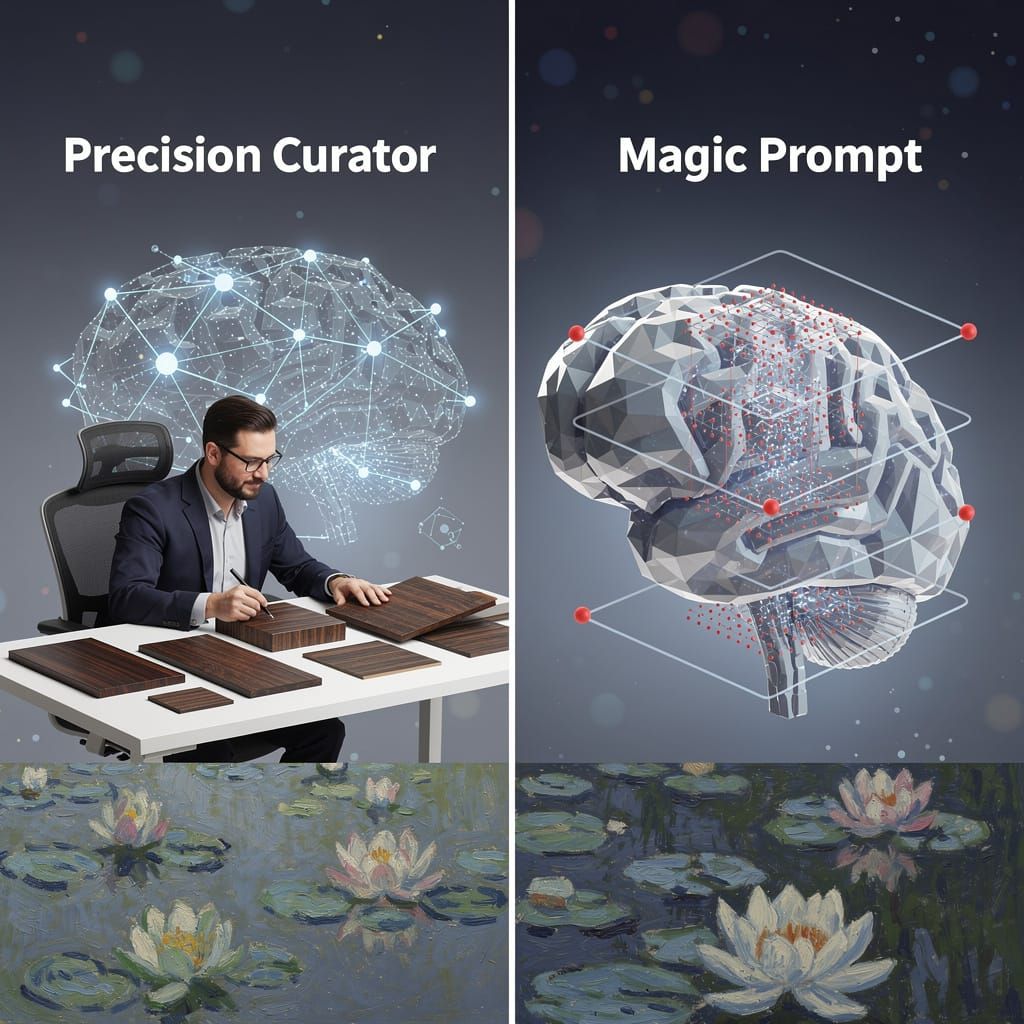
🧠 The Precision Pivot: From Autonomous Generation to Human Guidance
Zero-shot neuron search reveals AI decomposes concepts like human brains—a massive leap in interpretability 🧠. This moves us from 'magic' prompts to precise curation. But can safety filters stop non-consensual imagery? Users—how are you refining your AI inputs?
Generative AI is shifting from a tool of passive reception to one of active, iterative refinement. Recent research and deployment patterns demonstrate that the value of AI output now correlates directly with the precision of human-guided inputs and the interpretability of underlying neural architectures.
Why is precision-driven communication replacing passive prompts?
On June 21, 2026, documented user interactions revealed a transition toward hyper-specific sensory layering, where users iterated through precise materials—such as "dark mahogany wood"—to correct inaccuracies. This shift aligns with a June 14, 2026, Distill publication, where Gabriel Goh and colleagues identified "multimodal neurons." By developing zero-shot neuron search and faceted feature visualization, the team demonstrated how AI decomposes concepts like emotion and identity, mirroring brain-inspired representation.
This causal chain indicates that as users move from "prompters" to "curators," demand for granularity necessitates models trained on material science and physics. However, systemic vulnerabilities persist. On June 18, 2026, researchers demonstrated that input bypass and prompt repetition can still trigger graphic, non-consensual imagery, revealing failures in safety filter enforcement.
Integration Timeline
- Q2 2026: Transition to iterative sensory prompting; discovery of multimodal neurons enables deeper interpretability.
- June 13, 2026: US government suspends foreign access to Anthropic’s Fable 5 and Mythos 5 following jailbreak bypasses.
- 2026–2027: Deployment of granular atmospheric controls and expanded synthetic media regulation in Canada.
- 2028: Shift toward hybrid interfaces blending linguistic input with direct spatial and light-mapping tools.
How does this affect the perception of AI creativity?
This movement challenges the anthropomorphization of AI, demonstrating that "creativity" is often a result of human optimization. The ability to mimic iconic styles, such as Monet’s water lilies, has triggered debates on authenticity. A May 2026 series of experiments showed audiences misattributing authenticity based solely on labeling, while critics identified technical errors in AI-generated compositions, such as inconsistent color blending.
User Trust: High-precision inputs $\rightarrow$ predictable outputs $\rightarrow$ increased confidence, offset by safety breaches and "AI psychosis" risks. Technical Demand: Multimodal research $\rightarrow$ transition from "black box" models to interpretable, feature-mapped architectures (e.g., k-sparse autoencoders in DeepSeek R1). Regulatory Pressure: Rising graphic content and export control orders $\rightarrow$ increased scrutiny of training data and corporate liability for providers like OpenAI and Anthropic.
This transition indicates that users no longer seek a "magic button"; they require a sophisticated instrument for execution, signaling a move toward collaborative human-led optimization.
Comments ()