3.87M Credit Cards Stolen: AI-Powered GTA VI Phishing Swarm Hits US and Asia
TL;DR
- Systemic Fragility: Brazil's Emergency Broadcast Hijacked in 'Misantropi4' Attack. Could your local emergency alert system be hijacked by a single spoofed SMS command?
- 5.5MiB Limit: Zyxel Router Firmware Chaos — OpenWrt Community vs Corporate Bloat. Would you risk bricking your corporate router just to get 5.5MiB of open-source freedom?
- $1.9B Loss: GTA VI AI-Phishing Swarm Hits US and Asia via Oracle Zero-Day. Would you trade your entire bank account for a fake game beta, or are you actually immune to AI phishing?
🤡 'Misantropi4': The Day Brazil’s Emergency Alerts Became a Meme 🤡
3 states hijacked! A prompt for 'hatred of humanity' blasted through Brazil's emergency sirens like a digital flash mob 🤡. It's essentially a screen door for a latch. Who needs public safety when you have trolls? Anatel — is your infrastructure just a suggestion box for hackers?
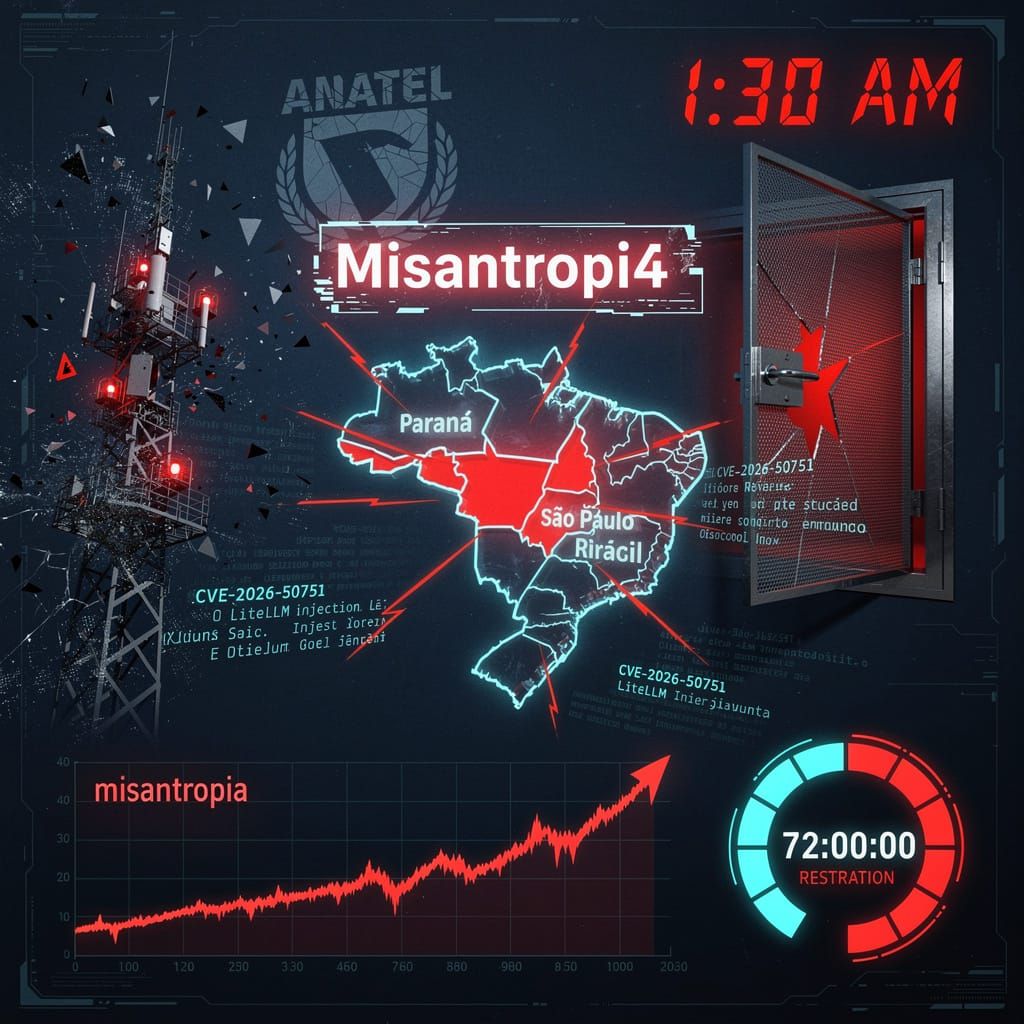
Imagine waking up to a government-mandated siren screaming in your hand, only for the message to be a random string of edgy gibberish. That’s the peak efficiency of our "robust" public safety infrastructure. On June 20, 2026, some chaotic genius decided to treat Brazil’s cellular emergency broadcast system like a personal group chat, blasting "misantropi4"—roughly translating to "hatred of humanity"—across Paraná, São Paulo, and Rio de Janeiro.
How did this dumpster fire happen?
Someone figured out that the cellular emergency protocol is basically a screen door with a broken latch. An external actor used a spoofed SMS broadcast to hijack the Cell Broadcast system managed by Anatel. By sending a remote unauthorized command, the hacker triggered "Extreme Alerts" that bypassed silent modes on Cat 4+ compatible devices.
This didn't happen in a vacuum. The world was already bleeding. Just days prior, the global landscape was a circus of AI-driven phishing and zero-days. While Brazil's sirens wailed, hackers were exploiting CVE-2026-50751 to bypass Check Point VPN passwords and using LiteLLM command injections (CVE-2026-42271) to treat cloud hosts like open playgrounds. The "Misantropi4" attack was just the loud, obnoxious cousin of a global trend where legacy protocols (like IKEv1) are being treated as welcome mats. 💅
The Chaos Timeline:
- 2026-06-20: "Misantropi4" alert hits Paraná, SP, and RJ; Defesa Civil Alerta platform is knocked offline.
- 2026-06-20 (1:30 AM): System rebooted after authorities frantically tried to stop the bleeding.
- 2026-06-21: The party continues in Belo Horizonte and Minas Gerais with "alien attack" warnings.
Who's laughing now?
While the government was busy notifying the Federal Police and pretending to have a handle on things, the public did what they do best: turned a critical infrastructure failure into a series of memes.
The Damage Report:
- Public Safety: High risk of panic $\rightarrow$ resulted in low-key confusion and a spike in "misantropia" searches.
- Infrastructure: National Civil Defense platform $\rightarrow$ completely compromised and taken offline.
- Gov Response: Anatel $\rightarrow$ played the "silent treatment" while the internet roasted them.
This isn't just a prank; it's a masterclass in systemic fragility. When your "Emergency Warning System" is as porous as a cheap sponge, you don't have a security protocol—you have a suggestion box for trolls.
System restored within 72 hours. We're all safe for now, unless the hackers decide to update the script. ✌️
🤡 Your Router is a Brick, but Now It’s an Open-Source Brick
5.5MiB of freedom! 🤡 That's the pathetic limit for OpenWrt on Zyxel B1s after a total firmware shitshow. Who needs corporate bloat when you can dance with TFTP servers to avoid a brick? 🛠️ Risking a bootloop for a MIPS CPU? Community hackers — is your hardware actually yours or just a rental from the C-suite?
Imagine paying a corporate premium for a Zyxel or Aerohive box, only to find the OEM software has the flexibility of a concrete slab. 🙄 For years, we’ve played the "please let me change one setting" game with vendors who treat firmware like a state secret. But the walls are crumbling, and it’s glorious chaos.
Who Actually Won Here?
On June 21, 2026, Zyxel finally caved and dropped the latest XGS1010-12 firmware. Instead of the usual corporate bloat, this one actually plays nice with OpenWrt’s rtl930x modules via pre-built binaries. It’s basically Zyxel admitting the community does their job better than they do. 🛠️
But the road to liberation was a total shitshow. On June 14, Zyxel released the XGS1010-12 B1, and users immediately tried to flash XGS1210 firmware onto it. Epic fail. The B1 is a nightmare of overlapping firmware partitions (RUNTIME1 and RUNTIME2) that wrap around flash memory at 0x900000. To keep the device from bricking, OpenWrt firmware is capped at a measly 5.5MiB. If you want this "freedom," get ready to dance with TFTP servers and a dual-core MIPS 34Kc CPU that would choke on actual high-performance routing.
Meanwhile, the real power moves are happening in the shadows. On May 12, the NWA50AX PRO was unlocked by forcing privileged mode and flipping the boot module debug flag in U-Boot. It's the digital equivalent of picking a lock with a paperclip. 🔓
And if you're tired of Zyxel's nonsense, the Banana Pi BPI R4 is eating the market. On May 18, OpenWrt v25.12.4 dropped support for SLC SPI-NAND storage, while the ARM Pulsefield IR GDRAM was disabled in Threading Engine MCU CPUs to force a dual BIOS primary transition. It's high-level wizardry for people who hate proprietary trash.
The "Freedom" Timeline:
- May 12, 2026: Zyxel NWA50AX PRO gets its U-Boot unlocked; debug flags enabled.
- May 18, 2026: OpenWrt v25.12.4 hits Banana Pi BPI R4 with SLC SPI-NAND support.
- June 12, 2026: Teltonika TSW202 hits the OpenWrt Wiki; U-Boot web recovery becomes the new gateway drug.
- June 14, 2026: Zyxel B1 release sparks a flashing war; 16MB NOR flash becomes a battlefield.
- June 21, 2026: Zyxel XGS1010-12 enables binary compatibility, killing the "too complex" excuse.
The Real-World Damage:
- Corporate Ego: Massive hit $\rightarrow$ Community-driven binaries are the only reason this hardware isn't e-waste.
- Deployment: Faster cycles $\rightarrow$ Zero-to-operational time plummets for terminal users.
- Security: Risky $\rightarrow$ New OTA protocols and flash updates increase breach risks if OEM signing fails.
Basically, we’re seeing a slow-motion train wreck for proprietary firmware. Enjoy your liberated packets while the C-suite figures out how to monetize the air you breathe. ✌️
💸 Your Wallet is Gone, but Hey, GTA VI Beta! 🎮
3.87M credit cards drained—that's roughly one for every thirsty gamer in a mid-sized city 🤡 Total loss: $1.9B. AI-powered Gemini phishing lures made
Imagine this: you've waited a decade for a trailer, and suddenly, a shiny email lands in your inbox promising "Beta Access." You click. You type. You feel the rush of early access. Then you check your bank account and realize the only thing you've unlocked is a masterclass in being a fucking idiot. 🤡
On June 21, 2026, a coordinated phishing swarm hit the US and Asia. This wasn't some script kiddie in a basement; it was the peak of "Phishing-as-a-Service" (PhaaS). Using Gemini-powered AI to generate high-fidelity HTML—complete with "gift redemption" templates—scammers fooled anyone with a pulse. While you dreamed of Vice City, the Outsider Enterprise toolkit was capturing your SMS codes and PINs in real-time.
How'd the Heist Actually Work?
Scammers leveraged a multimodal breach strategy. They didn't just spoof emails; they used compromised developer tools and supply chain exploits to push malware disguised as official installers. The chaos was amplified by ShinyHunters, who exploited an Oracle PeopleSoft zero-day (CVE-2026-35273) to leak internal data, making the phishing lures look terrifyingly authentic.
The Damage Report:
- Financial: 3.87M credit cards stolen $ ightarrow$ $1.9B in total losses since July 2023.
- Identity: 6M+ records leaked via infrastructure breaches $ ightarrow$ lifelong identity-theft cycles.
- Infrastructure: Gemini-generated phishing pages $ ightarrow$ 2.5M scam texts sent in May alone.
- Corporate: RICO Act lawsuits $ ightarrow$ Google and FBI chasing Chinese defendants who aren't coming back.
The "Security" Timeline
- May 26, 2026: Rockstar announces Nov 19 release; NordVPN flags fake stores immediately.
- June 15, 2026: Operation Ghost Hook seizes Outsider domains and $100k in USDT, but the damage is already done.
- June 21, 2026: Mass phishing emails hit; users trade life savings for a "beta key" that is actually a malware package.
- July–Nov 2026: Projected peak in AI-enhanced campaigns as launch desperation hits a fever pitch.
The Reality Check
The Scam: Gemini AI $ ightarrow$ mimics Rockstar $ ightarrow$ steers users to PhaaS harvesters $ ightarrow$ deploys malware. The Response: Google patches 74 vulnerabilities $ ightarrow$ FBI seizes servers $ ightarrow$ users still cry over empty wallets. The Fix: Stop believing every email that promises free stuff. If it looks like a gift, it's usually a robbery.
If you fell for this, congratulations! You just played the most immersive crime simulator available: one where you're the victim and the reward is a negative balance. 💸
Comments ()