1,000+ Aircraft Grounded: U.S. Aviation Face Systemic Risk Amid Weather Volatility
TL;DR
- 1,000+ Flights Grounded: U.S. Atmospheric Volatility and Infrastructure Gaps Trigger Aviation Crisis. How are U.S. aviation disruptions and weather forecasting gaps impacting your travel reliability?
- 22 Aviation Fatalities in June: Systemic Failures Hit US Military, NetJets, and France. Are systemic safety failures increasing across corporate and military aviation in 2026?
🌪️ Turbulent Skies: Atmospheric Volatility Disrupts U.S. Aviation
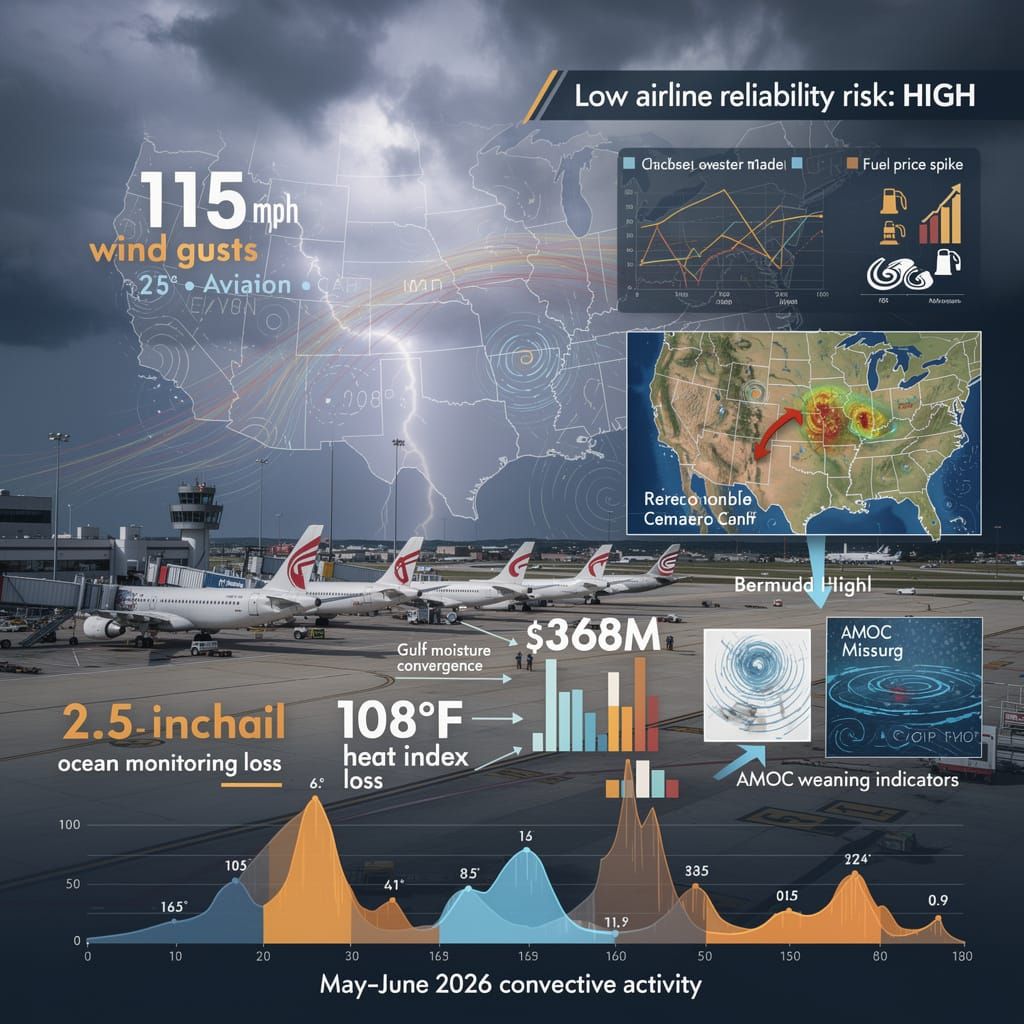
1,000+ aircraft grounded: staggering disruption equivalent to clearing multiple major hubs at once 🌪️. Data gaps from a $368M monitoring cut ever worsen prediction accuracy. Safety vs. Cost? U.S. passengers — how has this weather affected your travel plans?
Between May and June 2026, a cascade of severe convective systems and extreme heatwaves across the Central and Eastern United States triggered critical aviation disruptions. Driven by an intensified Bermuda High, increased Gulf moisture, and a developing "Super El Niño," these atmospheric conditions resulted in systemic flight cancellations, ground stops, and infrastructure failure.
How Weather and Policy Drivers Impacted Operations
Atmospheric instability, fueled by high Convective Available Potential Energy (CAPE) and strong wind shear, enabled the rapid development of supercells across the Great Plains. These systems produced wind gusts peaking at 115 mph and hail sizes reaching 2.5 inches, exceeding safe operating margins for regional aircraft. Concurrent heatwaves, with indices exceeding 108°F, increased surface instability and energy demand, straining airport grids.
This volatility coincided with a critical degradation in forecasting capacity. The U.S. government’s decision to dismantle the $368 million Ocean Observatories Initiative—removing 900 deep-sea instruments and 15 sensor platforms—created significant data gaps. This reduction in real-time ocean monitoring impairs the ability to track atmospheric circulation changes and AMOC weakening, increasing uncertainty in extreme-weather predictions.
Operational Impacts:
- Flight Stability: 70-knot gales $\to$ structural stress and loss-of-control risks.
- Surface Infrastructure: 90+ mph winds $\to$ aircraft skin damage and terminal power outages.
- Network Flow: Systemic disruptions $\to$ over 1,000 aircraft delayed or grounded during peak events.
Timeline of Convective and Thermal Activity
- May 12–21: Supercell activity in the Great Plains and flash floods in the Mid-Atlantic trigger early-season cancellations.
- May 21: NOAA projects a below-average Atlantic hurricane season due to El Niño, yet warns of localized severe impacts and record spring temperatures.
- June 2–8: Northern Plains and Gulf Coast storms result in widespread airport disruptions.
- June 10–12: Tornado outbreak hits Chicago hubs; 115 flights canceled and 232 delayed at O'Hare, while 180,000+ customers lose power.
- June 21-23: Massive storm system spans the Plains to the Northeast, delivering life-threatening hail and winds.
Strategic Outlook
The correlation between intensified Gulf moisture and rapid cyclogenesis demonstrates a critical need for hybrid weather models, combining AI with physics-based data. The current gap in observation infrastructure, coupled with geopolitical fuel price spikes from the Strait of Hormuz closure, projects a period of low airline reliability. While a cooling trend began after mid-June, the 1.5°C warming threshold and El Niño's influence indicate that hazardous storms and flash-flood risks will maintain a high-impact volatility state for U.S. air traffic through the summer.
🚨 High-Stakes Flight: The Convergence of Aviation Risk
22 deaths from 4 separate crashes in June alone—a staggering spike in aviation risk 🚨 Equivalent to losing several entire flight crews in weeks. Systemic failures across military and corporate sectors. Is safety being traded for speed? Private flyers—do you trust your charter's maintenance?
June 2026 has seen a concentrated cluster of aviation fatalities, highlighting systemic vulnerabilities across military, corporate, and recreational operations. From the loss of tech industry founders to the first fatal accident for a Berkshire Hathaway subsidiary, these events demonstrate a correlation between specific flight profiles and high-impact risk exposure.
Corporate and Private Fragility
On June 19, 2026, a Cessna 421 crashed near La Baule-Escoublac Airport in France. The accident resulted in two fatalities, including Claude Guillemot, co-founder of Ubisoft. This loss creates a strategic gap for Ubisoft during a period of organizational restructuring and labor disputes.
Simultaneously, NetJets experienced its first fatal crash. A Cessna Citation Latitude traveling from Mexico to Austin suffered an engine failure and attempted a fuel-low emergency landing, crashing on Loop 20 near Laredo, Texas. The incident resulted in the death of pilot Joshua Baer and injuries to seven others. The crash underscores the volatility of private charters during emergency diversions, where mechanical failure quickly transitions into public infrastructure risk.
Systemic Failures in Special-Purpose Aviation
Beyond corporate losses, data from June 2026 reveals a pattern of critical failures in specialized aircraft:
- Military Testing: On June 16, a B-52 Stratofortress crashed at Edwards Air Force Base during a radar modernization test. Eight people died. The crash, caused by a convergence of modified operator protocols and contractor-controlled systems, reduced the B-52 airworthy roster from 744 to 726 units.
- Recreational Jump-Planes: On June 14, a Pacific Aerospace P750 operated by Skydive Kansas City stalled and crashed near Butler, Missouri. The accident resulted in 12 fatalities, indicating a vulnerability in low-cost, high-adventure safety protocols.
- Cargo Operations: On May 20, a UPS MD-11F suffered engine and pylon detachment during takeoff at Louisville Muhammad Ali International Airport, resulting in a massive fireball and high-level recovery efforts.
Operational Impacts
Infrastructure: B-52 runway contamination delayed three weeks of missile tests; Laredo highway closures lasted two days. Regulatory: The FAA is currently evaluating NTSB recommendations following midair collisions and procedural failures, including a United Airlines light-pole collision at Newark Liberty Airport on May 3. Institutional: Sudden leadership vacancies in founder-led firms potentially erode investor confidence.
Timeline of June 2026 Critical Incidents
- June 14: P750 crash, Missouri; 12 deaths; focus on stall/maneuver failure.
- June 16: B-52 crash, California; 8 deaths; modernization test anomaly.
- June 19: NetJets crash, Texas; 1 death; engine failure/fuel-low emergency.
- June 19: Cessna 421 crash, France; 2 deaths; investigation into mechanical factors.
- June 21: Ubisoft confirms death of Claude Guillemot.

Comments ()