109M Records Leaked: FCC Proposes Mandatory KYC ID Storage in US
TL;DR
- KYC Mandate: FCC Proposed ID Verification Risks Massive Identity Data Leaks in US. Will the FCC's new KYC identity mandates actually stop robocalls or just create the ultimate hacker honeypot?
- RedHook v2026 Malware: Android 17 ADB Exploits Hit SE Asia Users. Is your Android 17 update actually a backdoor for RedHook v2026 malware to drain your bank account?
- RFC 10008: IETF Standardizes HTTP QUERY Method to End URL Bloat and Log Leaks. Will the new HTTP QUERY method actually fix data leaks or just create a refactoring nightmare for developers?
🤡 Your ID, Please: The FCC’s Masterclass in Digital Suicide
109M+ records leaked and the FCC's fix is to build a bigger honeypot. Absolutely delusional 🤡 This is like curing a leak by flooding the house. Mandated ID storage for 4 years? Pure gold for hackers. FCC — is this a security rule or a gift to identity thieves?
Imagine waking up and realizing the government’s solution to your phone being hacked is to demand a photocopy of your driver's license before you can send a text. Brilliant. Truly. 🤡
On June 12, 2026, the FCC adopted a Further Notice of Proposed Rulemaking for a 'Know Your Customer' (KYC) rule. The goal? Curb illegal robocalls. The method? Forcing voice service providers—including prepaid services—to verify identities, screen users against terror watchlists, and store this data for four years. Because clearly, the best way to stop scammers is to build a massive, centralized honeypot of identity documents for them to steal.
Why now? Because we love leaking data
The logic chain here is a goddamn disaster:
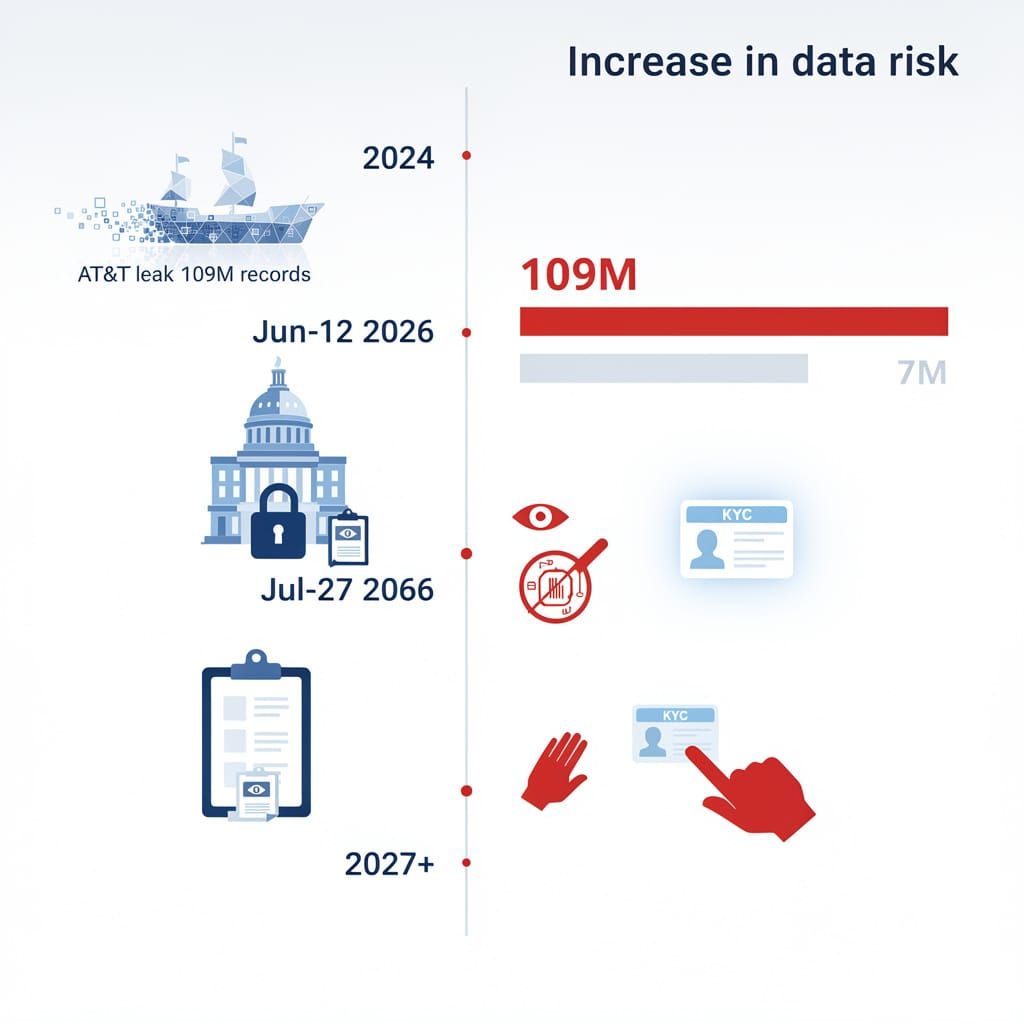
- The Catalyst: AT&T dumped 109 million records in 2024, and AssuranceAmerica just leaked ~6.99 million driver's licenses into the wild by July 8, 2026, via a compromised employee account.
- The Corporate Reflex: "Oops, we can't keep data safe!"
- The Government Solution: "Great! Let's mandate that every carrier collect even more sensitive data!"
It’s like curing a leaky faucet by flooding the entire house. 🌊
The 'Safety' Trade-off
While Chairman Brendan Carr and the FCC claim this protects us, the real-world math demonstrates a total failure in risk assessment:
Privacy: Mandatory ID verification → mass surveillance risk → zero anonymity for journalists and abuse survivors. Security: Centralized ID databases → high-value targets → increased attack surfaces for SIM-swap and account-takeover attacks. Human Cost: Victims of domestic abuse relying on burner phones → barred access → lethal exposure.
The Roadmap to Nowhere
- 2024: AT&T leaks 109M records, proving centralized databases are basically open doors.
- June 12, 2026: FCC proposes KYC mandates, 4-year data retention, and terror-list screening.
- July 27, 2026: Public comment deadline; the window to tell the FCC this is a dumpster fire closes.
- 2027+: Projected surge in identity theft as carrier honeypots inevitably leak.
The Reality Check
The Promise: Stops fraud and SMS abuse. The Reality: It does absolutely nothing to stop synthetic identity fraud—which currently costs US businesses $30–$35B annually. Researchers can now generate functional synthetic IDs in under 7 minutes. Spoofing allows bad actors to display any fake ID they want; this rule just makes it easier for the state to track you.
The Cost: High administrative friction for carriers. The Benefit: A warm, fuzzy feeling for regulators who love paperwork more than actual security.
If you enjoy the idea of your identity being stored in a database managed by people who couldn't secure a lemonade stand, this is a win. For the rest of us? Grab some open-source VOIP tools and start praying the FCC doesn't figure out how to block those too. ✌️
🤡 Your Phone is a Brick with a Screen 📱
53 command sets for total control! 💀 RedHook v2026 is basically a remote control for your bank account via Wireless ADB. While Google broke your Wi-Fi with Android 17, hackers just walked through the front door. 💅 Corporate 'security' vs. actual reality? Android users—is your 'secure' phone just a pricey brick? 📱
Congratulations! You updated to Android 17 in mid-June to get those fancy "Bubbles" and "Gaming Mode." Google probably told you it was "more secure" with its AI-driven threat detection. Meanwhile, the universe decided to laugh in your face. On July 13, Group-IB and Bleeping Computer dropped the news on RedHook v2026—a piece of malware that treats your phone’s accessibility settings like an open invitation to a house party where the guests steal your identity and drain your bank account. 🤡
How did we fuck this up?
It’s the classic corporate trade-off: convenience vs. not getting hacked. While Google was busy fighting IPv6 conflicts that broke Wi-Fi for Pixel users—forcing a massive migration to expensive mobile data just to keep apps running—the attackers found a better way in. RedHook doesn't need a fancy zero-day; it just tricks you into "configuring Wi-Fi debugging" and then hijacks Android’s native Wireless ADB (Android Debug Bridge) functionality. It’s not a bug; it’s a feature for the hackers. 💅
The Causal Chain of Chaos:
- June 17–19: Android 17 rollout → IPv6 implementation conflicts trigger widespread Wi-Fi failures and Google App connectivity loss.
- July 13: RedHook v2026 debuts → Uses wireless ADB to target users in Vietnam and Indonesia via phishing texts and social media links.
- The Result: Direct monetary theft. No "Free Pizza" link required; just a little social engineering to enable a "tool" that empties your savings. 🍕
The Damage Report:
- Control: 53 command sets → Full remote access to screen capture, SMS interception, and forced reboots. Your mic and texts are now shared property.
- Persistence: Dual-service redundancy → Self-restart protocols ensure the malware survives reboots faster than your corporate IT can schedule a Zoom call. 💀
- Evasion: Shizuku-based execution → Bypasses root requirements to manipulate the system from the inside.
What’s next on the disaster map?
Since the industry loves playing whack-a-mole with security, expect the following:
- Late July 2026: New adversarial variants emerge as Group-IB signatures get flagged.
- August 2026: Rapid-response patches deploy, likely breaking the landscape mode or gesture controls (again) in the process.
- Q3 2026: A new "convenience feature" is added, restarting the cycle of misery.
Stop trusting the "Secure by Design" marketing slide decks. If it's closed-source and bloated, it's a liability. Stick to lean, open-source tools or just throw your phone in a lake. Either way, the hackers win. ✌️
💀 Goodbye URL Bloat, Hello Refactoring Hell 🤡
2,000 characters of JSON in a URL is a digital hoarding nightmare 💀. That's roughly 4 full paragraphs of garbage in your logs. IETF's RFC 10008 finally gives us the QUERY method to stop the 414 meltdowns. 🙄 Security wins or refactoring hell? Devs—ready to trade ugly URLs for more Jira tickets?
Congratulations to every developer who thought their API was "finished." The IETF just dropped RFC 10008, introducing the `QUERY method—because apparently, stuffing 2,000 characters of JSON into a GET request like a digital hoarder wasn't "standard" enough. Now we have an idempotent, POST-like method for complex payloads that doesn't blow up your logs or trigger a 414 URI Too Long meltdown. 💀
Why the sudden panic?
For years, we’ve played a pathetic game of "Will this URL break the proxy?" while pretending REST is a religion. The QUERY method fixes this by allowing structured query content in the request body while ensuring the operation remains safe and idempotent. It’s basically a POST that isn't a sociopath; it doesn't mutate state, it just asks for data without making the URL look like a cat walked across the keyboard.
By formalizing safety semantics, the IETF enables native caching and reduces the need for application-layer hacks. While the spec is live, we're still stuck in a fragmented mess where middleware must bridge the gap for legacy infrastructure that still thinks it's 2012. 🙄
- June 15, 2026: RFC 10008 published, officially defining the HTTP QUERY method.
- June 19, 2026: IETF HTTP Working Group approves RFC 10008, standardizing a safe alternative to POST for retrieving results from processed data.
- 2026–2028: Integration lags as network infrastructure mirrors the glacial pace of the IPv6 rollout, leaving developers trapped in middleware purgatory.
Performance: Native caching of complex requests → reduced latency for those who enjoy marginally faster page loads. Security: Sensitive data stays out of public URLs → fewer idiots leaking session tokens in logs. Developer Experience: Massive refactoring overhead → more caffeine, more burnout, more Jira tickets.
So, while the corporate suits brag about "protocol evolution" and "URL hygiene," the actual engineers get to spend their weekends updating handlers so the app doesn't crash when a browser ignores the new header. It's a classic industry trade: we traded ugly URLs for a fragmented deployment cycle.
Enjoy the migration, losers! 🥂



Comments ()