50% Usage Caps: US Export Controls Trigger AI Scarcity and Credit-Based Pricing for Anthropic
TL;DR
- 50% Usage Caps: Anthropic Fable 5 Access Throttled Amid US Export Controls. How are US export controls and credit-based billing impacting AI developer productivity and access to high-capacity models?
- 30% Faster App Launches: Apple's iOS 27 Core AI Overhaul Hits iPhone 17 Amid EU Regulatory Block. Will the EU's block on Siri AI make your iPhone 17 feel obsolete in Europe?
📉 Regulatory Friction and the Monetization of Scarcity
50% usage caps! 📉 This drastic restriction on Fable 5 follows US export controls, creating artificial scarcity for AI access. Compliance now outweighs market growth. Is the shift to credit-based billing a fair cost of stability? Developers — how is this impacting your workflow?
Recent US export control directives, implemented on June 15, 2026, have fundamentally altered the distribution and pricing architecture of Anthropic’s high-capacity models. The US government cited security concerns to impose these controls, resulting in the immediate disabling of Fable 5 access on the same day. This signals a strategic shift where geopolitical compliance outweighs market penetration.
How do restrictions drive pricing shifts?
The transition toward a usage-credit billing model demonstrates a pivot to manage artificial scarcity. This follows a May 14 introduction of a programmatic credit system designed to clarify boundaries between paid and free access. By replacing flat fees with pay-per-unit conversion, Anthropic aligns revenue with actual compute costs during a period of heightened infrastructure volatility. However, this shift has triggered significant friction; a June 22 class-action lawsuit alleges that the Claude Max 20x plan underdelivers promised usage, providing only six to eight times Pro usage.
Technical instability further complicates delivery. A security incident on July 1, combined with tightened guardrails, enables a redirection mechanism that routes suspicious queries to the more restricted Claude Opus 4.8. This filtering, while necessary for compliance, creates fragmented toolchains for developers and increases latency in deployment pipelines.
Deployment Timeline
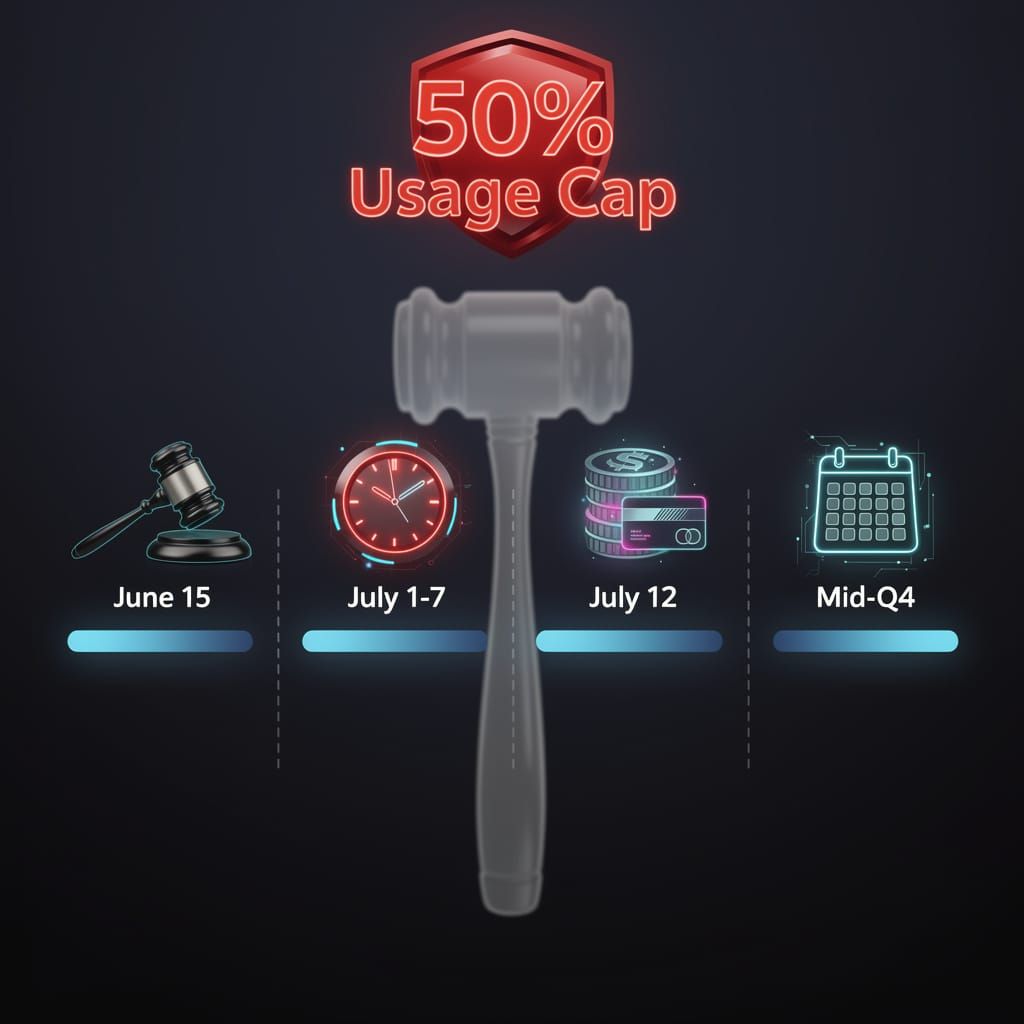
- June 15: US imposes export controls → Anthropic disables Fable 5 access.
- July 1–7: Limited restoration of Fable 5 with a 50% weekly usage cap.
- July 12: Restoration of free access under strict credit limits; pay-per-unit conversion begins.
- Mid-Q4 2026: Projected plateau for global availability as unauthorized export constraints persist.
Operational Impacts
- Revenue: Shift to credit-billing offsets premium income loss but risks consumer trust due to usage discrepancies.
- Infrastructure: Integration of Amazon Bedrock for Claude Fable 5 (launched June 15) optimizes workload distribution.
- Performance: High demand strains capacity; Anthropic paused API-rate billing changes for the Claude Agent SDK on June 16 to stabilize developer access.
- Development: Fragmented access cycles delay innovation and increase operational complexity for researchers.
Despite the deployment of Fable 5 via Amazon Bedrock to stabilize accessibility, the procurement pipeline remains congested. These constraints indicate that a full reintegration of Fable 5 into standard subscription plans is unlikely before September 2026. The current landscape demonstrates a causal chain where regulatory intervention necessitates technical throttling, which in turn forces a transition toward granular, credit-based monetization to sustain operational viability.
🚀 Apple Integrates Generative AI into iOS 27 Ecosystem
{}
Apple expanded its on-device AI capabilities with the rollout of iOS 27, transitioning Siri from a command-based assistant to a context-aware interface. Following the June 8 unveiling at WWDC 2026 and the July 7 release of developer beta 3, the system introduces a rebuilt Siri AI featuring on-screen awareness and personal context. To refine synthetic speech, Apple implemented "Pace" and "Expressivity" sliders, enabling users to modulate response speed and emotional tone.
How does iOS 27 reshape user interaction?
The update leverages the Core AI framework to process interactions locally. This architecture demonstrates measurable performance gains, with comparative tests on iPhone 17 devices confirming app launch speeds are up to 30% faster; specifically, Google Maps showed a 39.8% reduction in loading time. While Apple marketed an 80% increase in AirDrop speeds, independent testing indicates actual transfer improvements are approximately 5%. The integration of "Write with Siri" across Notes, Mail, and Messages reduces interaction friction by automating composition and organization.
Beyond functional utility, the update introduces a "liquid glass" UI redesign with SmartGlass priority elements. While the system targets improved user engagement, the rollout faces regional hurdles; EU regulators blocked the Siri AI launch in the EU due to DMA compliance and privacy concerns, delaying access for local developers and users.
Deployment Timeline
- June 8, 2026: WWDC announcement and developer beta release of iOS 27.
- July 1, 2026: Public beta availability via the Beta Software Program.
- July 7, 2026: Beta 3 introduces Siri "Pace" and "Expressivity" controls.
- October 2026: Revised consumer launch date.
System Impacts
- User Experience: Local AI processing → reduced response times and increased engagement via context-aware automation.
- Performance: Core AI optimization → 30% increase in app launch speed; marginal ~5% gain in AirDrop transfers.
- Security: Rapid AI deployment → ongoing scrutiny as Apple addresses multiple vulnerabilities (e.g., CVE-2026-28871) impacting device functionality.
- Market Position: Memory cost inflation → price increases across Mac, iPad, and Vision Pro (6% to 67%) due to HBM/DRAM shortages.
This strategic shift demonstrates a causal chain where deeper AI integration improves user retention—measured by a 4.3% week-over-week increase—which sustains hardware sales momentum. As Apple balances these advancements with a "serious memory crunch" and regulatory scrutiny, the transition toward autonomous, context-aware mobile environments accelerates.



Comments ()