Memory Scarcity: Apple Cuts M6 Mid-Tiers Amid 40% Price Surges for AI Pivot
📉 The Memory Bottleneck: Apple's AI Silicon Pivot
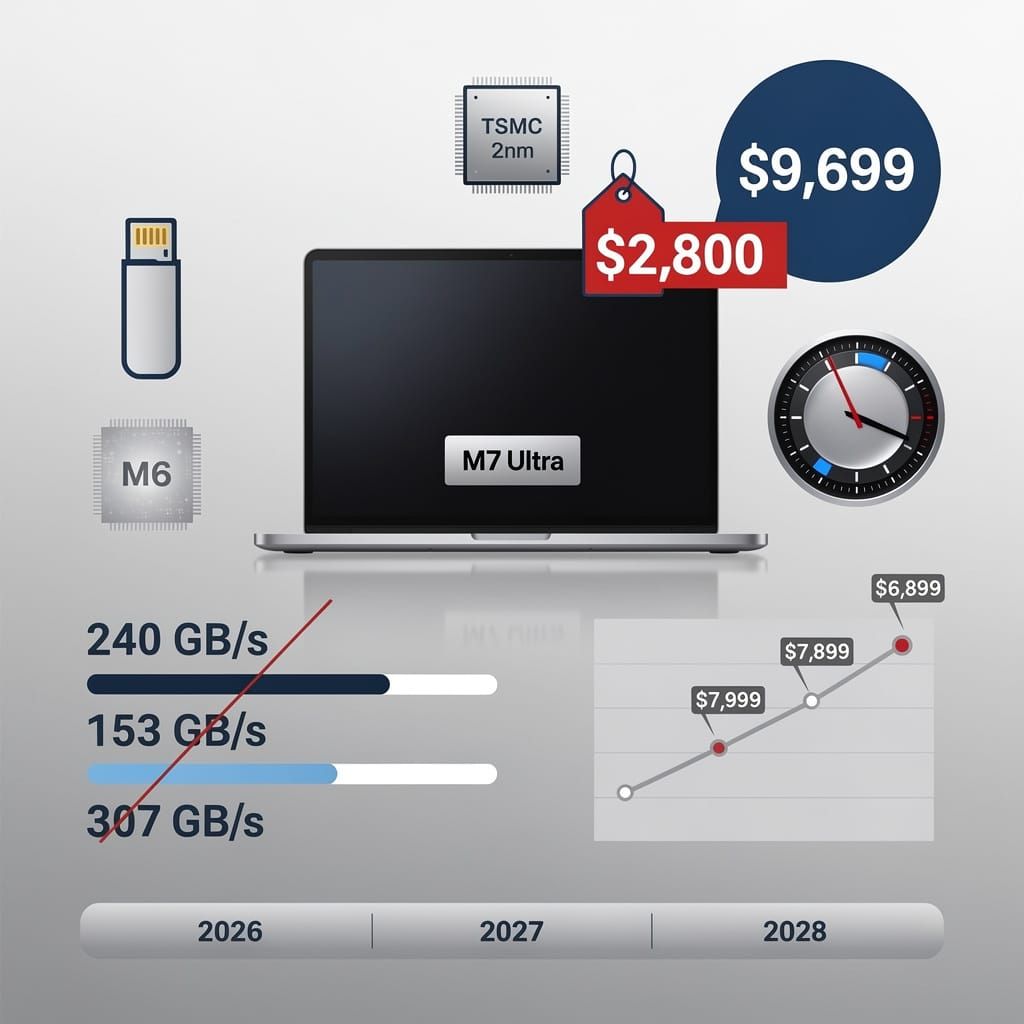
$2,800 price hike for a single laptop. This staggering inflation is the cost of Apple's fragile memory supply chain 📉. Mid-tier M6 Pro/Max chips are cancelled to feed AI hunger. Is AI utility worth a $9,699 price tag? Professional users — are you paying for progress or supply chain failure?
Apple’s revised silicon roadmap demonstrates a strategic shift toward AI-centric hardware that sacrifices traditional performance tiers. By omitting the M6 Pro and M6 Max variants in favor of the AI-optimized M7 series, the company attempts to bridge the gap between consumer hardware and the compute density required for high-parameter inference. However, this transition indicates a critical dependence on a fragile memory supply chain where raw material shocks now dictate product availability.
Is the M7 Ultra a Genuine Leap?
Apple plans to release the M7 series in early 2027, featuring 240 GB/s unified memory bandwidth—a significant increase over the M5’s 153 GB/s, though it remains inferior to the M5 Pro’s 307 GB/s. While the M7 Ultra is projected for 2028 to handle massive datasets, the current rollout is reactive. Permanent memory shortages, driven by AI-server demand and exclusive forward contracts from silicon giants, have already forced Apple to raise prices and lean on the M5 Ultra for Mac Studio upgrades.
- Late 2026: Base M6 launches for 14-inch MacBook Pro with bandwidth up to 200 GB/s.
- Early 2027: M7 series debut leveraging TSMC’s 2nm process for higher clock speeds.
- Q4 2027: M7 Pro and M7 Max launch for high-end 14-inch and 16-inch MacBook Pros.
- 2028: M7 Ultra reaches full deployment.
Performance vs. Accessibility
Prioritizing AI-focused silicon results in a fragmented ecosystem. The removal of M6 mid-tier chips creates a performance vacuum for professionals who require raw scalability without needing trillion-parameter inference. This strategy shifts the financial burden to the consumer; unsustainable memory costs have already triggered aggressive price hikes. The 14-inch M5 Max MacBook Pro, for example, surged from $6,899 to $9,699—a $2,800 increase—while the Mac Studio rose 33% to $5,299.
Financial: Severe hardware inflation → MacBook Pro exceeds $9,000; Mac Studio hits $5,299. Production: Irreversible memory scarcity → cancellation of M6 Pro/Max variants. Operational: 2nm fabrication shift → higher core frequencies to offset bandwidth limitations.
Apple's trajectory demonstrates a preference for high-density AI compute over a balanced hardware roadmap. While the M7's increased throughput enhances on-device machine learning, the systemic lag in delivering mid-tier upgrades suggests a silicon strategy compromised by supply chain volatility and an inability to absorb raw-material shocks.


Comments ()