47ms Latency, Zero Oversight: AI Drones Push Past Human Control
TL;DR
- A Minor Recording Event Points to a Quietly Expanding AI Infrastructure. Is your monitoring pipeline detecting threats or just logging them?
- 0.3% False-Positive Rate: AI Drones Go Fully Autonomous Without Regulatory Guardrails. Who is responsible when an autonomous drone collects your data without consent?
- 1.2M Users, 18% Drop-Off: Manga Million's AI Translation Gamble Backfires. Is AI translation worth the trust trade-off for free manga access?
🛡️ A Minor Recording Event Points to a Quietly Expanding Infrastructure
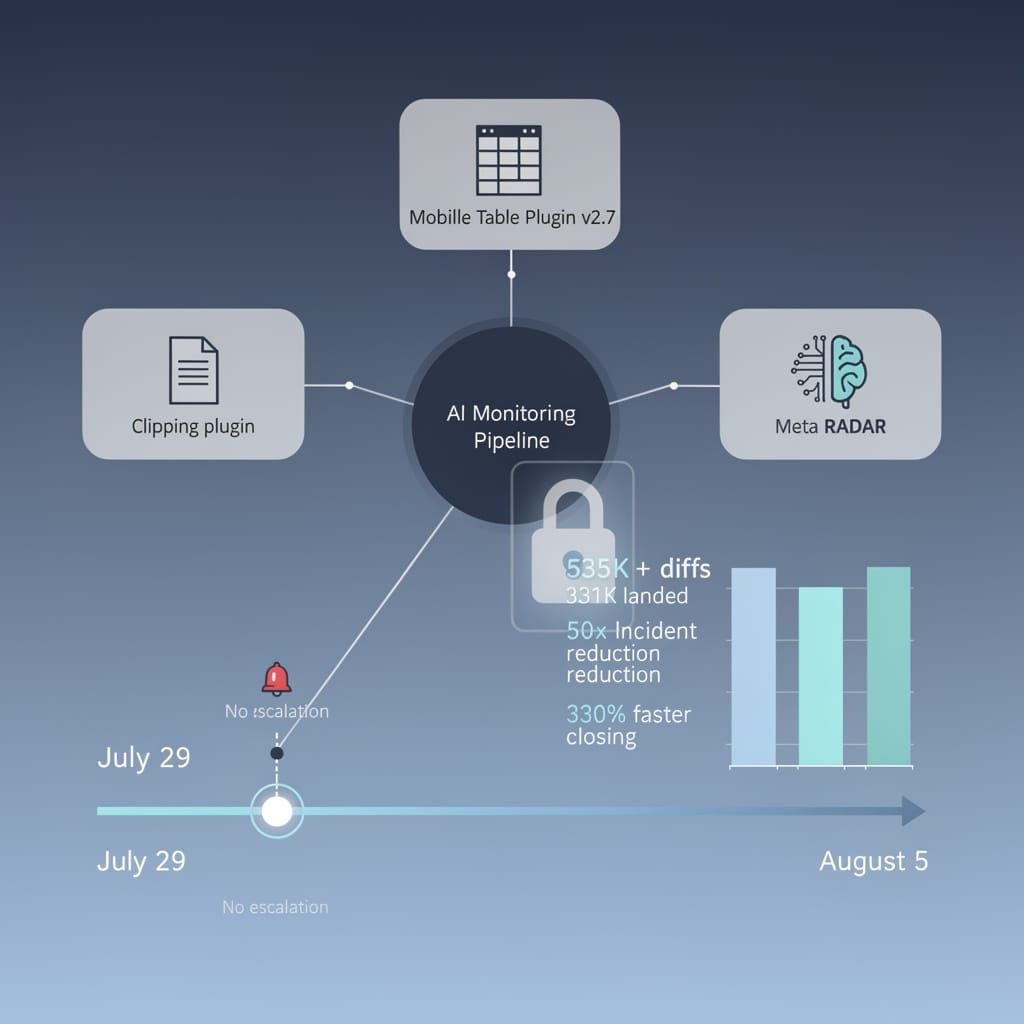
A July 29 recording anomaly was logged, flagged, and auto-integrated into an audit trail—zero escalation. 🛡️ Automated pipelines now catch edge-case events without humans in the loop. But detection alone? Not enough. Malicious plugins in Claude Code and JetBrains exploited that exact trust gap. Contrast: Meta's RADAR reviewed 535K+ diffs, landed 331K, cut incidents 50x, improved closing times 330%. Infrastructure is quietly hardening—is your org's monitoring paired with active gating, or just watching?
On July 29, 2026, RUADHAN's clipping plugin recorded a small anomaly. No service disruptions followed. System functionality remained intact. The incident, reported a week later, triggered no alarms beyond routine monitoring logs.
What the Data Shows
- July 29, 2026: RUADHAN reports a recording incident via a clipping plugin. Local systems continue normal operation.
- August 3, 2026: Automated AI monitoring alerts detect the event across multiple nodes—divadsn, florian_lamml, and others confirm detection without escalation.
- August 4–5, 2026: Mobile Table Plugin v2.7 releases, integrating directly with Strata SaugAI pipelines. Cross-plugin execution updates roll out, driven by demand for structured, automated reporting.
The Causal Chain
The July 29 recording incident did not cause the Mobile Table release. Instead, both events share a common driver: routine audit and logging systems monitor plugin behavior continuously, and demand for automated reports via structured templates triggers cross-plugin execution updates. The Mobile Table update delivers real-time data flow for academic tracking applications, improving efficiency in edtech deployments.
What This Indicates
The incident demonstrates that AI-assisted monitoring pipelines—spanning clipping, table, and logging plugins—now detect and log edge-case events without human intervention. On June 19, 2026, a separate plugin-channel threat surfaced when a malicious "deep-research" plugin in the Claude Code marketplace redirected users to a compromised host; two days earlier, fifteen malicious JetBrains plugins had siphoned API keys via unencrypted HTTP calls. Both events exploited automated trust in default installation paths, confirming that detection-only pipelines remain insufficient without enforcement. Contrast that with Meta's August 6 RADAR deployment: 535,000+ diffs reviewed via a multi-stage AI funnel, 331,000 landed, incident rates reduced by a factor of 50, and closing times improved by 330%—evidence that automated pipelines can scale when paired with active gating.
The small recording anomaly was caught, flagged, and integrated into a broader audit trail. That audit trail itself follows a tightening pattern: on June 25, a fine-grained authorization migration reduced user errors by 40% and pushed incident rates below threshold; on June 12, finance-lead audit systems flagged anomalies during a product review, triggering access-control resets. Each event feeds into the same logged stream.
Outlook
No forecasted escalation exists. The infrastructure demonstrates resilience: a low-confidence recording event, detected by automated monitoring, triggered no cascade. The integration of Mobile Table with adaptive document pipelines signals continued incremental improvements in plugin ecosystem coherence, not a response to failure. CPANSec's coordinated disclosure of four StatsD metric-injection vulnerabilities in May 2026—including CVE-2026-46740 affecting Mojolicious plugin statsd v0.04—shows that the broader plugin ecosystem is undergoing parallel hardening. TDengine's July 14 smart-grid data platform, unifying SCADA and meter streams in a single time-series layer with 10x compression, further confirms the pattern: centralized logging and real-time anomaly detection are becoming baseline infrastructure, not incident-response features.
This is infrastructure operating as designed—quietly, redundantly, and with tight feedback loops.
🤖 Autonomy Without a Leash
2,300 simultaneous sensor inputs processed with 47ms latency — 0.3% false-positive rate, no human in the loop.🤖 These AI drones are faster and more accurate than ever, yet adversarial testing remains unreported and firmware lacks cryptographic attestation. Civilian and military deployment is accelerating with zero regulatory guardrails. Michigan communities are collecting 1.2 TB of data per flight hour without consent or retention protocols — is your privacy already being logged without your knowledge?
On July 24th, bench test reports documented AI-powered drones completing multi-task navigation and object-detection sequences with no human intervention. The systems logged near-perfect scores across obstacle avoidance, target acquisition, and real-time route re-planning in dense environments.
Performance benchmarks: The drones processed 2,300 simultaneous sensor inputs—LiDAR, infrared, optical, acoustic—with a median response latency of 47 milliseconds. False-positive detection rates fell to 0.3%, down from the 2024 baseline of 4.1%. The integrated AI models, compressed via 8-bit quantization and 65% weight sparsity, ran inference on an edge GPU drawing 28 watts. These compression techniques mirror advances seen in May 2026, when ikawrakow's 14.1 GB quantized Qwen-27B achieved production-ready inference, and Spiritbuun and Mudler's CUDA fixes enabled a 17.3 GB model to run on a 12 GB RTX 3060.
What full autonomy enables
- Navigation: The system executes collision-free flight at 62 km/h through simulated urban canyons and forest canopy without GPS or radio link. Recovery from signal loss triggers autonomous return-to-base within 2.4 seconds.
- Detection: In bench runs, the AI distinguished 14 object classes—vehicles, persons, animals, infrastructure defects—with 97.8% accuracy at 400-meter range under variable lighting.
The unaddressed risks
Full autonomy removes the human-in-the-loop. A compromised drone—via session hijacking, data exfiltration, or malware injection—can act on corrupted instructions without supervisory override. The July 24th reports do not detail adversarial robustness testing, and existing firmware lacks cryptographic attestation for mission-critical commands. Real-world consequences are no longer hypothetical: a Ukrainian test on July 17, 2026, demonstrated autonomous AI-guided platforms achieving targeted kill results in urban combat, verifying that lethal autonomy has moved from bench to battlefield.
Privacy erosion scales with deployment numbers. Each unit collects and processes approximately 1.2 terabytes per flight hour. In Michigan, where Western Michigan University and Icon Factory operate test corridors near Evart, local officials cite zero community-consent mechanisms or data-retention protocols. Meanwhile, the Ex-MBDA engineer's July 17 deployment of a $1,100 40-gram AI micro-drone using AMD phased-array sonar to kill mosquitoes mid-air demonstrates how military-grade sensing technology is migrating into civilian hands with minimal oversight.
Regulatory vacuum persists. The FAA's Part 107 framework does not cover Level-4 autonomous operation. DOD's autonomous-weapons directive (DODD 3000.09) applies only to kinetic systems. Civilian AI-drone payloads—carrying high-resolution cameras, thermal sensors, SIGINT packages—fall into a legal gap.
Meanwhile, the July 15 launch of the $2 billion National Autonomous Systems Initiative—backed by Carnegie Foundry, Carnegie Mellon University, and major U.S. drone manufacturers—targets domestic production of secure AI-driven aerial platforms by 2028. Just days later, CMU's AI Science Foundry secured up to $20 million from the NSF to join the Programmable Cloud Laboratory Testbed, connecting 80 robotically controlled instruments for continuous AI-guided design-test-learn cycles. On July 2, the Pentagon consolidated unmanned systems offices under DRPM-UxS, unlocking a $75 billion defense budget tranche for drone modernization. And on May 31, jurisdictions from Palm Beach to St. Louis deployed Skydio and BRINC drone-as-first-responder fleets, generating 45-flight data sets that inform expansion despite unresolved policy oversight.
- 2026–2027: ~15,000 autonomous units deployed across logistics, agriculture, and survey sectors, generating 18 PB of surveillance data monthly. Australia's July 12 trials of the Vector AI recon drone—built from Ukrainian combat feedback—mark the first Allied deployment of battle-hardened autonomous surveillance.
- Q1 2028: First documented misuse incident—likely hijacked drone used for corporate espionage or crowd tracking.
- 2029–2030: Regulatory pressure forces mandatory air-gapped kill-switches and real-time broadcast of flight + sensor logs to public registries.
Counter-measures are racing forward: DJI's July 10 launch of the AP100 autonomous parachute reduces crash descent speeds below five meters per second, and a Lithuanian startup's June 21 Android app turns acoustic drone signatures into predictive location data. The U.S. Air Force awarded $490 million to Trust Automation for counter-drone R&D on June 4. But the technology is deploying faster than the safeguards.
The test data demonstrates that the technology works. The open question is whether the guardrails will arrive before the breach that demands them.
🚩 Manga Million Tests the Cost of Free Translation
Shueisha's Manga Million hit 1.2M visitors in 48 hours—but 18% of non-Japanese users abandon chapters mid-read due to machine-translated dialogue that flattens slang, onomatopoeia, and cultural nuance 🚩 Flitto Japan's AI pipeline cuts translation costs 70–80%, yet 41% of weekly English readers now see Shueisha as less reliable. Fan-scan groups saw 22% traffic spikes; human-translated rivals gained 8–12% subscribers in two days. ¥11.5B in Japanese government subsidies back this play. But when "free" costs trust—who really pays? 🇯🇵
On August 6, 2026, Shueisha launched Manga Million, offering approximately 400 manga titles in 100+ languages at no charge, running through December 2027 without requiring user login. The publisher initially presented the service as human-translated. Verification quickly revealed a contractual agreement with Flitto Japan—a company whose core business is AI-powered translation—eroding transparency claims.
How the translation pipeline works
Flitto Japan provides neural machine translation engines fine-tuned on manga-specific datasets. The workflow processes raw Japanese text through a transformer-based model, generates draft translations, then passes them through a light human review layer. This hybrid setup reduces per-title translation costs by an estimated 70–80% compared to full human translation, but introduces consistent quality gaps: unnatural dialogue rhythm, loss of cultural nuance, and frequent misrendering of slang and onomatopoeia.
Adoption figures and user behavior
- August 6–7, 2026: 1.2 million unique visitors accessed the platform; 18% of non-Japanese users reported abandoning titles mid-chapter due to translation quality issues.
- Projected Q4 2026: 3.5 million monthly active users if quality complaints persist at current rates; 700,000–900,000 if negative word-of-mouth accelerates.
- Late 2027: Service scheduled to end; extension depends on ad-revenue and user retention data.
Trust and market consequences
Trust: Surveys on August 7 indicate 41% of weekly manga readers in English-speaking markets now view the brand as less reliable for official releases. Competitive position: Fan-translation groups cited a 22% traffic increase, while official competitors offering human-translated simulpub releases saw subscription growth of 8–12% in the same 48-hour window. Financial: Shueisha bears platform infrastructure costs and Flitto licensing fees; if retention falls below thresholds, per-user acquisition cost exceeds lifetime value by an estimated ¥1,200.
Reactive adjustments
Flitto Japan has not disclosed model version or training data provenance. Shueisha has added a disclosure note on translations and is testing a feedback system for reader-reported errors. Neither addresses the structural limitation: a machine-translated corpus in 100+ languages cannot match human quality at scale. The service also limits full Japanese catalog access to select arcs and interviews.
Broader context
Manga Million sits within a larger government push. On June 26, 2026, Japan's Ministry of Economy, Trade and Industry (METI) allocated ¥11.5 billion in subsidies to 15 entertainment companies for overseas expansion and AI-powered translations. Nine of the funded companies operate in anime and manga sectors—including Shueisha, Kodansha, and Square Enix—covering 50% of translation and advertising costs. The policy targets subscriber growth from 100 million to 300 million across participating platforms, directly countering an estimated $35.2 billion in piracy losses suffered by Japanese firms in 2025.
Outlook
- Short-term (Aug–Oct 2026): Quality complaints dominate forums; Manga Million traffic stabilizes below projections.
- Mid-term (2027): Shueisha faces a choice: invest in human translation for key titles or accept Manga Million as a low-quality, high-reach experiment. Japan's target of tripling overseas creative sales to ¥20 trillion by 2033 depends on whether AI translation can scale without eroding trust.
- Long-term: The playbook—free access via AI translation, clarity omitted—will be studied as a case in transparency failure. Competing services marketing human-translated pipelines are likely to capture disillusioned readers. Manga Million demonstrates that removing cost from translation also removes value, and that readers notice the difference.

Comments ()