$12 Billion Quantum Pivot: US CHIPS Act Boosts Domestic Scaling to Counter Global Rivalry
🤯 Scaling the Quantum Frontier: The $12 Billion Pivot
$12 Billion massive pivot to quantum scalability. That's roughly 12x the cost of a mid-sized city's annual budget 🤯. Federal grants are slashing R&D risks to accelerate fault-tolerant manufacturing. But can the industry pivot to post-quantum encryption fast enough? IBM — how will this impact your region's tech hub?
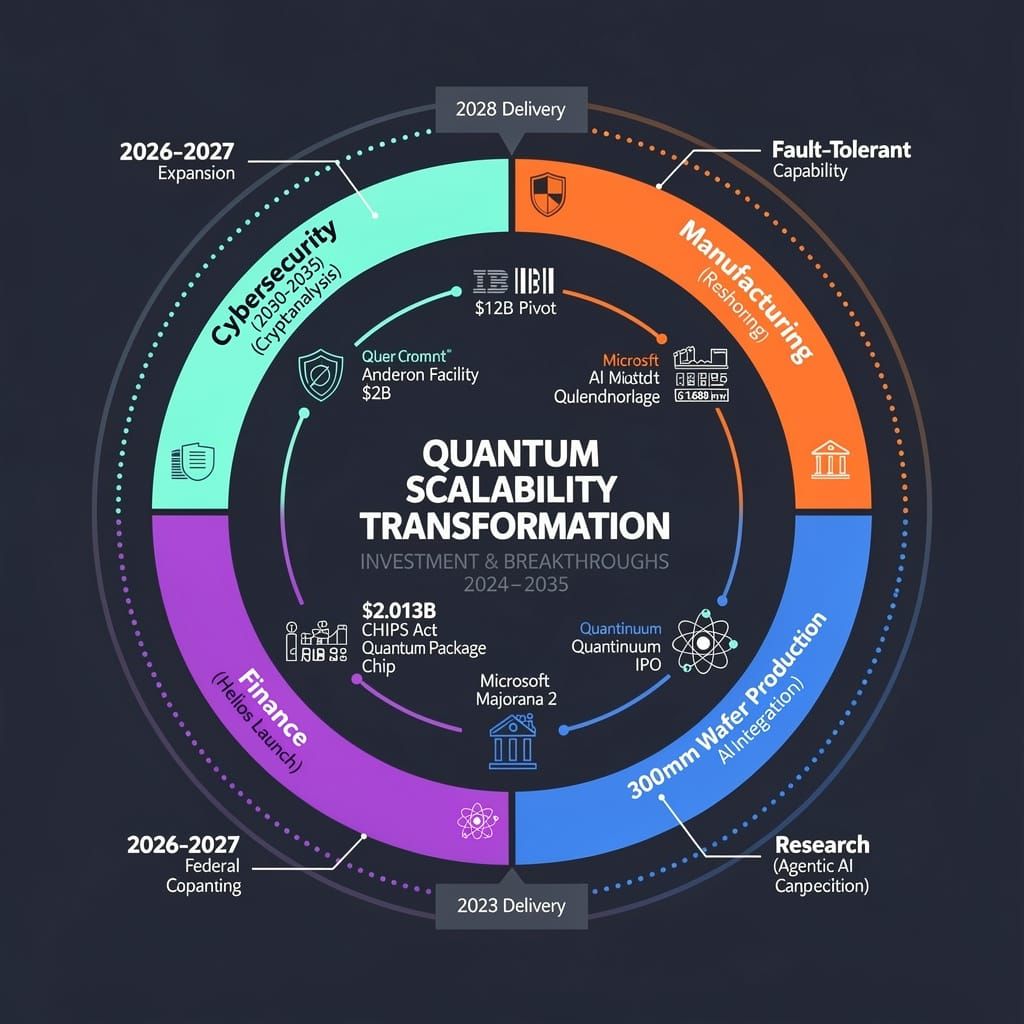
Global investment in quantum computing shifted toward industrial scalability in June 2026. The U.S. Department of Commerce distributed a $2.013 billion quantum-investment package under the CHIPS and Science Act, with $1 billion specifically allocated to IBM’s Anderon foundry and another $1 billion to GlobalFoundries. IBM’s subsequent $10 billion commitment, including a $2 billion allocation for the Anderon facility, enables a transition from laboratory proofs to scalable, fault-tolerant manufacturing. This federal-corporate synergy results in a surge of domestic semiconductor capacity tailored for quantum hardware.
How does this investment reshape infrastructure?
IBM’s strategy utilizes a specialized foundry approach, with Anderon producing 300mm wafers to scale beyond the current global fleet of systems. This creates a causal chain where federal equity stakes and grants reduce R&D risk, enabling corporate capital to accelerate production. Simultaneously, Microsoft’s Majorana 2 chip—developed using agentic AI for materials optimization—targets commercial viability by 2029 through improved qubit stability. Other breakthroughs, including NVIDIA's sub-microsecond quantum error correction and IonQ's installation of the first commercial quantum computer with logical qubits, further compress the development cycle.
- 2026–2027: Expansion of 300mm wafer production and integration of hybrid quantum-classical workflows.
- 2028: Projected delivery of scalable hardware utilizing topological qubits and industrial optimization tools.
- 2029: Target achievement of full fault-tolerant quantum capability and mainstream commercial deployment.
What are the sector-specific implications?
The push toward fault-tolerant systems creates distinct pressures across the technical and economic landscape:
Cybersecurity: Projected 2030–2035 cryptanalysis window $\rightarrow$ urgent migration to post-quantum cryptography (PQC) and quantum-resistant algorithms. Manufacturing: Shift toward domestic independence $\rightarrow$ reshoring of fabs and expansion of quantum-capable wafer lines via CHIPS Act funding. Finance: Quantinuum's IPO (raising $1.68 billion with 28 million shares at $60 each) $\rightarrow$ increased capital for the 98-qubit Helios launch and Apollo expansion. Research: Integrating agentic AI and quantum-dot qubit designs $\rightarrow$ accelerated materials science and drug discovery timelines.
This investment surge demonstrates a correlation between national security and corporate ambition. As the U.S. and China engage in a technological rivalry—evidenced by China's launch of the Hanyuan-2 and Origin Wukong-180—the resulting capital flow enables hardware that exceeds classical supercomputing limits. Early adopters in defense and medicine gain computational advantages, provided they resolve remaining error-rate challenges.



Comments ()