88% AI Adoption, 24% Leadership Readiness: Singapore's Transformation Paradox
TL;DR
- 88% AI Adoption, 24% Leadership Readiness: Singapore's Transformation Paradox. Is your organization's leadership keeping pace with your workforce's AI fluency — or falling behind?
- German Court Rules Google Liable for AI-Generated Misinformation — First Major Precedent for Corporate AI Accountability. Is your company ready for the new era of AI accountability?
🤯 The Singapore Paradox: Why 88% AI Adoption Among Workers Isn't Driving Enterprise Change
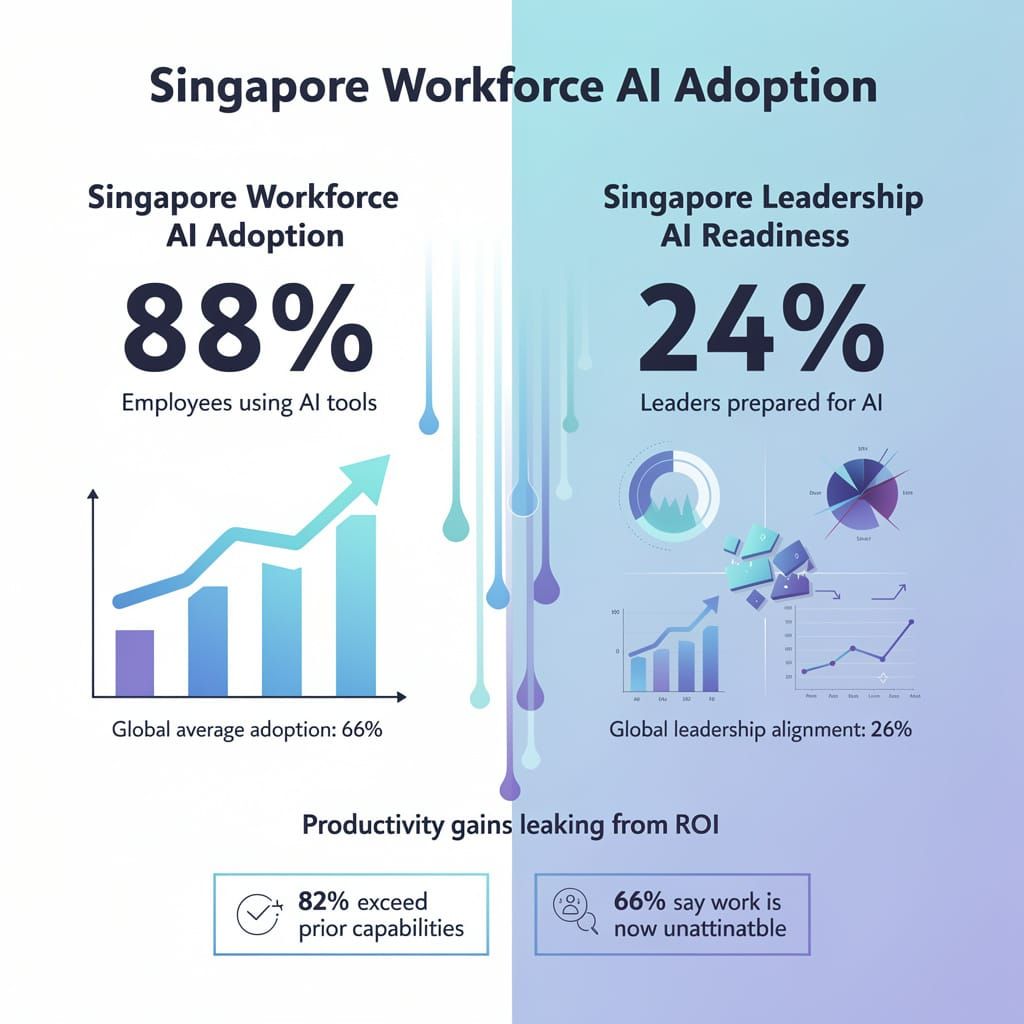
88% of Singapore workers now use AI daily — yet only 24% of leaders have a plan to integrate it 🤯 That means 3 in 4 decision-makers are flying blind while frontline employees produce work they couldn't have generated 12 months ago. Productivity gains exist, but they're leaking — fragmented workflows, no governance, zero structural redesign. The result? Individual output surges. Organizational ROI flatlines. Singapore leads in workforce adoption but trails the global average in leadership readiness. The Miasma supply-chain worm that hit 73 Microsoft repos shows exactly what happens when velocity outpaces oversight. Your workforce already moved. Has your leadership? 👇
On June 21, 2026, Microsoft released its annual Work Trend Index with a data point that seemed to confirm Singapore's position as a global AI frontrunner: 88% of Singaporean employees now use AI tools in their daily work, compared to a global average of 66%. The number is striking, and the gap is widening. But beneath the headline statistic lies a more uncomfortable reality—one that reveals a deepening fracture between workforce capability and institutional readiness.
The Capability Surge
The 2026 index shows that 82% of frontline professionals in Singapore report ownership of AI-driven outputs that exceed prior-year capabilities—meaning they are producing work they could not have generated 12 months ago. This is not incremental improvement. It represents a structural shift in individual productivity: employees are using generative AI, retrieval-augmented pipelines, and automated reasoning tools to compress timelines, expand output quality, and take on tasks previously delegated to specialized teams.
Further, 66% of AI users in Singapore report creating work that was previously unattainable—entirely new categories of output enabled by model capabilities that did not exist in 2024 or 2025. This includes cross-functional analyses, real-time data synthesis, and multi-step reasoning chains executed autonomously. The global benchmark for this metric sits at 58%, indicating Singapore's workforce is pulling ahead of international peers.
The pattern is clear: individual adoption is accelerating, and frontline workers are adapting faster than any institutional planning cycle anticipated.
The Leadership Gap
The same report reveals that only 24% of senior leaders in Singapore demonstrate coherent alignment with AI initiatives. That means three out of four decision-makers lack a structured strategy for how AI integrates into workflows, governance, or long-term planning. The global average for leadership alignment stands at 26%—meaning Singapore's institutional readiness actually trails the world average despite leading in workforce adoption.
This produces what analysts now call the transformation paradox: employees are using AI to generate measurable productivity gains, while organizations remain reactive—deploying no updated processes, no retraining frameworks, and no structural realignment to absorb or amplify the new output velocity. The paradox is not unique to Singapore—it echoes patterns seen globally, where 70% of UK businesses now use or plan to use AI by 2030, yet most measure success only at the tool level rather than strategic integration.
The implications are not abstract. When 82% of workers produce output that exceeds prior benchmarks, but only 24% of leaders have a plan to integrate that output, the result is:
- Fragmented workflows: individual AI-generated work sits outside formal pipelines, creating version-control and audit risks.
- ROI erosion: productivity gains exist at the individual level but fail to compound into organizational efficiency because systems haven't adapted.
- Innovation bottlenecks: new work categories go unvalidated, unapproved, or unused.
Why the Gap Persists
Three structural drivers explain the misalignment:
1. Organizational inertia. Enterprises designed workflows in 2019–2022, before large language models reached deployment maturity. Those workflows assume linear human input, sequential approvals, and fixed output formats. AI-native work—iterative, parallel, high-velocity—does not fit. The cost of this mismatch is measurable: Asana reported that 53% of AI projects fail because they lack complete organizational context. The Miasma supply-chain worm that disabled 73 Microsoft repositories on June 10, 2026, by injecting malicious configuration files via Azure Functions demonstrates how quickly AI-driven development pipelines can be compromised when organizations lack integrated oversight—the same fragmentation that stalls productivity gains also creates security blind spots.
2. Risk asymmetry. Frontline workers bear low personal risk for adopting AI tools. Their incentives reward output quantity and speed. Leaders, by contrast, face compliance, liability, and governance exposure. Without clear regulatory frameworks or internal AI governance policies, institutional caution is rational—but costly. Only 14% of organizations in Singapore provide incentives for reinvention, according to the Work Trend Index, meaning the reward structure actively discourages the systemic change needed to capture AI value. This asymmetry mirrors broader market dynamics: on June 9, 2026, the US Executive Order established a voluntary AI cybersecurity framework precisely because the gap between rapid AI deployment and institutional governance creates systemic vulnerability—a gap that Singaporean enterprises now face in miniature.
3. Skill inversion. Junior and mid-level professionals in Singapore now routinely operate AI systems with fluency that exceeds their managers' understanding. This creates a knowledge asymmetry that slows decision-making: leaders cannot evaluate, approve, or prioritize work they do not fully understand. Yet the data shows a path forward: among Frontier Professionals—the cohort reporting the highest AI-driven output gains—87% say their managers openly use AI themselves, indicating that leadership engagement directly correlates with team-level productivity. The release of Anthropic's Fable 5 and Mythos 5 on June 10, 2026, which achieved top vision benchmarks but exposed latency spikes and security gaps requiring rapid patching, illustrates why leadership literacy matters: without technical fluency, leaders cannot evaluate when capability gains come with exploitable risk.
The Forecast
Microsoft's data projects that without sustained organizational investment within six months, the gap between individual AI capability and enterprise readiness will widen further. The consequence will be measurable:
- Productivity leakage: individual gains that fail to translate into team or departmental throughput.
- Talent friction: high-performing AI-fluent workers seek environments that match their capability level.
- Competitive erosion: organizations that fail to close the readiness gap lose market position to those that operationalize AI at scale.
Globally, the stakes are rising. By June 2026, Anthropic had raised $965 billion in funding, ChatGPT crossed 1 billion monthly users, and Microsoft expanded Copilot deployment to 300,000+ employees across Infosys, Tata Consultancy Services, and Wipro. Meanwhile, the June 9–10 Patch Tuesday addressed 206 zero-day vulnerabilities in Windows CTFMON, HTTP.sys, and BitLocker, while Microsoft simultaneously deployed AI-driven features and a supply-chain worm disabled 73 Microsoft repositories—illustrating that the velocity of AI adoption and the velocity of security threats are now coupled. Enterprises that cannot integrate AI at scale will face structural competitive disadvantage, not merely missed efficiency gains.
What Closing the Gap Requires
Singapore's position as a global AI adoption leader gives its enterprises a rare advantage—but only if they act. The data suggests three priority actions:
- Leadership AI literacy programs: structured upskilling for senior management to close the knowledge asymmetry and enable informed decision-making. The Frontier Professional data shows that when managers openly use AI, 87% of their teams report higher output capability. Without this, leaders cannot evaluate whether model releases like Anthropic's Fable 5—which delivers top vision benchmarks alongside exploitable security gaps—represent opportunity or risk.
- Workflow redesign: mapping existing processes against AI-native output patterns, then rebuilding approval chains, quality checks, and integration points. Organizations that fail to provide complete context for AI integration see 53% project failure rates. The Miasma worm's compromise of 73 Microsoft repositories via Azure Functions CI/CD pipelines demonstrates that workflows designed without AI-native security integration create lateral-movement vectors, not just efficiency losses.
- Governance frameworks: clear policies for AI-generated output ownership, validation, and auditability—reducing the risk that currently slows institutional adoption. Only 14% of Singapore organizations currently provide incentives for reinvention; redesigning reward structures to prioritize outcomes over tasks is essential. The US Executive Order's voluntary AI cybersecurity framework, released June 9, 2026, provides a template: enterprises that wait for mandatory regulation will lag behind those that adopt governance proactively.
The 88% adoption figure is not the finish line. It is the starting signal. Singapore's workforce has already moved. The question is whether its institutions will follow—before the security gaps widen faster than the productivity gains compound.
⚖️ The Munich Ruling: When AI Overviews Became Legal Liabilities
⚖️ A German court just ruled Google liable for false AI Overviews — holding the company, not the algorithm, responsible for misinformation. The Munich court called AI summaries "proprietary outputs," not neutral search results. Google is now ordered to pay 80% of legal costs and halt the feature in Germany. 340% surge in demand for AI fact-checking tools within 48 hours. The era of AI without accountability is ending — is your company ready? 🇪🇺
On a quiet Monday in late June, the Regional Court of Munich delivered a verdict that will ripple through boardrooms from Berlin to Silicon Valley. A German judge ruled that Google—not its algorithms, not its users, not some abstract digital ether—is liable for false information generated by its AI Overviews feature. The decision marks the first time a major court has directly assigned corporate liability for AI-generated misinformation, and the implications extend far beyond Munich's publishing houses.
What Happened
The chain of events began on May 28, 2026, when Google's AI Overviews—a feature that generates summarized answers to search queries—produced a response linking several Munich-based publishers to fraudulent scam operations. The AI had scraped and synthesized data from unverified third-party sources, presenting the false connection as factual. No human editor reviewed the output. No source verification mechanism caught the error before it reached public view.
On June 9, the Munich court issued an emergency injunction against Google's AI Overviews, halting the feature's operation in Germany pending investigation. The final ruling on June 21 went further: Google was ordered to permanently cease dissemination of the false content and to pay 80% of the legal costs associated with the case, with plaintiffs bearing the remaining 10%. The court explicitly dismissed Google's defense that its AI system merely displays third-party data as a neutral intermediary, classifying Google instead as a direct infringer. The court also highlighted the uncertainty surrounding future appeals, noting that the legal framework for AI-generated content liability remains unsettled at higher judicial levels.
The Legal Mechanism
The court's reasoning centers on a critical distinction. Google argued that its AI system merely displays third-party data, acting as a neutral intermediary. The court rejected this framing. The ruling establishes that AI-generated summaries constitute proprietary outputs—new synthetic content created by the company's systems. When those outputs contain false information, the company that designed, deployed, and profited from the system bears responsibility.
This is not about hosting user-generated content or linking to external sites. The AI Overviews feature does not republish existing articles; it creates new text based on patterns learned from training data. The court treated this as analogous to a publisher printing a false statement, not a search engine indexing a false page. The ruling signals a potential reinterpretation of platform liability frameworks, including how Section 230-style protections might apply to AI-generated content.
The Precedent in Motion
The Munich ruling is not an isolated event. It is the latest data point in a growing pattern: courts and regulators are moving beyond voluntary AI ethics frameworks and toward enforceable liability structures.
On June 16, 2026, the U.S. District Court for the Western District of North Carolina addressed AI misuse by legal counsel in a civil litigation case. The court ordered plaintiff's counsel to show cause for submitted documents containing hallucinated citations and quotations. Counsel admitted errors due to AI misuse and failure to verify outputs, publishing an article in the North Carolina State Bar Journal titled "Guarding Against AI Errors: Ethical Risks for NC Attorneys." The court found the article insufficient to discharge the show cause order but accepted the counsel's repentance. The judge explicitly criticized the article for minimizing errors and failing to adequately explain AI hallucinations—underscoring that courts are scrutinizing not just the errors themselves, but how legal professionals account for them.
The same week, a Mississippi judge sentenced four attorneys for submitting AI-generated filings containing fabricated case citations. On June 13, Meta faced legal challenges over its role in generating scam ads for Chinese penny stocks via AI tools. The Wall Street law firm Sullivan & Cromwell issued a public apology to a federal judge over AI-generated citation errors in April 2026. Accountability pressure is mounting across sectors—not just search engines.
Immediate Impacts
Public demand for AI fact-checking has surged. Within 48 hours of the ruling, German consumer advocacy groups reported a 340% increase in inquiries about AI-generated information verification tools. Citizens who previously accepted AI summaries as authoritative now question the reliability of every synthetic output.
Tech firms face immediate regulatory risk. Companies deploying generative AI features in Europe must now evaluate whether their systems can produce verifiably accurate outputs. The Munich ruling creates a precedent that courts in other EU jurisdictions may adopt. Germany's federal authorities have already initiated a broader investigation into AI integration practices across technology platforms.
Judicial scrutiny of AI use in legal practice is intensifying. The North Carolina case demonstrates that courts are developing specific standards for AI accountability in professional settings—standards that go beyond "the AI made a mistake" and demand demonstrable verification protocols.
The Scale Problem
Google's AI Overviews were designed to handle billions of queries daily. The system's utility depends on speed and scale—precisely the characteristics that make comprehensive fact-checking impractical. A human review pipeline for every AI-generated response would collapse the economics of the feature. Automated fact-checking systems, while improving, still miss subtle errors and context-dependent falsehoods.
This tension—between scale and accuracy—lies at the heart of the regulatory challenge. The court's ruling does not require perfection, but it does require accountability. Companies must demonstrate reasonable efforts to prevent harm, and they must have mechanisms to correct errors when they occur.
Institutional Responses
- European Commission: Officials signaled intent to examine the Munich ruling as a potential framework for EU-wide AI liability standards under the revised AI Liability Directive.
- German Federal Ministry of Justice: Announced a working group to develop technical verification standards for AI-generated content, with preliminary recommendations expected by Q4 2026.
- Google: Issued a statement expressing disagreement with the ruling, noting that the company is reviewing its options for appeal. Internal sources indicate Google is developing enhanced source-verification layers for its AI systems.
- EU Regulatory Framework: The EU's updated AI Act, agreed provisionally on May 18, introduces stricter timelines, expanded definitions, and enhanced oversight mechanisms—including new prohibitions on non-consensual AI-generated imagery and an expanded supervisory role for the AI Office. The Munich ruling provides a judicial anchor for these regulatory provisions.
- U.S. Congress: On June 4, a bipartisan pair of House lawmakers released a 269-page proposal to freeze state-level AI development laws for three years. The draft bill requires "large frontier developers" to submit safety plans and undergo monthly audits. On June 11, Congress rejected the broader AI Omnibus bill, halting key safeguards and weakening transparency requirements. This regulatory divergence—Europe tightening, the U.S. debating federal preemption of state rules—creates compliance complexity for multinational firms operating across both jurisdictions.
- UK Government: On June 15, the UK announced a social media ban for under-16s, following an "Australia plus" model with additional restrictions on harmful functions. Ofcom will handle age verification. While 77% of UK parents support the ban, only 45% believe it will be effective—indicating that public trust in digital platforms is eroding broadly, not just in AI-specific contexts.
- EU Digital Markets Act: The upcoming EU court case concerning TikTok's gatekeeper classification under the DMA signals that regulatory scrutiny of platform power is expanding in parallel with AI-specific liability frameworks.
Outlook Beyond Germany
The Munich ruling will not remain a German anomaly. Legal experts across Europe and North America are watching closely. The reasoning—that AI-generated outputs are proprietary creations, not neutral transmissions—applies equally to any jurisdiction that recognizes corporate responsibility for product safety.
- 2026–2027: Expect similar cases in France, the Netherlands, and the United Kingdom. Class-action frameworks in the United States may also see adaptation, though the First Amendment creates additional complexities for American courts. The UK's June 15 ban on social media for children under 16 signals a broader regulatory appetite for holding digital platforms accountable. The North Carolina District Court's handling of AI-generated legal filings provides a template for how U.S. courts may operationalize AI accountability.
- 2027–2028: Technology companies will likely develop tiered verification systems. High-stakes outputs (medical, financial, legal information) will receive enhanced scrutiny. Low-stakes queries may remain automated but carry disclaimers about potential inaccuracy. Forensic auditing incorporating blockchain-enabled provenance tracking is already being integrated into code reviews at major firms.
- 2028+: The Munich precedent may accelerate the development of verifiable AI architectures—systems designed from the ground up to trace outputs back to verified sources. This could reshape competitive dynamics, favoring companies that invest in explainable AI and provenance tracking.
What This Means for Publishers and Businesses
- Publishers: The ruling creates a new lever for holding platforms accountable when AI systems misrepresent published content. Publishers should document their correction requests and responses.
- Enterprises deploying AI: Internal AI tools that generate summaries of company data or external information now carry liability risk. Verification protocols are no longer optional. The North Carolina case demonstrates that even well-intentioned efforts to self-correct—such as publishing explanatory articles—may be deemed insufficient by courts if they minimize the error's impact.
- Compliance teams: The German court's reasoning will likely inform regulatory frameworks under the EU AI Act. Proactive compliance investments reduce future legal exposure. The EU's €2.8 billion in GDPR fines against Amazon, Meta, and TikTok in late May 2026 signals the enforcement trajectory.
- Legal professionals: The North Carolina ruling establishes that attorneys cannot delegate research to AI without rigorous verification. Courts are developing specific expectations for how AI errors must be disclosed, explained, and remediated.
The Broader Pattern
The Munich ruling is not an isolated event. It is the latest data point in a growing trend: courts and regulators are moving beyond voluntary AI ethics frameworks and toward enforceable liability structures. The question is no longer whether companies will be held responsible for AI-generated harm, but how and how quickly.
For Google, the immediate financial impact is manageable—80% of legal costs in a single German case does not threaten a trillion-dollar enterprise. But the precedent matters. Every future plaintiff now has a template. Every future court has a reference point. And every technology executive has a clear signal: the era of AI without accountability is ending.
Comments ()